
How ChatGPT Helps Identify Profitable Niches
Finding profitable niches no longer requires weeks of guesswork and research. ChatGPT simplifies the process by acting as your personal strategist, helping you pinpoint niche markets with low competition and high potential. Here’s how it works:
- Niche Discovery: ChatGPT identifies intersections between interests (e.g., "eco-friendly pet products for urban living") and evaluates competition to find market gaps.
- Audience Research: It creates detailed customer personas, uncovering pain points, preferences, and buying triggers.
- Market Analysis: ChatGPT highlights emerging trends and analyzes consumer demand, helping you focus on opportunities before they become saturated.
- Competitive Insights: It maps competitors’ strengths and weaknesses, revealing areas where you can stand out.
- Profit Potential: ChatGPT estimates revenue projections and ranks opportunities based on feasibility and market demand.
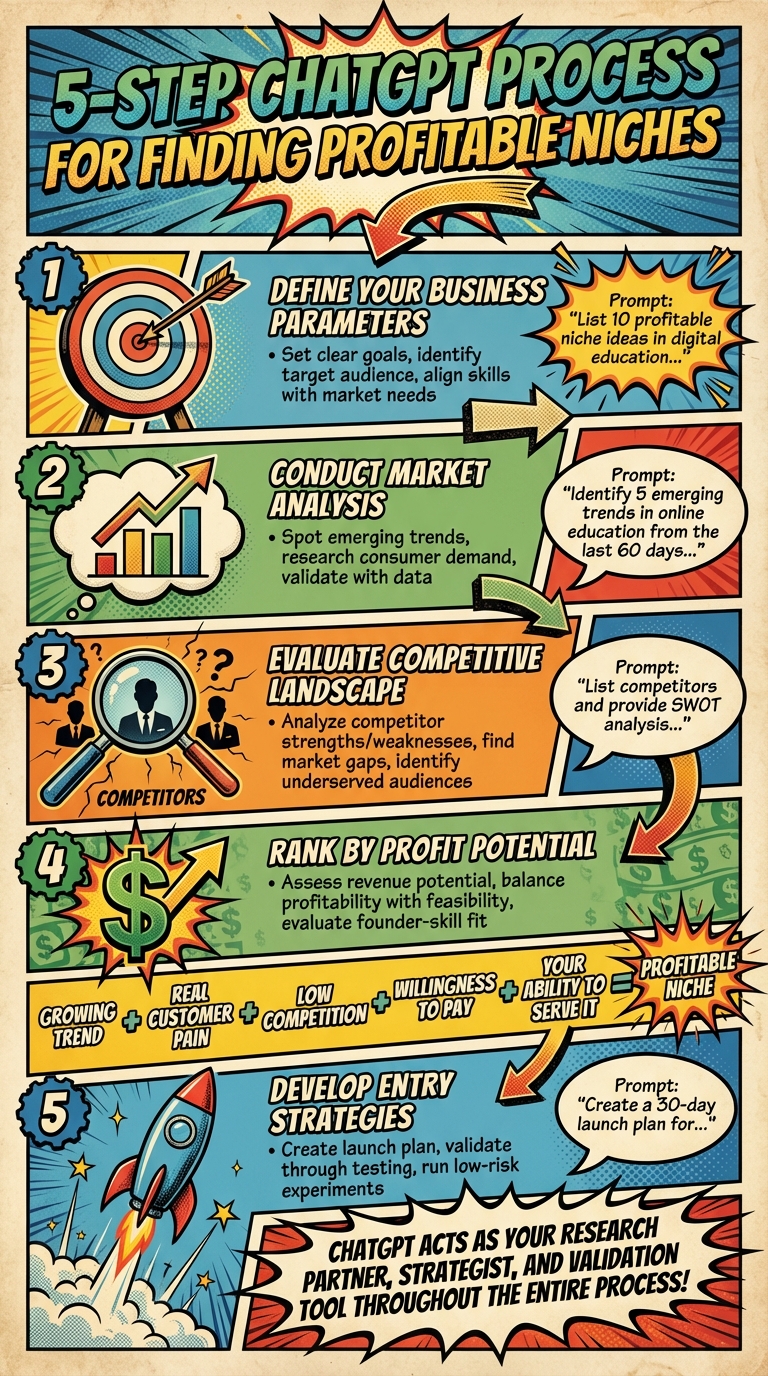
5-Step ChatGPT Process for Finding Profitable Niches
Step 1: Define Your Business Parameters with ChatGPT
Before jumping into market research, it’s crucial to outline your business parameters. ChatGPT delivers the best results when you provide clear boundaries, such as your skills, interests, budget, and business objectives. Without these guidelines, the AI might suggest ideas that are too broad or irrelevant. The aim here is to find the sweet spot where your expertise meets actual market needs.
Set Clear Goals and Objectives
Start by guiding ChatGPT to align your strengths with market opportunities. Instead of vague prompts like "give me niche ideas", be more specific. For example, try: "List 10 profitable niche ideas in digital education that match my expertise in graphic design and my interest in sustainability." This approach helps the AI focus on suggestions that fit your unique parameters, rather than throwing out random options.
"Your profitable niche resides at the intersection of your passion, skills, and market demand." – Paul Cardell, Tech & Biz Enthusiast
You can also use ChatGPT to drill down from broader interests to more specific micro-niches. Let’s say you’re passionate about gardening. Start with a broader category like "indoor gardening" and refine it further to "succulent indoor gardening for apartment dwellers." Each step narrows your focus to a niche with a targeted audience and less competition. For feasibility, you can ask ChatGPT: "Analyze the scalability of [Niche] and highlight potential challenges for a solopreneur with a $1,000 starting budget."
Identify Your Target Audience with AI
Once you’ve pinpointed your niche, use ChatGPT to create detailed customer personas. For instance, ask: "Describe the typical target audience for online courses teaching beginner photography skills, including demographics, buying triggers, and main objections." Then refine further by exploring their pain points: "What are the top 5 unsolved problems for people interested in [Niche]?" This helps you align your products or services with real customer needs.
Ready to leave the job you hate and find the fastest path to online wealth? Learn the best asset you have right now to leverage income and build financial run way in my bestseller "Fire Your Boss." Click here to download the book for free.
Step 2: Conduct Market Analysis and Trend Research
Now it’s time to dive into market trends. Think of ChatGPT as your personal trend analyst, pulling patterns from various data sources to uncover opportunities before they hit the mainstream. By working with well-defined parameters, this analysis helps you zero in on niches that are both promising and actionable. The trick? Ask questions that go beyond the surface, digging into specific and emerging opportunities.
Use ChatGPT for Trend Spotting
A vague prompt like "What are trending niches?" won’t get you far. Instead, try something more focused:
"Identify 5 emerging trends in online education from the last 60 days. Group them into themes and provide a confidence level for each."
This approach encourages ChatGPT to organize its findings and highlight trends supported by multiple data points.
Want to explore niche intersections? Use a prompt like:
"List 5 micro-niches combining sustainable living and remote work with strong growth potential."
This could lead to ideas like eco-friendly home office solutions for digital nomads or zero-waste meal prep kits for professionals working from home. These specific intersections often face less competition while addressing real needs.
For product-based ideas, try:
"What are 7 products currently sold on Amazon in the home organization category that solve specific problems for apartment dwellers?"
Add constraints like "avoid generic or saturated niches" and "focus on monetization potential" to refine the results. Keep in mind, ChatGPT’s suggestions are starting points – you’ll need to validate them with tools like Google Trends or keyword research platforms to assess actual demand.
Research Consumer Demand and Interest
Once you’ve identified trends, the next step is understanding why they resonate. Use ChatGPT to dive into customer motivations and uncover the "why" behind these trends. For instance, ask:
"Analyze common complaints about meal planning apps discussed on Reddit and Quora. What are the top 5 unsolved problems?"
This kind of analysis can reveal pain points that signal real market opportunities.
You can also explore deeper motivations using the jobs-to-be-done framework. A prompt like:
"What emotional and practical motivations drive someone to purchase productivity planners designed for ADHD adults?"
can help you understand not just who your audience is, but what drives their decisions. These insights are invaluable for crafting products or services that resonate on a deeper level.
For further validation, let ChatGPT help you design research tools. For example:
"Create 10 unbiased survey questions to test interest in a subscription box for eco-friendly pet products among millennial dog owners."
Use these surveys on social media or through email to gather feedback before committing resources. With 63% of businesses lacking a documented content strategy, integrating AI into your planning process gives you an edge.
Always back up AI-generated insights with external data. If ChatGPT suggests that "indoor vertical gardening kits for urban millennials" is trending, verify it by checking Google Trends for search volume and reading customer reviews on platforms like Amazon. Combining AI’s creative capabilities with real-world validation is the key to finding profitable niches.
Step 3: Evaluate the Competitive Landscape
To outpace your competition, you need to understand where they fall short. By identifying their weaknesses, you can uncover untapped opportunities in the market. ChatGPT can be a powerful ally in mapping out competitors and spotting these gaps.
Analyze Competitor Strengths and Weaknesses
Start by asking ChatGPT to identify competitors, both well-known and obscure. For example:
"I’m building a newsletter platform for independent journalists. List my direct and indirect competitors, including their unique features and pricing models in a table."
This gives you a clear overview of the market and lets you compare offerings side by side.
You can also dig deeper by prompting ChatGPT to conduct a SWOT analysis for specific competitors. For instance:
"List competitors in the creator economy space and provide a brief SWOT analysis for Ghost, ConvertKit, and Substack."
This helps you uncover patterns. For example, Ghost might stand out for its advanced customization at $9/month but may intimidate beginners with its learning curve. Meanwhile, ConvertKit, starting at $29/month, offers strong automation tools but lacks customization options. This kind of analysis highlights where competitors excel and where they leave gaps.
"Competitive analysis and benchmarking can be a heavy task but with ChatGPT as your assistant, you can considerably lighten the load." – Panoramata
To go beyond features and pricing, analyze customer sentiment. For instance, ask ChatGPT:
"Review Mailchimp’s Trustpilot feedback and summarize the top 5 recurring complaints."
This could reveal pain points like confusing pricing or deliverability issues. You can also evaluate competitor websites by asking:
"Visit [competitor URL] and identify their primary audience based on messaging, site elements, and page structure."
This exercise helps you understand who they’re targeting and how they’re positioning themselves.
By combining these insights, you can pinpoint underserved areas in the market and prepare to address them effectively.
Find Market Gaps and Underserved Audiences
Once you’ve mapped out competitor weaknesses, it’s time to zero in on what they’ve missed. Use ChatGPT to uncover overlooked opportunities. For example:
"Based on customer reviews of Patreon, what concerns or objections do creators mention before committing to the platform?"
This could highlight frustrations with commission fees or a lack of customization options.
If your business is content-driven, try this:
"Analyze the top 50 blog posts from [competitor website] and categorize them by theme. What topics have they covered extensively, and which have they neglected?"
This approach shows where competitors have saturated the market and where you could step in with fresh content.
For product-focused businesses, ask:
"What features do customers wish [competitor name] offered based on public feedback? How could a new entrant address these gaps?"
You might discover opportunities like better mobile usability, simpler onboarding processes, or clearer pricing.
Once you’ve identified these gaps, the next step is to evaluate their profit potential. While ChatGPT provides a great starting point, always verify its insights with updated data. Use tools like Google Trends or conduct direct customer research to ensure these gaps align with real market demand.
Step 4: Rank Opportunities by Profit Potential
Once you’ve identified market demands and gaps, the next logical step is to rank these opportunities by how much profit they could bring in. Not every idea will be worth pursuing – some might not generate enough revenue or might not align with what you’re capable of delivering right now. This is where ChatGPT becomes your ally, helping you weigh each niche against measurable factors like revenue potential, competition, and your ability to execute.
Assess Revenue Potential with ChatGPT
ChatGPT can help you forecast the financial upside of each niche idea. For instance, you could ask it: "Estimate the 12-month profit potential for a SaaS tool aimed at freelance graphic designers. Assume 100 customers at $29/month with a 5% monthly growth rate." This approach gives you a tangible revenue projection based on clear assumptions.
Want to test different monetization strategies? Try something like: "Compare the revenue potential for a gut health niche using affiliate marketing, info products, and a membership site. Include estimated audience size and pricing for each." ChatGPT can break this down, showing which model might yield the best results.
It’s also crucial to understand whether your audience has the purchasing power to afford your offering. Ask something like: "Analyze the purchasing power and willingness to pay for solo travelers interested in gut health supplements. What price points would this demographic support?" This kind of analysis helps determine if your target market not only wants your product but can also afford it. Don’t forget to factor in costs to ensure you maintain healthy profit margins.
Once you’ve got a clear picture of potential revenue, it’s time to assess whether the opportunity is practical for you to pursue.
Balance Profitability with Feasibility
Profitability means little if you can’t execute the idea effectively. After analyzing the market and competition, take a step back and consider your own resources and skills. ChatGPT can help you assess "founder-skill fit", which is essentially how well a niche aligns with your budget, expertise, and available time. For example, you might ask: "Rate these three niche ideas on founder-skill fit: AI video editing for musicians, email marketing automation for dentists, and productivity coaching for remote workers. I have $2,000 to invest, intermediate marketing skills, and 15 hours per week."
"A profitable niche = Growing Trend + Real Customer Pain + Low Competition + Willingness to Pay + Your Ability to Serve It." – Nizamuddin Siddiqui
You can also use ChatGPT to identify potential roadblocks. For example: "List the main barriers to entry for launching a micro-SaaS tool for independent podcasters, including technical needs, initial investment, and time to market." If a niche requires $20,000 to develop and you’ve only got $3,000, it’s clearly not the right fit.
To make comparisons easier, ask ChatGPT to organize the data into a ranking table: "Rank these five niche ideas from most to least promising based on profit potential, competition level, search volume, and alignment with my skills in content creation and basic coding." A visual summary like this can quickly highlight your top opportunities.
A real-world example of balancing profit and feasibility comes from Nico, the founder of Neural Frames. Initially, he launched a general text-to-video tool but soon pivoted to focus solely on music video creation for musicians. Even with $45,000 in monthly GPU and API costs, he scaled to $100,000 per month in revenue by tailoring his technical expertise to a specific audience’s needs. As Nico wisely noted:
"Somebody pays for a problem solved. They don’t pay for the tech around it; they don’t care about that."
The sweet spot lies where profit potential and your ability to execute overlap. That’s where your sustainable niche will emerge.
Step 5: Develop Entry Strategies and Validate Niches
Now that you’ve analyzed your market and evaluated competitors, it’s time to move from theory to action. You’ve identified a promising niche, but before diving in headfirst, you need a solid market entry plan and a way to validate your idea without risking too much upfront. This is where ChatGPT steps up – not just as a research tool, but as a strategic partner to help you map out your launch and test your assumptions.
Create a Launch Plan with ChatGPT
Think of ChatGPT as your right-hand strategist, helping you turn rough ideas into actionable plans. It’s not just about generating content – it’s about creating a clear roadmap. Start by asking it to break your launch into manageable phases. For instance:
"Create a 30-day launch plan for a micro-SaaS tool that helps independent podcasters automate show notes. Include validation steps, MVP development, and initial marketing."
With this kind of prompt, you’ll get a structured timeline that helps you tackle each step without feeling overwhelmed.
You can also lean on ChatGPT for niche-specific marketing strategies. For example:
"Provide a 7-day email series outline to promote a premium subscription service for solo travelers interested in gut health supplements. Include subject lines and key pain points to address in each email."
This approach delivers targeted promotional content that resonates with your audience’s needs and frustrations.
When it comes to product development, ChatGPT can help you define the essentials for your Minimum Viable Product (MVP). Try asking:
"What are the essential features I should consider for my MVP based on an AI video editing tool for musicians? How can I decide on the critical functionalities to validate market demand?"
This ensures you focus only on what’s necessary to launch quickly and test the waters. For monetization strategies, you could ask:
"Compare the pros and cons of launching my niche using e-commerce, digital downloads, a membership site, or a SaaS model. Which fits best for a service targeting freelance graphic designers?"
This kind of insight helps you align your revenue model with both your audience’s preferences and your operational strengths.
Once you’ve built your plan, it’s time to test your assumptions before committing to major investments.
Validate Niche Ideas Through AI-Driven Testing
Before building your product or service, you need to validate your concept. ChatGPT can simulate customer feedback to uncover potential objections. For example:
"Act like a skeptical freelance graphic designer. Poke holes in this business idea: a $29/month SaaS tool for automated client invoicing. What would make you hesitate to trust this brand?"
This exercise helps you identify and address potential concerns early, improving your messaging and offer.
ChatGPT can also create detailed customer profiles to refine your marketing. Try asking:
Ready to leave the job you hate and find the fastest path to online wealth? Learn the best asset you have right now to leverage income and build financial run way in my bestseller "Fire Your Boss." Click here to download the book for free.
"Build a customer profile for a 45-year-old solo traveler interested in gut health. Include their daily routine, biggest fears, past failed solutions, and what would make them trust a new brand instantly."
The more specific your customer avatar, the easier it becomes to craft tailored offers and marketing copy.
For low-risk testing, ChatGPT can design quick experiments. For instance:
"How can I test this niche idea in 7 days without spending money? Include social media engagement tactics and a simple landing page strategy."
Or:
"What metrics should I track when running a pilot service for email marketing automation aimed at dentists? How can I measure success?"
These prompts help you validate your idea while keeping costs low, giving you valuable feedback before scaling up.
If you’re testing pre-sales, ChatGPT can assist with crafting high-converting sales copy and setting realistic expectations. For example:
"Generate pre-sale marketing copy to gauge market interest in a productivity coaching program for remote workers. What conversion rate should I expect to consider this viable?"
A successful pre-sale not only confirms demand but also provides initial funds to fuel further development.
As Gpt Prompts, an AI Content Strategist, put it:
"Most people use AI as a shortcut to write mediocre blog posts. That’s a mistake. I learned to use ChatGPT as a thinking partner. It became the COO to my CEO."
Validation isn’t a one-time task – it’s an ongoing dialogue with your market. Use ChatGPT to refine your strategies as you gather feedback, but always back up its suggestions with real-world tools like Google Trends or direct conversations with potential customers. This iterative process ensures your plans are grounded in reality while leveraging the power of AI for smarter decision-making.
Advanced Prompts for Profitable Niche Discovery
Once you’ve nailed the basics, it’s time to take things up a notch. By crafting advanced prompts, you can push ChatGPT to think more strategically, evaluate opportunities, and uncover gaps others might miss. These techniques can help you refine your approach to discovering profitable niches.
Refine Niche Ideas with AI-Powered Brainstorming
The secret to effective advanced prompts lies in specificity. Instead of asking for generic ideas, give ChatGPT a clear role and set boundaries. For example, ask it to act as a senior digital marketing analyst with expertise in e-commerce, SEO, and trend forecasting. This kind of framework can provide more targeted and actionable insights.
Here’s a step-by-step way to use this approach:
- Step 1: Start with focused niche ideas. For instance:
"Identify 8 underserved niche markets within the wellness industry that have income potential but are overlooked by major brands. Avoid generic niches like fitness or travel." - Step 2: Once you find a promising idea, dig deeper. For example:
"Analyze the competition level for eco-friendly coffee substitutes aimed at productivity-conscious professionals. Suggest 5 unique angles or gaps I can leverage to stand out." - Step 3: Evaluate feasibility by asking:
"What are the barriers to entry for this niche, and how might they impact long-term profitability?"
This process helps you filter ideas through essential criteria like competition, audience demand, and monetization potential.
Another way to uncover opportunities is by exploring untapped intersections. For example:
"What intersections exist between digital minimalism and remote work productivity that competitors haven’t explored?"
This approach can guide you toward micro-niches like vegan keto meal prep for busy nurses – a space with lower competition and higher conversion potential.
Use ChatGPT for Long-Term Market Trends
Once you’ve refined your niche, focus on long-term viability. Advanced prompts can help you spot trends early, giving you a 12–24 month head start before markets become saturated. To distinguish between lasting opportunities and fleeting trends, try asking:
"Investigate trends and forecasts for neighborhood microgrids. What emerging technologies, consumer behavior shifts, or economic indicators suggest growth in this niche over the next two years?"
You can also use ChatGPT to identify fringe movements before they hit the mainstream. For example:
"What emerging lifestyle changes among Gen Z show early signs of growth but haven’t yet been commercialized by major brands?"
This type of prompt has revealed trends like:
- Analog Renaissance: Gen Z embracing flip phones and film cameras.
- Toolbelt Generation: Skipping college in favor of trades as AI reshapes white-collar jobs.
- Mainstream Preparedness: Families adopting prepper habits, from water filters to off-grid gear.
To validate AI insights, pair them with real-world data from tools like Google Trends, Reddit, or niche forums. Setting up monthly prompts to monitor consumer sentiment can also help you stay ahead of the curve.
For a practical example, combine trend analysis with monetization ideas by asking:
"For the worldschooling movement targeting nomadic families, suggest 5 digital products or subscription services that solve their pain points and align with their budget."
This ensures that you’re not just chasing trends but also identifying opportunities with real profit potential and diverse revenue options.
Integrating Serve No Master Resources for AI Mastery
Courses and Books on Niche Identification
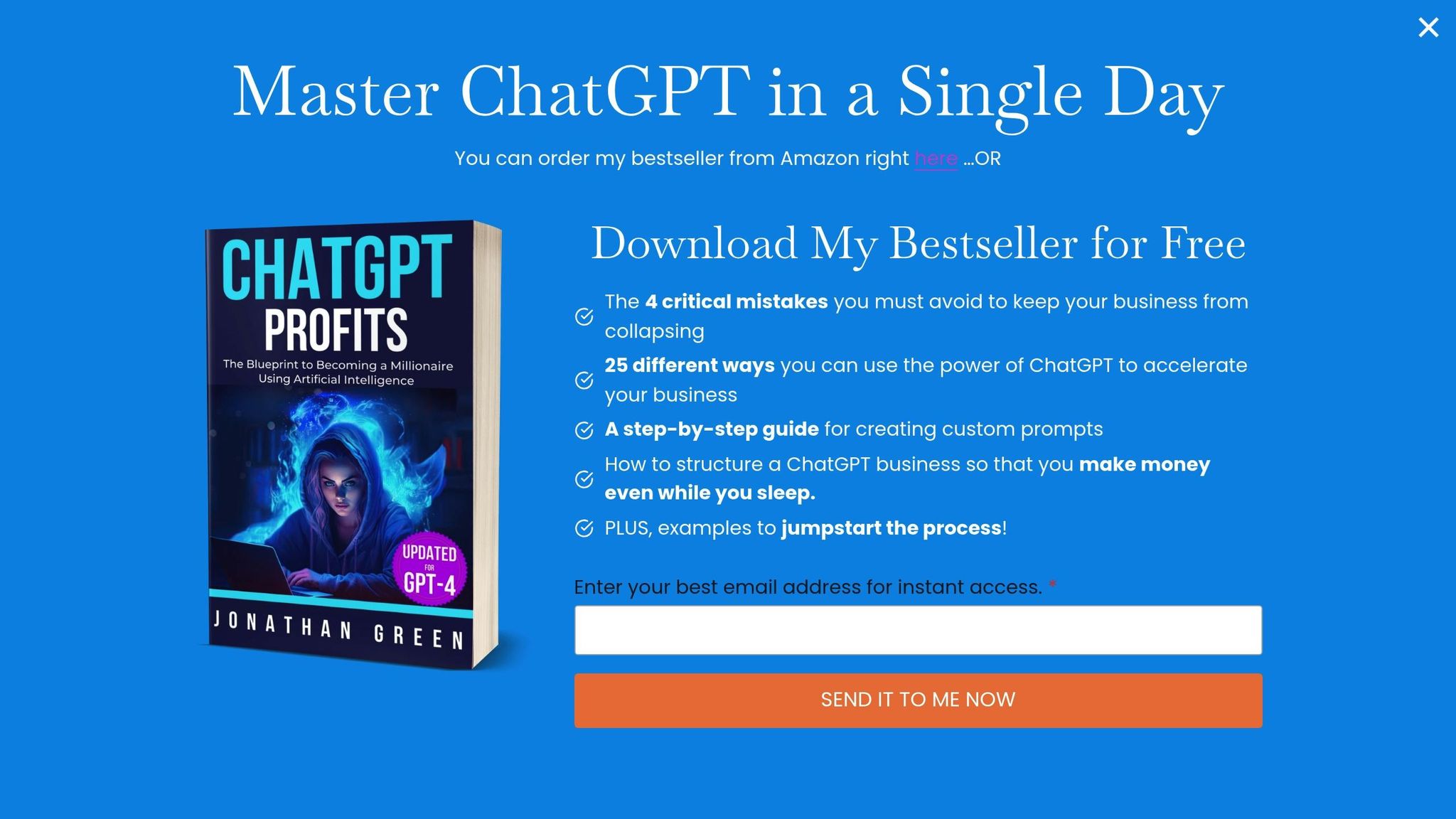
When it comes to refining your niche strategy with ChatGPT, Serve No Master provides tools that make the process easier and more effective. For those looking to scale their efforts with AI, the platform offers resources that strip away the complexity and get straight to the point. The flagship book, ChatGPT Profits, is a practical guide that helps you test business ideas and uncover profitable niches. It even claims you can master ChatGPT in under a week.
Serve No Master also provides additional tools to complement your journey, such as the Avatar Worksheet, which works hand-in-hand with ChatGPT to help you nail down your ideal customer profile. The course Breaking Orbit offers a step-by-step approach to launching a bestseller and building an entire business around a specific niche. Then there’s the foundational Serve No Master book, which focuses on identifying your target audience and turning your skills into a reliable income stream. These resources align perfectly with the strategies outlined earlier, offering both actionable insights and practical tools. You can find them on Amazon or download them for free through the Serve No Master website.
Success Stories and Practical Guidance
Beyond the educational materials, real-life examples show how these strategies deliver results. Jonathan Green, the creator of Serve No Master, has built a lifestyle where he works remotely, using ChatGPT to handle the workload of five people in just four days a week. His approach offers a clear path to generating income from anywhere.
Serve No Master introduces a three-stage framework: Runway, which focuses on using your current skills to earn immediate cash; Passive, where you set up income streams that run on autopilot; and Freedom, which is about leaving traditional employment behind. One standout example is AI Maestro, a method that teaches entrepreneurs how to earn income by creating AI-driven music for YouTube – all without ever appearing on camera. Many readers of ChatGPT Profits have praised its straightforward monetization strategies, which cater to both beginners and experienced professionals alike.
Conclusion
Using ChatGPT to find profitable niches is all about making smart, informed decisions right from the start. This five-step system turns the often overwhelming process of niche research into something manageable and repeatable. As Ash Banerjee, an AI and automation expert, wisely notes:
"Picking the right niche is half the battle. It sets the ceiling for everything you build."
The key is to move past broad categories and focus on micro-niches – those smaller, specific markets where competition is lighter, and customer needs are more defined. ChatGPT becomes your research partner, helping you uncover untapped opportunities, refine monetization strategies, and even test ideas through AI-powered simulations. But as Chelsea Lila, a digital strategist, reminds us:
"ChatGPT opens up a world of possibilities in niche exploration… However, remember that AI is a tool, and your personal judgment and expertise should guide your decision-making process."
To get started, use the prompts and frameworks outlined in this guide. Generate micro-niche ideas that align with your passions, validate demand with external data, and test customer interest through an MVP or pre-sale. The formula is simple: a growing trend + specific customer pain + low competition + willingness to pay + your ability to deliver = a sustainable business idea.
The real winners are those who know how to filter and validate ideas effectively. ChatGPT is a powerful filter, but only if you use it thoughtfully. Set clear goals, ask it to act as a niche research expert, and adapt your approach as markets shift. With the tools and methods shared here, you can move from brainstorming to validation in days rather than months.
The next step is straightforward: open ChatGPT, try one of the advanced prompts from this guide, and start narrowing down your niche. Your journey begins now.
FAQs
What data should I use to verify ChatGPT niche ideas?
To test niche ideas using ChatGPT, concentrate on gathering insights about market demand, competition, and trends. Look into search volume to measure interest, evaluate competition to spot oversaturation, and check trends to determine if the niche is on an upward trajectory. Use targeted prompts to dig into audience behavior, identify pain points, and explore ways to monetize the niche. By piecing together these details, you can confirm whether your niche has actual customer interest and profit potential before committing your time or money.
How do I know if a niche is too competitive?
To figure out if a niche is overcrowded, take a close look at market saturation and competition levels. Pay attention to metrics like search volume, the number of competitors, and how market share is divided. AI tools can make this easier by spotting trends, analyzing audience behavior, and uncovering demand in less crowded sub-niches. The goal? Zero in on specialized or overlooked markets where demand is increasing, giving you a chance to stand out.
What’s the fastest way to validate a niche with low budget?
If you’re working with a tight budget, one of the fastest ways to test a niche is by using AI tools like ChatGPT to conduct quick, data-driven research. Kick things off by crafting prompts that help you dig into market demand, competition, and what your audience is looking for. Pair this with free resources like Google Trends to identify emerging patterns and growth opportunities. This approach keeps costs low while delivering actionable insights – no need for expensive surveys or lengthy testing processes.
Related Blog Posts
- How Do I Create Passive Income Streams? 8 Answers
- ChatGPT vs. Claude: Blog Formatting Comparison
- 5 Mindset Shifts for AI Career Success After 40
- How to Build an AI Decision Framework
Ready to leave the job you hate and find the fastest path to online wealth? Learn the best asset you have right now to leverage income and build financial run way in my bestseller "Fire Your Boss." Click here to download the book for free.