
How Do I Create Passive Income Streams? 8 Answers
Passive income isn’t just for the wealthy or tech-savvy. With AI tools like ChatGPT, Midjourney, and n8n, you can build income streams that generate money while you sleep. Whether you’re over 40 and looking to secure financial freedom or simply tired of the 9-to-5 grind, the strategies outlined here can help you break free.
My first digital product went live at 10 am on New Year’s Eve. By the time I was ringing in the new year in Washington DC, my phone kept buzzing in my pocket—sale after sale rolling in while I celebrated. I was making money faster than I was spending it for the first time in my life. Even when I finally fell asleep, the sales kept coming. That’s the power of passive income: your systems work while you don’t.
Here’s a quick look at 8 ways to start earning passive income using AI:
- Affiliate Marketing: Automate content creation, funnels, and traffic for recurring commissions.
- Digital Products: Create and sell eBooks, templates, or guides with minimal effort.
- AI-Powered Blogs: Build niche websites with automated content and SEO optimization.
- Print-on-Demand: Design and sell products like T-shirts or mugs without managing inventory.
- Online Courses: Turn your expertise into courses with AI handling scripting and delivery.
- Automated Lead Generation: Use AI workflows to capture and nurture leads effortlessly.
- YouTube Automation: Run faceless channels with AI scripts, voiceovers, and video production.
- AI Consulting Products: Package your knowledge into templates, guides, or pre-built systems.
Why now? The side hustle economy is worth $556.7 billion, and AI is making passive income more accessible than ever. Pick one method, use AI to streamline the process, and let automation handle the heavy lifting. Start today – your future self will thank you.
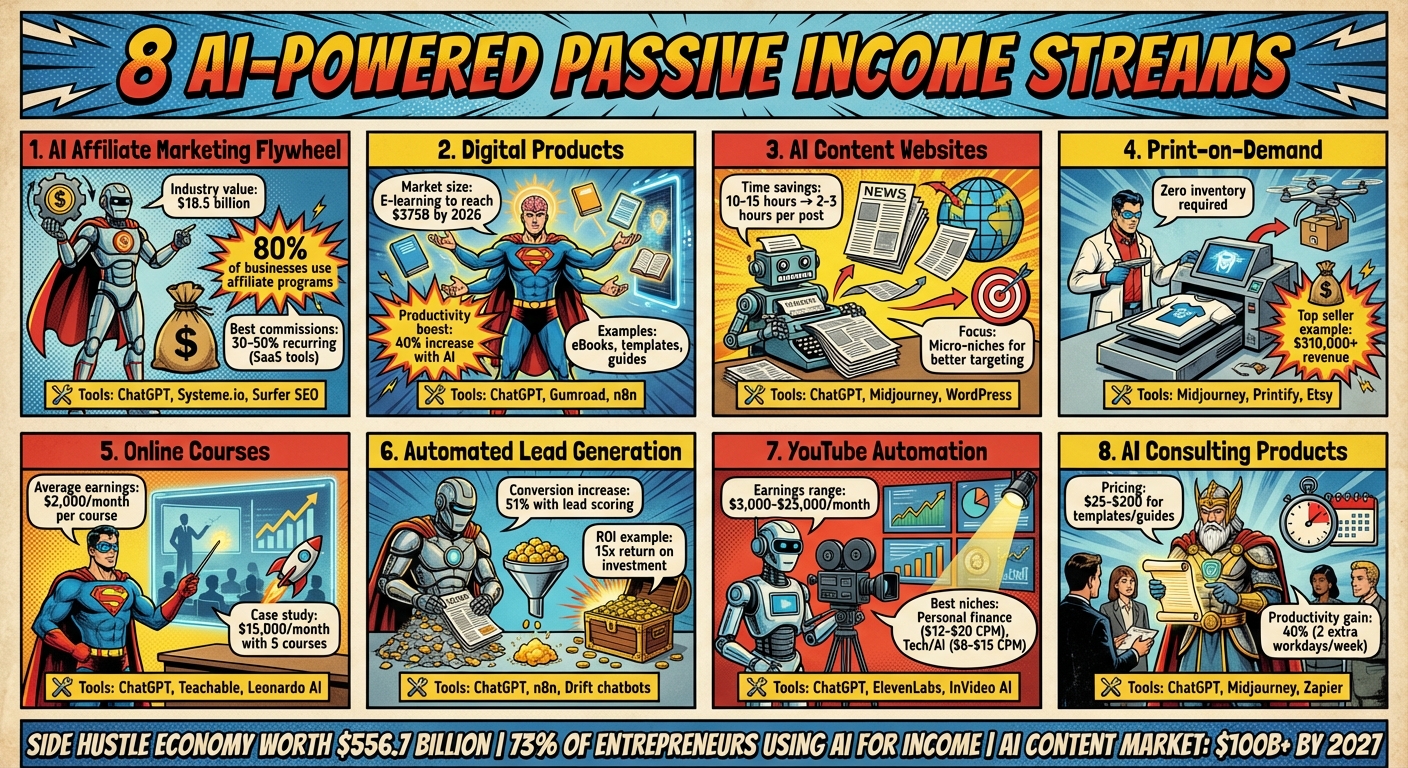
8 AI-Powered Passive Income Streams: Quick Reference Guide
1. AI Affiliate Marketing Flywheel
Affiliate marketing is a massive $18.5 billion industry, with more than 80% of businesses leveraging affiliate programs to drive sales. But let’s be honest – manually researching products, creating content, and chasing traffic can be exhausting. AI changes the game by automating the heavy lifting. This "flywheel" strategy sets the stage for the automated systems we’ll dive into later.
The AI Affiliate Flywheel operates in five steps: find profitable offers, generate content, automate funnels, drive traffic, and scale. Instead of spending hours hunting for niches, tools like ChatGPT with a game-changing prompt can analyze platforms like Reddit and Quora to uncover underserved opportunities. For instance, you can ask it to act as an "Expert SEO Strategist" and generate long-tail keywords that show high purchase intent, like "best AI writing tools for bloggers under $50/month."
Ready to leave the job you hate and find the fastest path to online wealth? Learn the best asset you have right now to leverage income and build financial run way in my bestseller "Fire Your Boss." Click here to download the book for free.
To maximize earnings, focus on programs offering recurring commissions rather than one-time payouts. SaaS tools such as Systeme.io, Jasper.ai, and Surfer SEO provide 30% to 50% monthly commissions. This model builds long-term revenue streams far more effectively than single-payment options.
Finding Profitable Affiliate Offers with AI
In line with the AI-driven approach, ChatGPT is a powerful ally for niche discovery. Start by prompting it to brainstorm micro-niches where AI can meet most of the audience’s needs. Instead of targeting broad categories like "fitness", narrow it down to something like "desk stretches for office workers over 40" or "balcony gardening for apartment renters." These niches face less competition and attract buyers looking for immediate solutions.
Once you’ve identified a niche, apply the Automated Content Test (ACT) to ensure it delivers evergreen value. If it passes, you’re good to go. Next, ask ChatGPT to find high-conversion keywords with "transactional intent" – terms like "best", "top", "vs", or "review" that signal readiness to buy.
Take it a step further with a competitor gap analysis. Feed ChatGPT the top-ranking articles in your niche and let it identify missing topics or underserved segments. For example, if most "email marketing tools" articles cater to large businesses, there could be an opportunity to target solopreneurs or side hustlers.
| Tool Category | Recommended Affiliate Programs | Commission Type |
|---|---|---|
| Marketing Suites | Systeme.io, GetResponse, ConvertKit | 30% – 50% Recurring |
| AI Writing | Jasper.ai, Rytr, Frase.io | 30% Recurring |
| Video/Design | Pictory.ai, AdCreative.ai | 30% – 40% Recurring |
| SEO Tools | Surfer SEO, Outranking.io | Variable Recurring |
Automating Content Creation and Funnels
AI takes content production to the next level. Use prompt chaining: start by generating an SEO-friendly outline, then draft sections individually, and finally refine the content for readability and strong calls-to-action.
Build a three-step funnel to capture and convert leads. First, create a landing page using Systeme.io’s free tier and offer a lead magnet that solves a specific problem. Second, set up a 5-day automated email sequence (Welcome, Story/Benefit, Bonus/Scarcity, FAQ, and Final CTA) that ChatGPT can draft in under an hour. Third, drive traffic with AI-generated blog posts and social media content that link back to your landing page.
Place affiliate links strategically: within the first 100 words, right after addressing a pain point, and in clear call-to-action buttons. Use ChatGPT’s "Custom Instructions" to define your brand voice, audience, and tone for consistent messaging.
Batch-create content to repurpose across formats – think video scripts, social media snippets, email newsletters, and even podcast outlines. This multiplies the value of every piece of content you produce.
Driving Traffic with AI-Generated Strategies
Once your content and funnels are set, AI can help you bring in traffic. Tools like Frase.io and Surfer SEO optimize content with natural language processing (NLP) and internal linking. ChatGPT can also pull questions from Google’s "People Also Ask" sections to integrate into your headers, capturing long-tail search traffic.
For social media, AI can create a month’s worth of captions and visuals in under an hour. Schedule these posts using platforms like Buffer, Tailwind, or Ocoya. Automate the process further by setting up a Pabbly workflow to generate social posts for every new blog post. Pabbly offers lifetime pricing—pay once, use forever—so your automation costs don’t scale up as your business grows.
Faceless YouTube channels are another goldmine. Use ChatGPT for scripts, ElevenLabs for voiceovers, and Pictory for video production. Tools like OpusClip can then repurpose long-form videos into short clips for TikTok, YouTube Shorts, and Instagram Reels.
For paid ads, platforms like AdCreative.ai generate high-performing visuals and copy, while AI fine-tunes targeting. Focus on transactional keywords with high commercial intent – phrases like "best [product] for [audience]" or "[Product A] vs [Product B]" can significantly boost affiliate conversions.
"With the right AI systems, you can cut busywork nearly in half – freeing you to focus on the high‑value moves that actually grow your income." – Emerge Insight
AI-powered email funnels from tools like GetResponse or Systeme.io handle everything from welcome emails to audience segmentation, delivering personalized affiliate recommendations around the clock. This hands-off system transforms traffic into revenue while you sleep.
2. Creating and Selling Digital Products
Digital products are a fantastic way to build passive income streams, especially when you combine them with AI tools to scale your efforts. These products don’t come with the headaches of inventory or shipping, yet they can generate consistent profits. For perspective, the global e-learning market is projected to hit $375 billion by 2026, and solopreneurs using AI can boost their productivity by up to 40% – essentially gaining nearly two extra workdays each week.
The secret lies in using ChatGPT as your creative brainstorming partner. You can ask it to come up with niche ideas like "printable planner templates for teachers" or "eBook topics for busy parents." Narrowing your focus to micro-niches – think "meal planners for CrossFit moms" instead of broad fitness topics – helps you stand out in a crowded market.
Start with Validation: The Automated Content Test (ACT)
Before diving into product creation, make sure your idea passes the Automated Content Test (ACT). Ask yourself these three questions:
- Is the information evergreen or reusable?
- Can the product be delivered digitally (like text, images, or code)?
- Can customers get value instantly without your manual involvement?
If the answer is yes to all three, you’re on the right track. ChatGPT can also help you uncover "Digital Dust" – those overlooked problems or recurring questions on platforms like Reddit or Quora that signal untapped opportunities.
Generating Ideas with ChatGPT
Start by listing your skills and interests, then prompt ChatGPT with something like, "Can AI automate 80% of the value in this area?" This can reveal niches perfect for passive income. For example, if you’re a former teacher, ChatGPT might suggest creating customizable lesson plans or behavior tracking sheets for substitutes.
Use the Prompt-Product Flywheel to streamline your process:
- Use AI to research market pain points and find high-purchase-intent keywords.
- Generate content outlines and drafts.
- Create product descriptions and marketing copy.
This loop can take you from concept to launch in a single ChatGPT session. To pinpoint what people are willing to pay for, ask ChatGPT to generate long-tail keywords with high purchase intent, like "best printable budget planner for families." These phrases often point to specific gaps you can fill with digital products, such as a $19 PDF guide or a $49 template bundle.
When creating a product like an eBook, don’t let ChatGPT write the whole thing at once. Start with a detailed outline, then tackle each section individually. This keeps the content focused and ensures you’re solving real problems.
Automating Delivery with n8n
Once your product is ready, tools like n8n can automate the delivery process. For example, when a customer buys your digital product, n8n can:
- Send the download link via email.
- Add the buyer to a welcome email sequence.
- Use ChatGPT to generate a personalized instruction guide.
You can even automate customer support. By setting up email parsers in n8n, you can scan incoming messages for keywords like "download link" or "access" and trigger instant replies. This setup eliminates repetitive tasks, letting you focus on creating new products while your system handles fulfillment and customer care 24/7.
Picking the Right Platforms to Sell
Choosing the right platform is crucial for reaching your audience and handling logistics like payment and file delivery. Here’s a quick breakdown:
| Platform Type | Examples | Best For | Key Advantage |
|---|---|---|---|
| Marketplace | Etsy, Amazon KDP | eBooks, Printables | Built-in traffic and search |
| Direct Sales | Gumroad, LemonSqueezy | PDFs, Templates, Software | Instant delivery, easy setup |
| Course/Membership | Teachable, Kajabi | Online Courses, Communities | Professional branding, high-ticket pricing |
For beginners, Gumroad is a great starting point because it’s simple to set up and handles payment processing and file delivery. If your focus is on printables or design assets, Etsy provides access to a massive audience already searching for these types of products. Platforms like Teachable or Kajabi are ideal for more complex offerings like courses or memberships, although they come with subscription fees. Self-hosted options like WordPress give you full control but require more technical know-how.
To maximize your sales, integrate your platform with marketing tools. For example, when someone buys your product on Gumroad, you can set up an automated email sequence to deliver bonus content, request testimonials, and pitch your next offering. This turns a one-time buyer into a repeat customer.
Test Before You Build
Before investing too much time or money, validate your idea with a "smoke test." Create a simple one-page site using Carrd or Gumroad to describe your product and collect emails from interested buyers. If you get around 50 sign-ups in a week, you’ve validated demand. If not, it’s a sign to tweak your idea before going all in.
3. Building Automated AI Content Websites
Creating automated AI content websites is a smart way to expand your passive income streams. Niche websites, in particular, are incredibly scalable when you use AI to handle most of the workload. Instead of being the writer, you step into the role of content director – you focus on strategy and vision, while AI takes care of the bulk of the production. This approach streamlines content creation and sets you up for effective site monetization.
The sweet spot for these AI-driven sites lies in micro-niches. For example, instead of targeting a broad topic like "gardening", narrow it down to something like "beginner balcony gardening for apartment dwellers." This level of specificity helps you stand out and allows AI to generate highly relevant and targeted content that performs well in search rankings.
Using ChatGPT for Blog Content Creation
Don’t rely on a single-prompt approach; instead, use a structured, multi-step process. Prompt chaining is key here – guide ChatGPT through stages like creating an SEO blueprint, outlining content, generating sections piece by piece, and polishing for SEO and monetization. This method ensures quality and avoids the generic tone that often comes from one-shot AI writing.
To maintain consistency, set up Custom Instructions in ChatGPT. Define your brand voice and target audience so that every piece of content aligns with your vision without needing constant adjustments.
Break down long-form articles into smaller chunks. Start with the introduction, then work on each subheader individually. This step-by-step process ensures higher quality and allows you to fact-check, refine, and add unique insights as you go. AI should be your co-pilot, providing drafts and ideas, but the final touches – accuracy, expertise, and value – are up to you.
Use ChatGPT to uncover long-tail, question-based keywords with high purchase intent, such as "best organic compost bin for apartment living." These keywords often face less competition and attract readers who are ready to make a purchase, making them ideal for affiliate marketing.
SEO Optimization and Monetization
Once you’ve drafted your content, ask ChatGPT to create concise meta descriptions (under 160 characters) and generate an FAQ section based on common search queries. These small details can significantly improve your click-through rates.
Pair your AI-written content with custom visuals using tools like Midjourney or DALL-E 3 (approximately $30/month for Midjourney). Unique images not only enhance credibility but also help your content stand out.
For monetization, strategically embed affiliate links – such as Amazon Associates – into "Top 5" lists or how-to guides. With the affiliate marketing industry valued at $18.5 billion and over 80% of businesses incorporating it into their strategies, this is a lucrative option. Start with broad programs like Amazon for ease of entry, then explore niche platforms like ShareASale or ClickBank for higher commission rates.
Display advertising, through platforms like Google AdSense, becomes a viable option once your site attracts significant traffic – think thousands of monthly visitors. While it’s a more passive income source, the revenue per visitor tends to be lower compared to affiliate marketing or selling digital products.
Setting Up Automation Workflows
After optimizing your content, automate your publishing and promotion processes. Tools like n8n or Zapier can handle repetitive tasks. For instance, when you publish a new WordPress post, an automation workflow can prompt ChatGPT to create social media captions and schedule them across your platforms automatically.
You can also automate email marketing with tools like ConvertKit. When someone subscribes to your blog’s newsletter, n8n can trigger a welcome email series, deliver a free guide, and even pitch affiliate offers – all without manual intervention.
The time savings with AI are dramatic. What used to take 10-15 hours – like writing a 3,000-word blog post – can now be completed in 2-3 hours with AI drafts and human editing. Marketing emails that once required 5-8 hours can now be finished in under an hour. This efficiency allows you to focus on growth and strategy instead of getting bogged down in content production.
"Very soon, almost all the content we consume will be created with AI. The intention behind each piece of content will be human, of course, but the production will be automatic." – Guy Sopher, Head of AI Assistant, Wix
To maximize your reach, repurpose each blog post into multiple formats – turn it into a social media thread, an email newsletter, or even a video script. This approach not only diversifies your traffic sources but also boosts your monetization opportunities.
4. Starting a Midjourney-Powered Print-on-Demand Business
Print-on-demand (POD) is a fantastic way to earn passive income without worrying about inventory. The concept is simple: you create designs, upload them to a platform that handles production and shipping, and earn a profit from each sale. No inventory, no shipping headaches – just creativity and automation. By using Midjourney, you can quickly generate high-quality art, but the key to success lies in selecting a focused niche. Instead of going broad with ideas like "funny cat shirts", try something more specific, like "retro space prints for mid-century modern homes" or "AI art for neurodivergent journaling." This combination of AI-driven creativity and automated fulfillment can turn your ideas into a scalable business.
Ready to leave the job you hate and find the fastest path to online wealth? Learn the best asset you have right now to leverage income and build financial run way in my bestseller "Fire Your Boss." Click here to download the book for free.
Creating Designs with Midjourney
Midjourney is perfect for crafting designs that are ready to sell. To get the best results, use detailed prompts like this:
[Subject], [Artwork style], [Artwork mood], [Artwork lighting], vector, t-shirt design graphic, contour, clean background.
The terms "vector" and "clean background" ensure your design is optimized for printing on various products. For example, a prompt such as:
“Savory ramen noodles, pop art, vibrant, bright lighting, vector, t-shirt design graphic, contour, clean background”
can produce a polished design that’s ready to upload directly to a POD platform.
To keep your designs unique and avoid a cookie-cutter style, use ChatGPT to brainstorm niche ideas and generate multiple prompts. Also, always upscale your images to high resolution. While Midjourney creates great visuals, larger products like posters may need additional AI upscaling for the best quality.
Connecting with Print-on-Demand Platforms
Platforms like Printify and Printful make it easy to handle production and shipping. Printify, for example, offers a free tier where you can create unlimited designs for up to five stores. This setup is perfect for testing different niches without any upfront investment. All you need to do is upload your Midjourney design, mock it up on a product (like a mug, T-shirt, or pillow), and sync it with platforms like Etsy or Shopify. Once a customer places an order, the POD provider takes care of the rest – printing and shipping the item directly to them.
"Your margins are smaller but there’s virtually no risk. Validate your idea then figure out how to make more money when you see people are interested."
– John Angelo Yap, Writer
In November 2023, John Angelo Yap showcased this process by creating a "Savory Ramen Noodles" pop-art design using Midjourney, uploading it to Printify, and syncing it with an Etsy store – all in just a few minutes. The result? A fully functional product that required no manual fulfillment. You can also use ChatGPT to craft SEO-friendly product titles, descriptions, and tags to help your designs stand out in competitive marketplaces.
Expanding Your Product Line
Once you find a design that sells well, you can expand its reach by offering it on other items. For instance, a successful T-shirt design (which typically starts at around $14.66 on Etsy) can be adapted for mugs, phone cases, stickers, posters, and pillows. While stickers often sell in high volume with lower profit margins, clothing can bring in higher revenue per unit despite tougher competition.
Start by launching about 10 products in a specific category to test the waters. Track what performs best, then double down on those successful items. For example, a top-selling T-shirt design on Etsy with over 21,000 reviews can generate more than $310,000 in revenue. To make your business even more hands-off, consider hiring virtual assistants from platforms like Upwork or OnlineJobs. They can manage your shop’s daily operations, handle customer service, and upload new designs, allowing you to focus on scaling your business once it’s consistently profitable.
5. Developing AI-Driven Online Courses
Online courses are one of the most scalable ways to earn income today. Thanks to AI tools like ChatGPT, turning your expertise into a structured course has never been easier. Whether you’re a consultant, a seasoned professional, or a niche specialist, you can transform your knowledge into a digital product that practically sells itself. With AI handling tasks like curriculum design and automated enrollment, you can focus on delivering meaningful content. Let’s dive into how AI can take your raw knowledge and transform it into a polished, market-ready course.
Creating Course Content with ChatGPT
ChatGPT is a powerhouse for transforming ideas into professional course materials. Start by brainstorming module ideas and identifying your audience. For example, a sustainable gardening expert might use ChatGPT to organize their expertise into a logical course outline. You can even upload research papers, documents, or videos for the AI to break down into structured modules, complete with assessments.
From there, ChatGPT can help you script lessons, design activities, and generate workbooks or checklists. To keep the creative momentum going, try creating multiple modules or scripts in one session. Use prompt templates like: "Create a detailed guide on [topic] for [audience], including an introduction, 5–7 main sections with actionable tips, and a conclusion with next steps." You can also repurpose key lessons into various formats – video scripts, PDF summaries, or even social media content – to extend your reach.
Take Michael Chen, for instance. In early 2024, this sustainable living instructor, with no prior teaching experience, used ChatGPT to design his curriculum and Leonardo AI for visuals. He launched his first course on Teachable in just three weeks and marketed it using Genspark AI. The result? $8,000 in revenue during the first month and a growing catalog of five courses that now generate over $15,000 monthly in passive income.
"I had expertise in sustainable gardening but no teaching experience. Using ChatGPT to structure my curriculum and Leonardo AI for illustrations, I created my first online course in just three weeks."
– Michael Chen, Sustainable Living Instructor
Setting Up Automated Enrollment Systems
Once your course content is ready, automation is the secret to turning it into a true passive income stream. Automation tools can seamlessly link your storefront to delivery systems. For instance, you can set up workflows that automatically add new students to your email list, grant them instant access to course materials, and enroll them in a welcome sequence after purchase.
A typical 5-day email sequence might look like this:
- Day 1: Immediate access to the course and a warm welcome.
- Day 3: A bonus resource to keep them engaged.
- Day 5: A success story or subtle nudge toward an advanced offering.
AI-driven chatbots or email parsers can also handle common support issues, like missing download links, resolving up to 80% of inquiries without human involvement.
"Without automation, you haven’t built a passive income stream. You’ve just built yourself another job."
– Tomas, Founder, Entrepedia
Monetizing Your Expertise Over Time
Once your course and automation are in place, it can generate income with minimal upkeep for months or even years. AI-enhanced courses often produce around $2,000 per month. To maximize earnings, consider offering tiered pricing. For example:
- Mini-courses: $49–$99
- Premium bundles: $200+ with extra features like AI-generated templates or workbooks.
Platforms like Udemy or Skillshare offer access to built-in audiences, while Gumroad or Podia provide higher profit margins. For ultimate control, a self-hosted option like LearnDash might be the way to go. Regardless of your setup, the combination of AI-generated content and automated delivery ensures your course works for you – not the other way around.
6. Automating Lead Generation for Passive Income
AI and automation can create systems that handle lead generation and nurturing without constant oversight. Tools like ChatGPT for content creation and n8n for workflow automation work together to streamline the process. Once these systems are in place, they manage everything from attracting potential leads to converting them into paying customers, seamlessly integrating into your passive income strategy. Whether you’re promoting affiliate products or offering services, automation makes lead generation a hands-off process.
Creating Automated Lead Funnels
An automated lead funnel captures contact information, nurtures prospects, and guides them toward conversion. AI chatbots like Drift can engage visitors 24/7, answer questions, and collect emails without human intervention. Once a lead is captured, n8n can transfer their details to your CRM and initiate an email sequence crafted by ChatGPT.
Here’s an example of a simple workflow:
- Day 1: Send a welcome email with your lead magnet.
- Day 3: Share a helpful tip, no strings attached.
- Day 5: Include a case study and a soft call-to-action for an affiliate product.
Wrike, a project management software company, used Drift’s AI chatbots to engage visitors in real-time. The results were striking: a 496% increase in pipeline generation and a 454% increase in bookings from chatbot-assisted leads, delivering a 15x return on investment. Automated lead scoring, which ranks prospects based on their likelihood to purchase, can increase conversion rates by 51%.
Monetizing Leads Through Affiliate Offers
Once your automated funnel is nurturing leads effectively, you can monetize them through affiliate promotions. Offers with recurring commissions – like AI tools, web hosting platforms (e.g., Bluehost), or subscription-based software – are ideal for generating passive income. These types of products provide ongoing earnings as long as the referred customers remain active.
Leverage ChatGPT to personalize email subject lines and content based on audience segments, such as freelancers versus small business owners. This tailored approach can improve open rates by 5%–10% and boost revenue by 10% to 15%.
For even greater efficiency, set up an n8n workflow to monitor incoming emails for keywords like "download link" or "access." This workflow can automatically send pre-written responses, resolving 80% of common inquiries without manual effort.
Once your funnel and affiliate promotions are running smoothly, you can focus on scaling your system.
Expanding Lead Generation Efforts
After your initial funnel proves successful, scaling becomes a natural next step. Build a content amplification system where publishing a single blog post triggers n8n to generate social media content via ChatGPT. These posts can then be scheduled across platforms to drive traffic back to your funnel.
Expand into additional traffic sources to grow your reach. For instance, if you’re relying on organic blog traffic, consider adding paid ads or YouTube videos. Use AI to brainstorm 30 niche content ideas at once, then turn them into lead magnet ideas like "prompt packs", "cheat sheets", or "templates" to capture more email addresses. The beauty of automation is that your nurture sequences and affiliate promotions remain consistent, regardless of where the leads originate.
AI-driven insights, such as intent signals, can further enhance your conversions by 93%. As your system gathers more data, you can fine-tune your approach, creating a snowball effect where each optimization makes the entire system even more profitable.
7. Generating Passive Income Through YouTube Automation
YouTube automation is another way to build a steady income stream, all without stepping in front of a camera or using your own voice. Faceless channels have proven to be lucrative, pulling in anywhere from $3,000 to $25,000 per month, with some creators earning around $104,000 annually.
The trick lies in targeting high-earning niches. Topics like personal finance, technology, and AI tools generally offer higher CPMs (cost per thousand views). As of 2026, personal finance channels average $12–$20 CPM, while tech and AI-related niches typically range from $8–$15 CPM. These rates significantly outpace lower-paying areas like entertainment or motivational content.
Scripting and Producing Videos with AI
Creating content for faceless channels has never been easier, thanks to AI tools. Start by using ChatGPT to generate scripts. Ask it to craft a snappy 5-second hook, a structured outline, and even a call-to-action to keep your audience engaged. For voiceovers, tools like ElevenLabs and Murf.ai can create realistic narrations, so you don’t need to hire a voice actor.
Once your script is ready, platforms like InVideo AI and AI Studios can handle video production. InVideo AI pairs your script with stock footage, while AI Studios can generate lifelike avatars to narrate your content in over 150 languages.
Take this example: In late 2025, a faceless channel focused on "AI Business Tools" used ChatGPT for scripts and AI Studios for video creation. After publishing 32 videos over four months, the channel hit 85,000 subscribers and pulled in $4,200 per month in ad revenue. Similarly, in 2024, a creator known as "Money Tent" leveraged InVideo AI to produce videos and promote affiliate products, earning $3,720 monthly.
With your videos ready, the next step is ensuring they’re optimized for discovery and revenue.
Optimizing Content for Search and Monetization
Success on YouTube hinges on visibility, and that’s where SEO comes in. Tools like VidIQ, TubeBuddy, and Ytool can simplify keyword research, helping you craft optimized titles, tags, and descriptions. Focusing on long-tail keywords – such as "Best AI tools for students" – can boost your search rankings.
Don’t underestimate the power of thumbnails. Bright colors, bold text, and high contrast can make your videos pop in search results. AI tools like Midjourney, Leonardo AI, or Canva are excellent for creating designs that drive clicks.
Beyond ad revenue, adding affiliate links to your video descriptions can generate earnings even before you meet YouTube’s Partner Program requirements (1,000 subscribers and either 4,000 watch hours in a year or 10 million Shorts views in 90 days). Promoting subscription-based products, such as web hosting or AI software, can secure recurring commissions for additional income.
Once your videos are optimized, automation can help you stay consistent without overwhelming your schedule.
Automating Uploads and Scheduling
Batch production is a game-changer. Use ChatGPT to create multiple scripts in one session – say five to ten – and then produce the corresponding videos in bulk. YouTube Studio’s scheduling feature allows you to set release times automatically, ensuring your videos go live when your audience is most active.
For added efficiency, platforms like Zapier, Make, or n8n can automate social media posts whenever you publish a video. Tools like OpusClip can also convert long-form content into YouTube Shorts, helping you grow your subscriber base faster while your main videos rack up watch hours. This dual strategy ensures you’re maximizing both reach and revenue.
| Task | Recommended AI Tool |
|---|---|
| Scripting | ChatGPT, Claude |
| Voiceover | ElevenLabs, Murf.ai |
| Video Generation | InVideo AI, AI Studios |
| Thumbnails | Midjourney, Leonardo AI, Canva |
| SEO/Keywords | VidIQ, TubeBuddy, Ytool |
| Automation | Zapier, Make, n8n |
8. Turning AI Consulting into Passive Products
If you’re already in the consulting game, you have a treasure trove of knowledge that can be transformed into digital products. Instead of trading your time for money through one-on-one sessions, imagine creating templates, guides, or automated systems that can serve countless customers – day and night.
The secret sauce? The "Brain-Artist-Connector-Platform" framework. Here’s how it works: your AI Brain (like ChatGPT or Claude) takes care of content creation, your AI Artist (such as Midjourney) designs visuals, your Connector (tools like n8n or Zapier) automates delivery, and your Platform (think Gumroad or Etsy) handles sales. This setup removes the usual hurdles of time, design, and tech, making it easier to scale your consulting expertise into products that sell themselves.
Packaging Expertise into Products
Start by identifying common questions or challenges your clients face – these are gold for creating digital products. Use ChatGPT to outline and draft content, then refine it step by step. For visuals, Midjourney can generate professional diagrams, covers, and templates for as little as $30 a month.
Consider pricing options: industry-specific prompt libraries often sell for $50 to $200, while template collections range from $25 to $150. Offering tiered pricing ensures you can cater to different budgets and client needs.
Take Michael Chen, for example. In 2024, this sustainable living instructor turned his gardening expertise into an online course. Using ChatGPT for content and Leonardo AI for illustrations, he built his course in just three weeks. After launching on Teachable and leveraging Genspark AI for marketing, he earned $8,000 in his first month. By 2025, he had expanded to five courses, generating over $15,000 monthly.
Automating Client Onboarding and Delivery
Automation is the backbone of passive income. With tools like n8n or Zapier, you can set up workflows that handle everything from onboarding to delivery. For example, when someone buys your product on Gumroad, automation can instantly add them to your email list, send a personalized AI-written welcome message, and deliver the digital files – all without you lifting a finger.
Want to take it further? Some consultants create chatbots that provide 24/7 customer support. These bots can cost $500–$1,000 to set up, with ongoing maintenance fees of about $100 per month. It’s a small investment for a system that works around the clock.
Examples of Successful Productization
Real-world success stories highlight the potential here. Sarah, an AI art entrepreneur, launched her Etsy shop in 2024 using Leonardo AI to create minimalist, nature-inspired wall art. By optimizing her listings with Genspark AI, she grew her monthly passive income from $200 in her first month to over $5,000 within six months.
For service-based consultants, the "AI Automation Agency" model is a game-changer. Instead of taking on custom projects, you can sell pre-built automation workflows or chatbots with recurring maintenance fees. For instance, a real estate consultant could offer a lead qualification chatbot for $1,000 upfront and $200 monthly. With one product serving multiple clients, your time investment stays minimal.
The numbers speak for themselves: 73% of entrepreneurs are now using AI to generate income, and solopreneurs using these tools report a 40% boost in productivity. That’s like gaining two extra workdays per week – time you can use to create more products or simply enjoy the rewards of your passive income.
Conclusion: Start Building Your Passive Income Today
You’ve just walked through eight effective ways to create passive income using AI, from affiliate marketing to print-on-demand ventures, automated blogs, and productized consulting. With tools like ChatGPT, Midjourney, and n8n, you can increase productivity by 40%, giving you nearly two extra workdays each week to focus on strategy and scaling.
Ready to leave the job you hate and find the fastest path to online wealth? Learn the best asset you have right now to leverage income and build financial run way in my bestseller "Fire Your Boss." Click here to download the book for free.
Pick one income stream that matches your skills – whether it’s crafting digital products, starting an affiliate blog, or automating lead generation – and commit to mastering it. Each approach shared here is designed to help you move closer to financial independence and reclaim your time. The beauty of passive income lies in setting up systems that keep working for you long after the initial effort.
For those looking to dive deeper, Serve No Master provides step-by-step guides and free resources like the ChatGPT Profits book. This resource is packed with 25 business ideas for ChatGPT, tips to avoid common mistakes, and practical examples to kickstart your journey. Whether you’re a seasoned professional over 40 or someone juggling a side hustle, the tools and training are there to help you build income streams that run around the clock.
The side hustle economy is already valued at about $556.7 billion, and AI is making passive income more accessible than ever – no advanced tech skills or massive investments required. With AI-generated content expected to generate over $100 billion in revenue by 2027, now is the time to carve out your piece of this growing market.
So, take the plunge: pick one strategy from this article, spend the next few weeks building it with AI, and let automation do the heavy lifting. The sooner you start, the sooner your systems can begin working for you – even while you’re fast asleep.
FAQs
How can I use AI tools to create passive income?
AI tools are your secret weapon for building passive income by taking over repetitive tasks, crafting scalable digital products, and fine-tuning your business operations. Picture this: ChatGPT helps you churn out engaging content, Midjourney designs eye-catching visuals, and platforms like n8n handle workflow automation – all while you focus on the bigger picture.
With these tools, you can create and sell products like ebooks, online courses, or templates without needing constant hands-on involvement. On top of that, AI can supercharge your marketing by tailoring campaigns and boosting lead generation, making it easier to grow your income stream without working around the clock.
What are the best AI tools to create digital products quickly and efficiently?
AI tools are changing the game when it comes to creating digital products. They speed up workflows and take the pressure off by handling repetitive tasks, all while giving your creativity a boost.
For writing projects like ebooks, guides, or online courses, ChatGPT and Claude are standout options. They can help you draft, refine, and polish content in record time. On the visual side, tools like Canva AI and MidJourney are perfect for generating high-quality graphics and illustrations that look professional without needing a design degree.
Want to take it a step further? Platforms like n8n can tie everything together, automating tasks such as content publishing and marketing. By blending these tools, you can create scalable products – think ebooks, courses, templates, and stunning visuals – while spending less time on manual work.
How can I test my passive income idea before committing time and money?
Testing out your passive income idea before diving in headfirst is a smart way to avoid unnecessary risks. Start by doing your homework: look into market demand, figure out who your target audience is, and take a close look at your competition. Make sure your idea not only fits your skills and resources but also solves a real problem or fulfills a need.
Once you’ve done your research, try validating your idea on a smaller scale. For instance, you could launch a simple version of your product or service and get feedback from potential customers. This helps you gauge interest, fine-tune your offering, and get a sense of whether it’s financially viable – all before committing more time and money. These steps can set you up for a strong and steady passive income venture.
Related Blog Posts
- How to Quit Your Job and Work for Yourself in 2026
- Freelancing vs Starting a Business: Which Is Right?
- How to Validate Business Ideas Before Quitting Your Job
- AI Tools for Personal Branding and Networking
Ready to leave the job you hate and find the fastest path to online wealth? Learn the best asset you have right now to leverage income and build financial run way in my bestseller "Fire Your Boss." Click here to download the book for free.