
Ultimate Guide to Fractional Chief AI Officer Certification
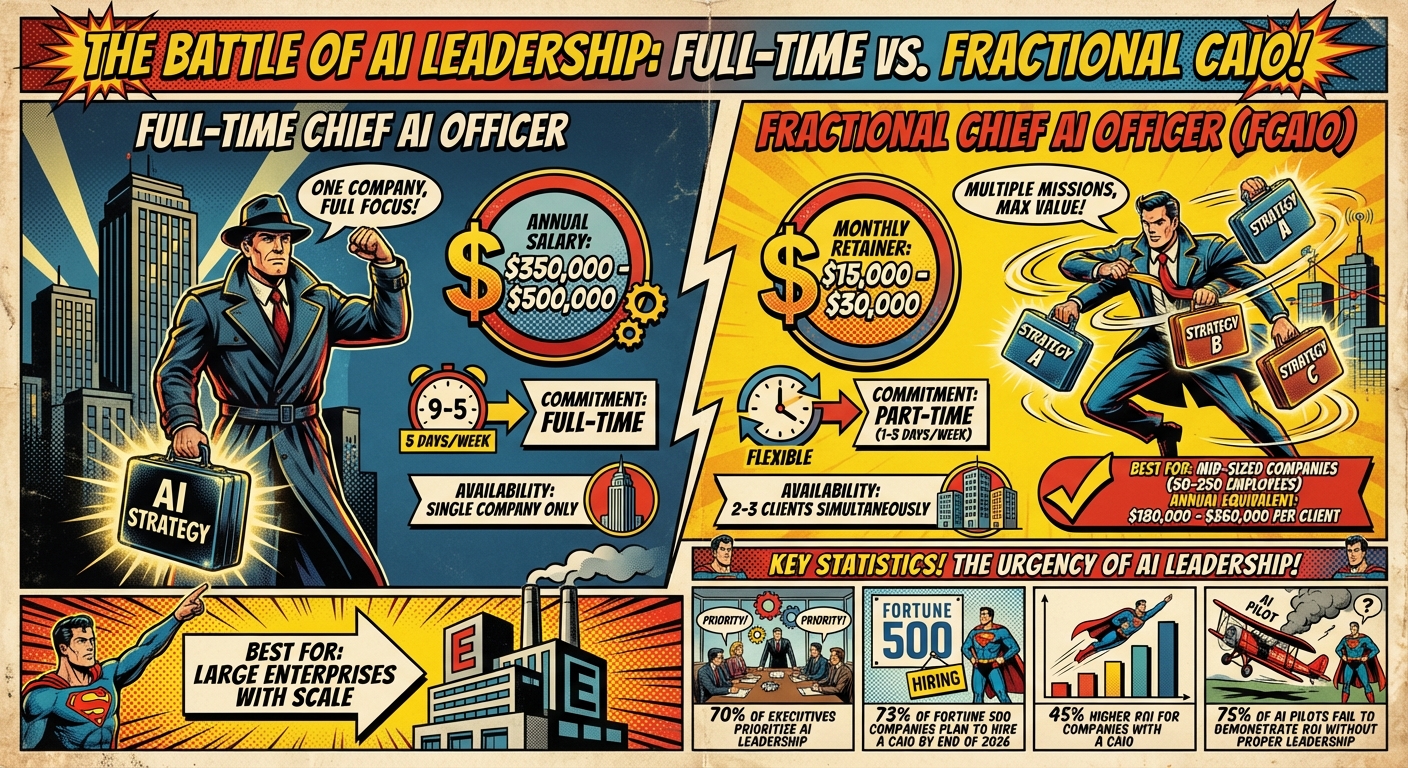
Full-time Chief AI Officers are rare and expensive. With salaries ranging from $350,000 to $500,000, most mid-market companies simply can’t justify the cost—even when they desperately need AI leadership. Here’s the thing: most of them don’t need a full-time executive anyway. They need someone 1-3 days per week to set strategy, establish governance, and guide implementation.
That gap is the opportunity. Fractional Chief AI Officers (FCAIOs) deliver executive-grade AI leadership at $15,000–$30,000 per month—a fraction of full-time cost while providing exactly what these companies need. Here’s what makes this role stand out:
- Focus on Strategy, Not Coding: FCAIOs align AI with business goals, manage costs, and ensure ethical practices – no advanced technical skills required.
- Flexible Income: Work 1-3 days per week with multiple clients, earning more than many full-time roles.
- Growing Demand: 70% of executives now prioritize AI, with mid-sized companies leading the charge.
I’ve spent the last few years working as a fractional GTM engineer and watching this market explode. The August 2026 EU AI Act compliance deadline is accelerating demand even further—companies face penalties up to €35M or 7% of global revenue for non-compliance, and most have no idea how to prepare. That’s why I built Fraction AIO, a certification program specifically for professionals over 40 who want to leverage their leadership experience in this space.
Why Listen to Me?
I’m Jonathan Green — and I’ve been where you are.
I spent years as a CTO, leading companies through the compliance gauntlet (HIPAA, SOC-2) and watching executives drown in AI decisions they weren’t equipped to make. I’m the bestselling author of ChatGPT Profits and hundreds of other books, host of one of the top AI podcasts, and I’ve been featured in the Boston Herald, Miami Herald, ABC Radio, and International Business Times.
But here’s what actually matters: I’ve helped hundreds of professionals over 40 escape the corporate grind and build consulting practices that give them freedom, income, and control over their time. Not by teaching them to code — by showing them how to leverage the business judgment they’ve spent decades developing.
Ready to leave the job you hate and find the fastest path to online wealth? Learn the best asset you have right now to leverage income and build financial run way in my bestseller "Fire Your Boss." Click here to download the book for free.
The Fractional CAIO model isn’t theory to me. It’s the path I’ve watched work over and over for people who thought they were too late to the AI game.
Full-Time vs Fractional Chief AI Officer: Cost and Value Comparison
What FCAIO Certification Programs Cover
FCAIO certifications are all about strategy – helping executives align AI projects with business objectives, establish governance frameworks, and drive measurable results. Programs range from basic introductions to comprehensive certifications that include done-for-you templates, client acquisition systems, and ongoing support. The essential topics covered include:
Main Topics in the Curriculum
The curriculum focuses on four major areas:
- Leadership and Strategy: Learn how to create AI roadmaps and communicate effectively in boardrooms.
- Governance and Risk: Understand how to design ethical frameworks, comply with regulations like the EU AI Act and GDPR, and tackle cybersecurity and bias issues.
- Operational Impact: Develop skills to build investment cases, use ROI calculators, and manage AI FinOps expenses.
- Technical Innovation: Gain executive-level insights into generative AI, machine learning, and enterprise tools.
This strategic approach is critical, especially when over 75% of AI pilots fail to demonstrate ROI. The next step is applying these concepts through hands-on training and case studies.
Practical Training and Case Studies
A standout feature of most programs is the Capstone Project, which accounts for about 13% of the final grade. This project involves creating an AI Transformation Blueprint. Students also explore over 50 real-world case studies, covering everything from AI implementation failures to ethical dilemmas and successful industry applications.
The practical training includes more than 40 executive toolkits and templates, such as AI ROI calculators, risk registers, change management guides, and ethics checklists – all tailored for boardroom use. Philip Blake, a Managing Director, shared his perspective:
The interesting emphasis for me was around the softer skills on AI adoption but overall a well hands on course.
This practical emphasis is why I structured my own Fraction AIO certification around a 90-Day Client Transformation Framework—the exact methodology I use in my fractional GTM engineering work. Students don’t just learn concepts; they build an actual AI Transformation Blueprint they can use with their first client.
Live demonstrations and collaborative sessions further enhance your ability to present AI strategies confidently.
Support and Resources After Certification
Certified professionals earn blockchain-verified credentials and LinkedIn-ready digital badges. Many programs provide one-year or lifetime access to updated materials, which is crucial given the fast pace of AI advancements and regulatory changes. Participants also gain access to extensive libraries, including templates, industry playbooks, and in some cases, personalized guidance from an "AI Mentor".
These certifications also connect you to professional networks like the International Chief AI Officers Association, where you can exchange ideas and best practices with peers. For example, the AI CERTs® program offers a one-year subscription that includes updates to videos, e-books, and podcasts, along with a free exam retake. These resources ensure you’re ready to deliver immediate value in fractional roles or leadership positions.
Who Becomes a Fractional CAIO
The path to becoming an FCAIO isn’t about advanced degrees or coding bootcamps. It’s about leveraging the expertise you already have.
Ideal candidates include:
- Business consultants looking to add high-value AI services
- Compliance and risk professionals (especially those with HIPAA, SOC-2, or regulatory experience)
- Operations leaders who understand how businesses actually work
- Industry experts ready to translate their domain knowledge into AI governance roles
What these backgrounds share: the ability to translate complex requirements into actionable business decisions. That’s exactly what companies need from an AI leader — someone who can evaluate risk, ensure compliance, and guide strategy without getting lost in technical weeds.
You don’t need to be an AI engineer. You need to understand how businesses operate, how to manage risk, and how to communicate at the executive level. If you can do that, you can learn the AI-specific frameworks in weeks, not years.
Career Paths and Financial Returns from FCAIO Certification
The job market for certified FCAIOs is evolving quickly, especially for seasoned professionals over 40 with years of leadership experience. This certification isn’t just about adding a fancy title to your résumé – it’s a chance to tap into new income streams and leadership roles. By building on your existing expertise, it positions you for high-paying opportunities.
I’ve watched this play out with my own students. One Automation Certification graduate went from zero automation knowledge to landing a $48,000 contract in his first month. Another pivoted from traditional management consulting to AI advisory services and tripled her rates within six months. These weren’t technical specialists—they were business professionals who learned to translate AI capabilities into measurable outcomes.
The numbers back this up: 73% of Fortune 500 companies aim to hire a CAIO by the end of 2026, and businesses with a CAIO report a 45% higher return on their AI investments compared to those without one. These trends are opening doors to a variety of career paths and financial growth opportunities.
Industries and Jobs for Certified FCAIOs
Certified FCAIOs are finding roles across a wide range of industries. While tech companies were early adopters, traditional sectors undergoing digital transformation are now catching up. For instance, healthcare organizations need leaders to oversee clinical AI and precision medicine projects, while financial services firms are turning to AI for fraud detection, algorithmic trading, and compliance with fair lending laws. Manufacturing companies are also leveraging AI for predictive maintenance and simulations using digital twins.
The rise of the fractional CAIO model has created opportunities in mid-sized businesses with 50–250 employees. These companies often require high-level AI strategy but can’t justify paying a full-time executive salary of $400,000 or more. Industries such as home services (like HVAC and plumbing), professional services (law and accounting), healthcare-adjacent businesses like medspas, and franchisors are especially eager to hire fractional CAIOs. As Umbrex noted:
"A fractional CAIO solves the dilemma – delivering executive-grade AI strategy, governance, and engineering oversight one to three days a week until the organization reaches the scale or risk profile that justifies a permanent seat."
- Umbrex
Beyond fractional roles, certified FCAIOs often step into C-suite positions or lead AI Centers of Excellence within their organizations. They also play a key role in mentoring staff engineers into machine learning leadership positions and helping companies recruit long-term successors for AI-focused roles. These varied opportunities naturally lead to a wide range of income possibilities.
Income and Career Growth Potential
The financial upside of FCAIO certification is substantial. Full-time CAIOs in U.S. tech hubs earn base salaries between $250,000 and $500,000, with senior executives making as much as $2.5 million or more. For those who prefer flexibility, the fractional model offers attractive options, particularly for professionals over 40 who value control over their schedules. Fractional CAIO retainers typically range from $15,000 to $30,000 per month. What’s more, you can work with 2–3 clients at the same time, potentially doubling or tripling your income while working fewer hours. Additionally, certified AI professionals earn 20–30% more than their non-certified peers.
The long-term growth potential is equally promising. Over the past five years, CAIO job openings have tripled, and the AI market is expected to grow to $1.8 trillion by 2030. Federal agencies in the U.S. are now required to have CAIOs, ensuring consistent demand for skilled AI leaders. For those who can deliver measurable results – such as cutting inference costs by 25% or reducing production timelines from months to six weeks – the earning potential keeps climbing.
Beyond direct earnings, certified FCAIOs can create passive income by turning their expertise into repeatable frameworks or offering mentorship to the next wave of AI professionals. This career path is particularly appealing for those over 40 who want to stay relevant and achieve financial independence in an increasingly AI-driven world.
How to Start Your FCAIO Journey
Most professionals considering this path have the same fear: What if I invest in training and can’t land clients?
The answer is the Parallel Exit Plan — a methodology for building your fractional CAIO practice while still employed. Instead of quitting your job and hoping clients appear, you land your first 1-2 clients before you ever give notice. This eliminates the financial risk that stops most people from making the transition.
The process works like this:
- Position yourself as an AI governance advisor (not an "AI expert" — that attracts the wrong clients)
- Target mid-market companies ($5M–$500M revenue) facing compliance pressure but unable to afford full-time AI executives
- Land your first client using discovery calls that focus on their pain, not your credentials
- Scale to 3-5 clients before transitioning out of employment
The August 2026 EU AI Act deadline has created unprecedented urgency. Companies that use AI — and almost all of them do now — need someone to ensure they’re compliant. They don’t need that person to write code. They need that person to provide oversight, governance, and strategic direction.
Taking the Next Step
If you’re serious about becoming a Fractional Chief AI Officer, the fastest path is structured training that gives you both the frameworks and the client acquisition system.
I created Fraction AIO specifically for experienced professionals who want to escape corporate constraints and build a high-income practice on their own terms. The program covers:
- The complete Parallel Exit Plan for landing clients while still employed
- AI governance and compliance frameworks (EU AI Act, ISO 42001, NIST)
- The 90-Day Client Transformation methodology
- Client acquisition systems that work for non-technical professionals
- Real templates, scripts, and tools — not theory
This isn’t about becoming a programmer. It’s about becoming the person companies trust to make AI decisions.
Register for the Free Training →
Conclusion
FCAIO certification offers a clear path for professionals to combine strategic leadership with AI transformation, addressing the growing demand for expertise without the hefty price tag of a full-time $350,000–$500,000 executive. Instead, it positions you to earn fractional retainers ranging from $15,000 to $30,000 per month, creating an avenue for financial independence.
This certification equips you with actionable skills, such as navigating the complexities of the EU AI Act, cutting inference costs by 25% or more, and turning failed AI projects into measurable success stories. With 70% of executives identifying AI as a strategic priority, the need for leaders who can connect technology and business outcomes is skyrocketing. Yves Binda, CAIO and AI Strategist at Eli Lilly, captured the value of this certification perfectly:
"Best career choice … it’s outstanding training – nobody knows the stuff I know about AI"
The program focuses on high-level strategic leadership rather than technical coding. You’ll gain expertise in creating AI Governance Charters, developing three-horizon portfolios, and mentoring internal teams – skills that make you indispensable across industries and clients. This approach helps businesses move beyond "zombie prototypes" to disciplined, 90-day cycles that deliver real results.
Whether you’re an experienced executive looking to future-proof your career or a consultant aiming to command premium rates, FCAIO certification provides the credibility and frameworks to lead real transformation.
The August 2026 EU AI Act deadline is creating a window that won’t stay open forever. Companies that have been procrastinating suddenly face real penalties, and they need help now. The first wave of certified practitioners will capture the premium positioning before the market normalizes.
If you want to see exactly how I’m training professionals to build fractional CAIO practices, come to my ai workshop where I break down the 90-Day Client Transformation Framework and show you how to land your first high-ticket engagement.
FAQs
What are the main advantages of becoming a Fractional Chief AI Officer?
The fractional model solves problems on both sides of the table. Companies get executive-level AI leadership at a fraction of the cost of a full-time hire ($15K-$30K/month vs. $350K-$500K/year salary). You get the flexibility to work with multiple clients, set your own schedule, and build a practice that doesn’t chain you to a single employer.
The real advantage for experienced professionals: your business judgment and industry expertise become your differentiator. Companies don’t need another technician — they need someone who understands how their business works and can translate AI capabilities into strategic decisions. That’s a skill set built over decades, not downloaded from a coding bootcamp.
How can FCAIO training help executives transition into AI-focused leadership roles?
The transition from traditional executive roles to AI leadership is simpler than most people assume — if you have the right methodology. The key is the Parallel Exit Plan: building your client base while still employed rather than quitting first and hoping for the best.
Effective training programs focus on three areas: AI governance frameworks (EU AI Act, ISO 42001, NIST), client acquisition systems designed for non-technical professionals, and the 90-Day Client Transformation methodology that delivers measurable results for your clients. The goal isn’t to turn you into a programmer — it’s to position you as the strategic leader companies trust to guide their AI decisions.
Which industries benefit most from certified Fractional Chief AI Officers?
Mid-market companies ($5M–$500M revenue) across virtually every industry now need AI governance leadership. The August 2026 EU AI Act deadline has made this urgent rather than optional.
Industries with the strongest demand include healthcare (HIPAA meets AI compliance), financial services (fraud detection, algorithmic trading, fair lending), professional services (law firms, accounting practices), manufacturing (predictive maintenance, quality control), and any regulated industry facing new AI-specific requirements. Home services, franchisors, and medspas are also emerging markets — these businesses are adopting AI rapidly but lack internal expertise to manage the risks.
Related Blog Posts
- How to Quit Your Job and Work for Yourself in 2026
- How Do I Create Passive Income Streams? 8 Answers
- How to Validate Business Ideas Before Quitting Your Job
- How ChatGPT Helps Identify Profitable Niches
Ready to leave the job you hate and find the fastest path to online wealth? Learn the best asset you have right now to leverage income and build financial run way in my bestseller "Fire Your Boss." Click here to download the book for free.