
How to Build an AI Decision Framework
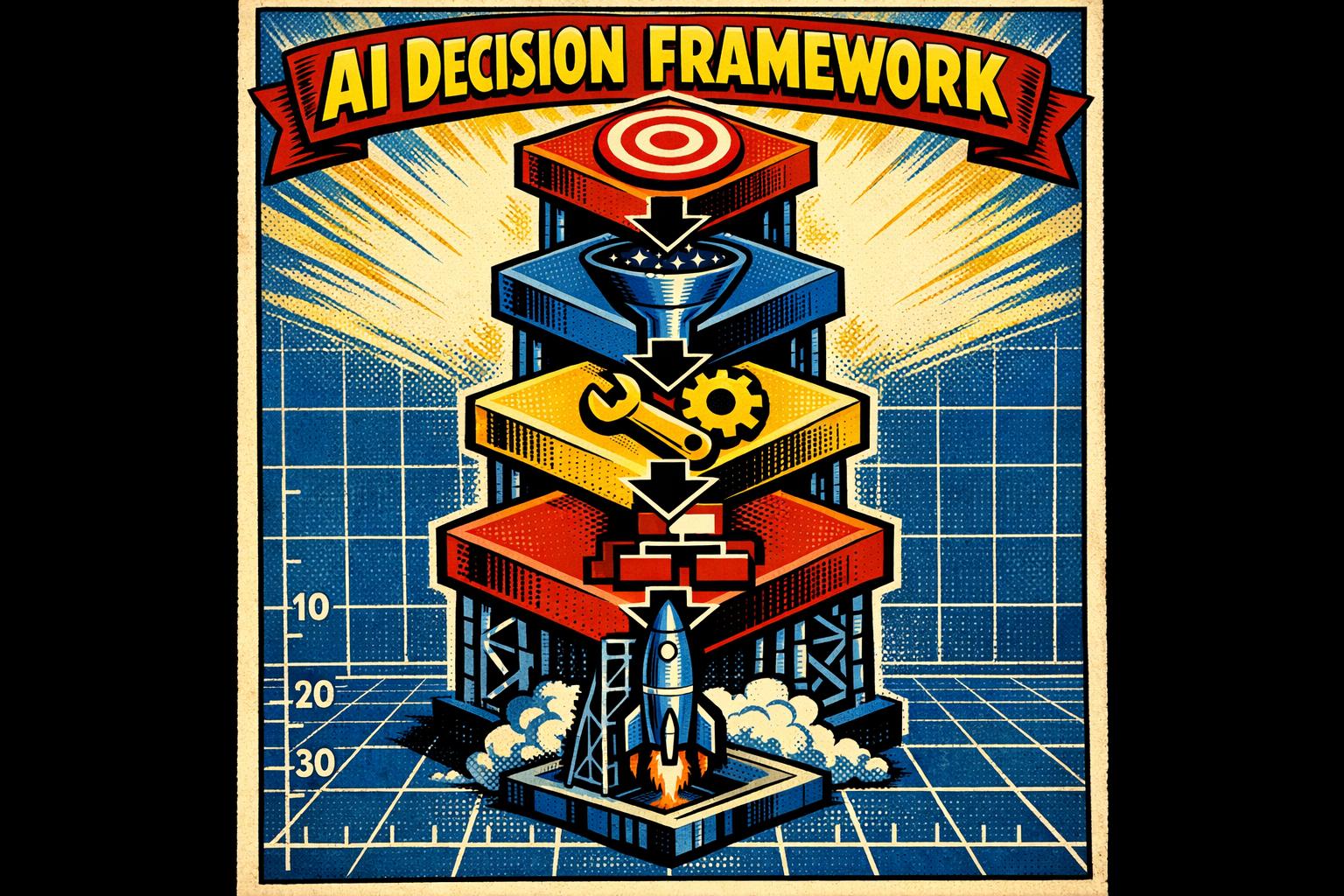
AI decision frameworks help you make smarter, data-driven choices by connecting technology to business goals. Instead of jumping to tools, start with clear objectives. Here’s the step-by-step process:
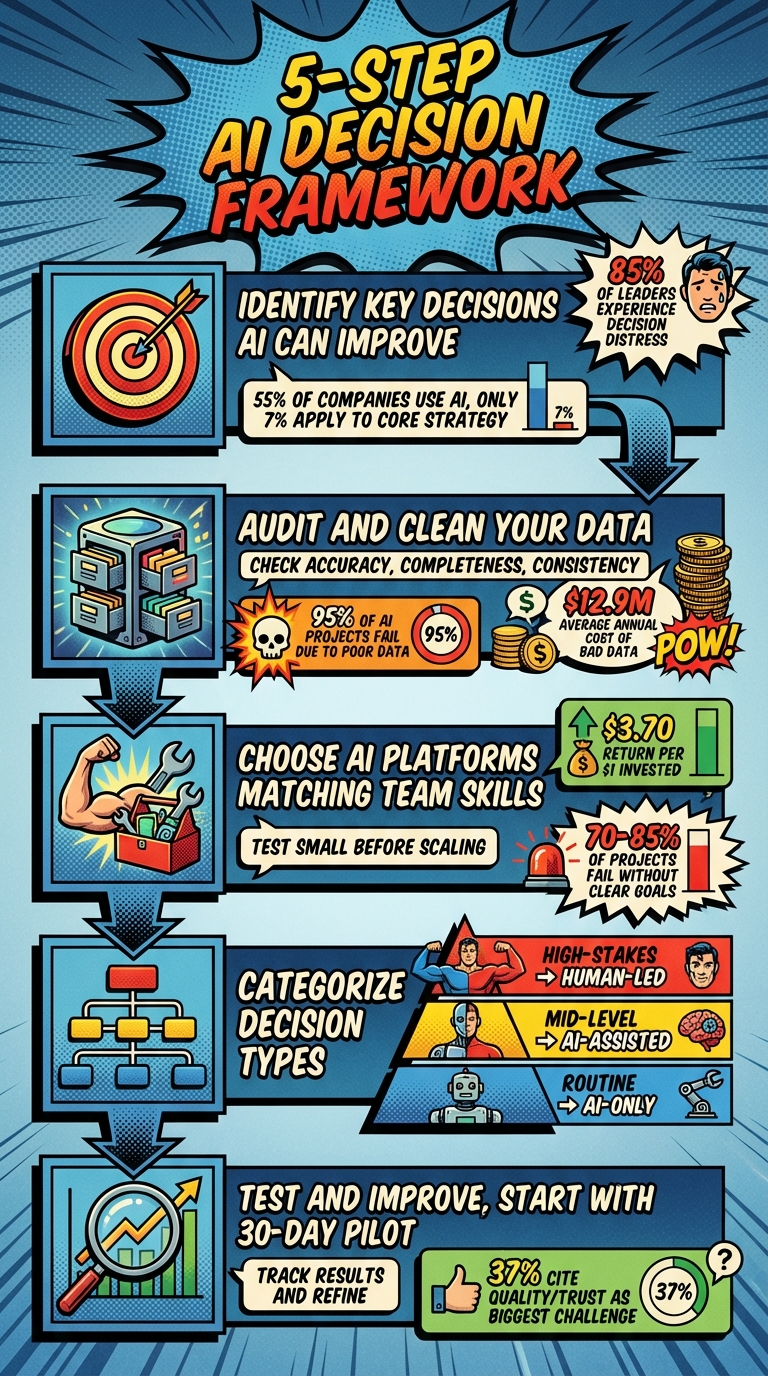
- Define Goals: Identify key decisions AI can improve – like reducing response times or analyzing large data sets.
- Organize Data: Audit and clean your data for accuracy, consistency, and relevance.
- Select Tools: Choose AI platforms based on your team’s skills and integration needs. Test small before scaling.
- Structure Decisions: Break decisions into categories – high-stakes (human-led), mid-level (AI-assisted), and routine (AI-only).
- Test and Improve: Start with a pilot, track results, and refine your framework before expanding.
Key takeaway: AI isn’t about replacing humans – it’s about creating systems that save time and reduce guesswork. Focus on measurable outcomes and ethical safeguards to ensure success.
5-Step AI Decision Framework Implementation Process
Step 1: Set Your Business Goals and Decision Targets
Find Your High-Impact Decisions
Start by pinpointing decisions that could benefit the most from AI. Look for repetitive tasks that slow down operations or areas where large data sets need analysis – places where AI can spot patterns that might escape human attention.
By early 2025, 55% of companies were using AI, but only 7% applied it to core strategies like financial planning or foundational decision-making. This leaves a huge gap for businesses to capitalize on. Talk to your team – they’re the ones who know where manual processes are creating bottlenecks. For example, a manufacturing company discovered through employee feedback that predictive maintenance was a major challenge. After rolling out an AI-powered fault detection system, they saw a 25% jump in machine uptime and a 20% boost in engineering productivity.
Focus on use cases that balance effort and value. Start with "Quick Wins" – tasks that require little effort but deliver high returns, such as automating reports or deploying basic customer service chatbots. These early successes build momentum and prove AI’s value. It’s worth noting that 85% of business leaders report "decision distress", regretting or second-guessing strategic choices made in the past year. AI can help by providing unbiased, data-driven insights that challenge assumptions instead of reinforcing them. These insights lay the groundwork for achieving measurable results with AI.
Create Measurable Success Metrics
Once you’ve identified your key decisions, establish clear metrics to track success. Define specific goals like reducing customer churn, cutting response times, or increasing sales conversions.
Ready to leave the job you hate and find the fastest path to online wealth? Learn the best asset you have right now to leverage income and build financial run way in my bestseller "Fire Your Boss." Click here to download the book for free.
Before introducing AI, document your baseline metrics. For instance, a global retailer used an AI-powered retention platform to flag at-risk employees and address their concerns. The result? Their annual attrition rate dropped from 18% to 12%. This improvement was possible because they knew their starting numbers. On average, AI delivers $3.70 for every $1 invested, with top performers seeing up to $10 per $1. However, outdated measurement systems leave 95% of organizations unable to realize measurable returns.
Track both financial outcomes (like revenue growth and cost savings) and operational metrics (such as automation rates and cycle times). In Summer 2025, Lowe’s analyzed how employees used their AI tools and found that voice-to-text was preferred over typing. By adapting their tools based on this insight, they improved both employee satisfaction and customer experiences.
"Know what value metric you’re gunning for when you choose a use case".
Step 2: Review and Organize Your Data
Audit Your Current Data
Before diving into AI, take a hard look at your data. Is it ready to be used, or does it need some serious cleanup? Start by listing every data source you have – structured ones like CRM or ERP systems and unstructured ones like emails, PDFs, or product guides. Then, map out how data moves between departments. This will help you spot silos and bottlenecks that could throw a wrench in your AI plans.
Here’s a reality check: 95% of enterprise AI projects fail to deliver their promised results, and fragmented or poorly managed data is often the culprit. On top of that, bad data quality costs businesses an average of $12.9 million each year. To avoid these pitfalls, evaluate your data against six key dimensions: accuracy, completeness, consistency, timeliness, validity, and uniqueness.
Be on the lookout for "hidden fat" that can mess up AI models – things like duplicate entries, mismatched units, or missing values. Joe DosSantos, VP of Enterprise Data and Analytics at Workday, summed it up perfectly:
"Our beautiful governed data, while great for humans, isn’t particularly digestible for an AI".
Unstructured files, like scanned documents, might need extra work – think OCR processing – before they’re AI-ready. And if you’re still relying on manual surveys to track sensitive data, it’s time to switch to automated tools that can continuously monitor your systems.
Once you’ve got a clear picture of your data landscape, focus on the pieces that matter most to your goals.
Prioritize Relevant and Accurate Data
Not all data is created equal. Zero in on the 20% of your data that delivers 80% of your business value – especially fields tied to revenue, compliance, or mission-critical operations. Outdated or irrelevant data can throw off AI predictions, so it’s crucial to replace it with up-to-date information.
Rita Sallam, Distinguished VP Analyst at Gartner, warns:
"At least 30% of generative AI projects will be abandoned by the end of 2025 because of poor data quality (besides rising costs and inadequate risk controls)".
Set accuracy standards based on how critical the data is. For example, "Customer ID" might need to be 100% accurate, while "Lead Source" could work fine at 95%. Identify and validate the top 20 fields that are essential for your AI use cases.
To ensure everyone’s on the same page, establish formal "data contracts" between the teams that create data and those that use it. General Motors takes this approach, embedding trust and accountability into their operations. As Sherri Adame, Enterprise Data Governance Leader at GM, explains:
"By treating every dataset like an agreement between producers and consumers, GM is embedding trust and accountability into the fabric of its operations".
Finally, assign data stewards within each department. For instance, Finance should handle expense categorization rules, while Sales takes charge of lead qualification standards. This way, there’s always someone responsible if a quality check fails.
Step 3: Choose Your AI Tools and Platforms
Compare AI Tools for Your Needs
Start by focusing on the problem you want to solve – not the technology itself. Before diving into vendor websites or signing up for free trials, identify the specific issue you’re tackling. Is it cutting down response times for customer inquiries? Or maybe automating repetitive data entry? Without clear use cases, you risk wasting time and money. In fact, a staggering 70% to 85% of AI projects fail because companies pick tools without first defining their goals.
Your team’s technical skills should guide your choice of tools. If your team isn’t made up of developers, no-code platforms like Zapier or Microsoft Copilot Studio can get you running in just days or weeks. On the other hand, if you have developers on board, code-based frameworks like LangChain allow for deeper customization – though these projects typically take 2–6 months to build out.
"AI tools require a different evaluation framework. One that accounts for learning curves, data requirements, integration complexity, and adoption challenges that traditional software doesn’t present."
The potential benefits are clear. Small businesses can save 40 to 60 minutes per employee each day. Organizations often see a return of $3.70 for every $1.00 invested. Sales teams using AI report revenue growth rates of 83%, compared to 66% for those without it. Real-world examples back this up. In July 2025, Noventiq saved 989 hours of manual work in just four weeks using Microsoft 365 Copilot. Similarly, NTT DATA automated up to 65% of its IT service desk tasks with Microsoft AI solutions.
When evaluating tools, start small. Test with 5–10 users over 4–8 weeks and use a scorecard (rated 1–5) to assess factors like business alignment, security, integration, ease of use, and cost. This process helps you confirm whether the tool actually supports better decision-making. Once you’ve narrowed down your options, ensure the chosen tool integrates smoothly with your existing systems.
Check Compatibility with Current Systems
After defining your use cases and narrowing your options, the next step is to verify that the AI tool fits within your existing software ecosystem. Begin by listing your key platforms – such as Microsoft 365, Google Workspace, Salesforce, or Slack – and confirm that the tool offers native integrations, well-documented APIs, or webhooks for smooth connectivity.
"An AI tool that doesn’t connect to your current software creates more work, not less."
Security and identity management are also crucial. Confirm that the tool supports features like SSO (using SAML or OIDC protocols), SCIM provisioning, and private connectivity options like Azure Private Link or AWS PrivateLink. Additionally, check where your data is processed – locally or in the cloud – and whether the vendor uses your data to train their models.
Finally, put the tool to the test by integrating it into 2–3 of your daily workflows. This hands-on approach helps you determine if it genuinely reduces friction or just adds extra complexity. For instance, in 2024, the brokerage firm Deriv deployed Amazon Q Business and saw a 45% boost in onboarding speed along with a 50% reduction in recruiter review time after real-world testing.
Step 4: Build Your Framework Structure
Create Layers for Different Decision Types
Organize your AI framework into three layers: strategic, tactical, and operational decisions. Each layer corresponds to a different type of decision-making and requires varying levels of human involvement.
- Strategic decisions (or "Type 1" decisions) are high-stakes and irreversible. Think of major pivots, product launches, or forming large partnerships. For these, AI plays a supporting role by synthesizing data, running models, and simulating scenarios, but the ultimate call rests with human leadership.
- Tactical decisions ("Type 2" decisions) are reversible and mid-level in impact. Examples include adjusting marketing budgets, hiring for specific roles, or tweaking product features. In these cases, AI can take the lead, with humans stepping in for oversight.
- Operational decisions are routine and require speed and consistency. Tasks like inventory reordering, programmatic ad bidding, or routing customer service inquiries can be fully automated, as long as you set clear thresholds and conduct regular audits.
To put this into practice, create a spreadsheet with three columns – Strategic, Tactical, and Operational – and map your current decisions into these categories. This simple exercise helps clarify where AI should assist and where it can operate independently.
"Structure, not tech, is the bottleneck. Most companies aren’t struggling with AI tools – they’re struggling with unclear governance and decision rights."
– Lex Sisney, Founder, Organizational Physics
Once your decision layers are defined, the next step is to establish ethical rules and safeguards for each level.
Add Ethics Rules and Risk Management
With your decision tiers in place, it’s time to integrate ethical guidelines and risk controls. Start by identifying who will be affected by each decision. Stakeholders fall into three categories:
- Primary stakeholders: Those directly impacted, like customers or employees.
- Secondary stakeholders: Indirectly affected groups, such as suppliers.
- Tertiary stakeholders: Those experiencing broader consequences, like communities or competitors.
Mapping these groups helps you anticipate ethical risks and avoid blind spots.
Next, classify decisions into three zones:
- AI-Only: For predictable, low-risk tasks.
- Human-Only: For high-stakes or value-sensitive decisions.
- Hybrid: Where AI makes recommendations, but humans have the final say.
For example, automating email send times might fit into the AI-Only zone, while decisions about workforce reductions would remain Human-Only.
Introduce a contestability rule to ensure that any AI decision is explainable and can be reviewed or overturned. For instance, if AI denies a refund, there should be a clear process for human intervention. Research shows that structured ethical frameworks can reduce blind spots by 60% compared to relying on intuition alone.
For high-stakes choices, apply a 24-Hour Rule: any decision involving more than $500 or 20 hours of work should be delayed for a day. This pause allows for reflection and avoids rash actions. A good litmus test: "Would we be comfortable if this decision made the front page of a major newspaper?" If not, it’s time to revisit your approach.
Finally, set up automatic escalation triggers. If AI repeatedly fails to complete a task or is about to take a high-risk action – like issuing a large refund or canceling a contract – escalate the decision to a human immediately. Companies with strong ethical frameworks tend to outperform their peers by 23% in profitability and see 40% lower employee turnover.
By combining structured layers and ethical safeguards, you can ensure that your AI framework supports responsible, data-driven decision-making. Here’s a quick overview of decision zones:
| Decision Zone | AI Role | Human Role | When to Use |
|---|---|---|---|
| AI-Only | Decide | Monitor | Predictable, low-risk tasks |
| Hybrid | Recommend | Decide | Mid-range decisions needing context |
| Human-Only | Inform | Final decision-maker | Strategic, ethical, or high-stakes choices |
Step 5: Test, Track, and Improve
With your framework in place, it’s time to roll up your sleeves and test it thoroughly. This stage is all about refining your approach and ensuring it delivers results.
Start with Small Test Projects
Kick things off with a 30-day pilot in a focused area. Choose a decision type that takes up about 20% of your effort but delivers 60% of the value. This lets you validate your assumptions without stretching your resources too thin. For example, if you’re automating customer support routing, start with a single product category instead of tackling your entire product line.
Use the "3-customer rule" to confirm the problem you’re solving is real. If three different sources highlight the same issue, you’re on the right track. Before diving into full automation, test your decision-making process manually to ensure demand exists and refine it as needed.
Keep a decision log to track every AI-driven choice, its expected outcome, and any risks you identified at the time. Review this log at 30 and 90 days to compare your predictions with actual results. Testing like this is crucial – over 37% of organizations say AI quality and trust are their biggest challenges when scaling AI systems.
Track Results and Fix Problems
Once your pilot is live, monitor specific metrics to measure performance. For yes/no decisions, focus on:
- Precision: How accurate are the "yes" predictions?
- Recall: How many relevant cases are correctly identified?
- F1 Score: A balance between precision and recall.
For numerical results, track Mean Absolute Error (MAE) to see how far predictions deviate from the correct answers.
Pay attention to override rates. If users are correcting more than 30% of AI decisions, the system needs immediate adjustments. Take Samuel Patel’s example: in October 2025, his AI customer-support assistant handled 18,000 chats weekly. By improving retrieval accuracy and refining prompts, his team reduced errors (or "hallucinations") from 2.4% to less than 1%, cut response times to under 1 second, and reduced escalations by 28%. This saved about 40 agent-hours daily.
"AI systems ship with hypotheses. You validate those hypotheses only by deploying them into live workflows and testing relentlessly." – Richard Naimy, Product Leader
When issues arise, tackle them systematically. Change one variable at a time – like the prompt, data formatting, or API connection – and create a small, repeatable input that consistently triggers the bug. Once the issue is fixed, verify it works and document the solution as a test case to prevent future recurrences.
When your metrics stabilize and the bugs are ironed out, you’re ready to scale.
Expand After Proving Success
Once your pilot demonstrates measurable success, it’s time to expand. Use shadow testing on 5–10% of traffic to compare new models against a control group before rolling them out fully. This approach minimizes risk and provides valuable real-world data.
Take Notion’s AI team as an example. By moving from manual spot-checking to automated testing, they increased their issue-resolution rate from 3 fixes a day to 30. Similarly, Nurture Boss improved their AI assistant’s date-handling accuracy from 33% to 95% through targeted testing and error analysis.
As you scale, keep an eye on concept drift – the tendency for models to lose accuracy as real-world conditions evolve. Regularly test your framework against a set of "golden prompts" to ensure it stays aligned with current facts and business policies. Maintaining high-quality standards and re-testing frequently will help your system stay reliable and effective.
Using Serve No Master for AI Decision Frameworks

Building an AI decision framework takes more than just tools – it requires a clear strategy to automate processes and generate revenue effectively. Serve No Master, created by bestselling author Jonathan Green, offers tailored training for entrepreneurs aiming to use AI to become your own fractional AI officer and build location-independent businesses with minimal overhead. By tapping into these resources, you can create a framework that not only streamlines decision-making but also fuels long-term business growth.
Ready to leave the job you hate and find the fastest path to online wealth? Learn the best asset you have right now to leverage income and build financial run way in my bestseller "Fire Your Boss." Click here to download the book for free.
AI Training for Entrepreneurs
One of the standout offerings from Serve No Master is ChatGPT Profits, a 400-page guide that dives deep into leveraging GPT-4 for automation, content creation, and smarter decision-making. The program includes a Prompt Library – a Google Doc packed with ready-to-use prompts from the book. This makes it easy to copy, tweak, and apply them to your business, no technical skills required.
The training introduces the 4-Factor Decision Framework, which helps entrepreneurs evaluate which tasks are worth automating. It breaks down decisions into four key areas:
- Complexity: How many steps and potential failure points are involved?
- Consistency: Are inputs predictable enough for automation?
- Trust: What are the risks if something goes wrong?
- ROI: Does the time saved justify the build time?
This framework ensures you focus your resources on high-impact automation projects. Many users have reported significant time savings after integrating ChatGPT into their workflows.
Another highlight is the Content Decision Pipeline, a system that uses tools like Gemini Advanced and AI project management assistants to automate the entire content process – from research to drafting to scheduling. For example, one entrepreneur saw LinkedIn article views skyrocket to over 7,000 in just four weeks, with daily averages topping 500 views – a potential annual reach of over 180,000 views. This content pipeline complements the decision-making framework, making it a seamless addition to your strategy.
Creating Passive Income with AI
Serve No Master doesn’t stop at automation – it also provides a roadmap for creating passive income streams using AI. The program outlines a 4-phase approach: building your platform, optimizing email funnels, launching offers that fly off the shelves, and scaling recurring revenue. A key focus is on growing owned audiences through email lists, which are more reliable and controllable compared to social media followers.
The training also dives into using AI Agents to handle repetitive tasks like inventory management, customer support, and lead qualification. With tools like n8n, you can implement a "build once, run unlimited" model, avoiding per-task fees that can eat into profits. This setup allows entrepreneurs to replace multiple roles, boosting back-office productivity by 20-40%.
For those seeking additional guidance, Jonathan Green offers coaching calls typically priced at $1,000 per hour, with occasional discounts available. These sessions can provide personalized insights to help you maximize the potential of AI in your business.
Conclusion: Creating Your AI Decision Framework
Main Points for Business Owners
Building a tailored AI decision framework isn’t about chasing the latest tech trends – it’s about setting clear goals and using the right tools to achieve measurable business outcomes. Start by pinpointing what you want to accomplish, like cutting response times or increasing sales, and ensure your data and systems are ready to support your objectives.
Here’s a compelling stat: companies leveraging AI agents see an average return of $3.70 for every $1 spent, with top performers hitting $10. Plus, decision quality has a 95% correlation with financial success. To get there, your framework needs to combine several layers – solid data infrastructure, advanced analytics, decision-making intelligence, and strategic alignment. Don’t forget governance rules to safeguard data privacy and root out bias.
Start small with a 30-60-90 day plan. Use the first 30 days to establish baseline metrics, launch pilot projects by day 60, and scale up based on proven success by day 90. Focus on areas where AI shines, like automating repetitive, rules-based tasks. For example, customer support and lead enrichment processes can see up to 80% of task time automated and errors reduced by as much as 90%. A smart hiring tip? Before bringing on new contractors, test the waters with an AI workflow for that role. Run it for two weeks to identify performance gaps and refine your approach.
Once you’ve nailed these basics, you’re ready to explore how Serve No Master can help you take your AI framework to the next level.
Getting Started with Serve No Master
Serve No Master offers a straightforward way for entrepreneurs to dive into AI decision frameworks. Their ChatGPT Profits guide is packed with a prompt library to get you started instantly, along with expert advice from Jonathan Green.
The platform focuses on scalable AI strategies that align with your long-term goals. Ready to take the first step? Visit Serve No Master to download the free ChatGPT Profits guide and start building your framework today.
FAQs
What’s the first AI decision to automate?
When deciding what to automate first with AI, look for tasks that are repetitive, time-consuming, and easy to streamline. Think about things like handling customer inquiries, scheduling appointments, or qualifying leads. These types of tasks are predictable and often create bottlenecks, making them perfect candidates for automation to boost efficiency.
How clean does my data need to be?
Clean data is the backbone of reliable AI results. It needs to be well-organized, consistent, and free from errors, biases, or gaps. When data quality is neglected, the consequences can be significant – flawed predictions, poor decisions, and unnecessary expenses. If you’re aiming for successful AI outcomes, make data quality your top priority. It’s the foundation for making accurate and dependable decisions.
When should AI decide vs a human?
AI shines when it comes to predictable, repetitive tasks that demand speed and consistency – think crunching data or spotting patterns. But when it comes to decisions that involve ethics, trust, or nuanced judgment, humans need to stay in the driver’s seat.
When deciding whether to use AI, focus on three key factors: how predictable the task is, how critical it is, and the context in which it’s being used. At its best, AI isn’t about replacing humans – it’s about being a powerful assistant that enhances human decision-making.
Related Blog Posts
- How to Start a Side Hustle While Working Full Time
- Ultimate Guide to Fractional Chief AI Officer Certification
- How to Validate Business Ideas Before Quitting Your Job
- 5 Mindset Shifts for AI Career Success After 40
Ready to leave the job you hate and find the fastest path to online wealth? Learn the best asset you have right now to leverage income and build financial run way in my bestseller "Fire Your Boss." Click here to download the book for free.