How AI Simplifies Niche Validation
Most startups fail because they solve problems no one cares about. For solopreneurs, this can mean wasted time, money, and energy. Niche validation ensures your business idea has a real market before you invest heavily. But traditional methods take months and often lead to analysis paralysis.
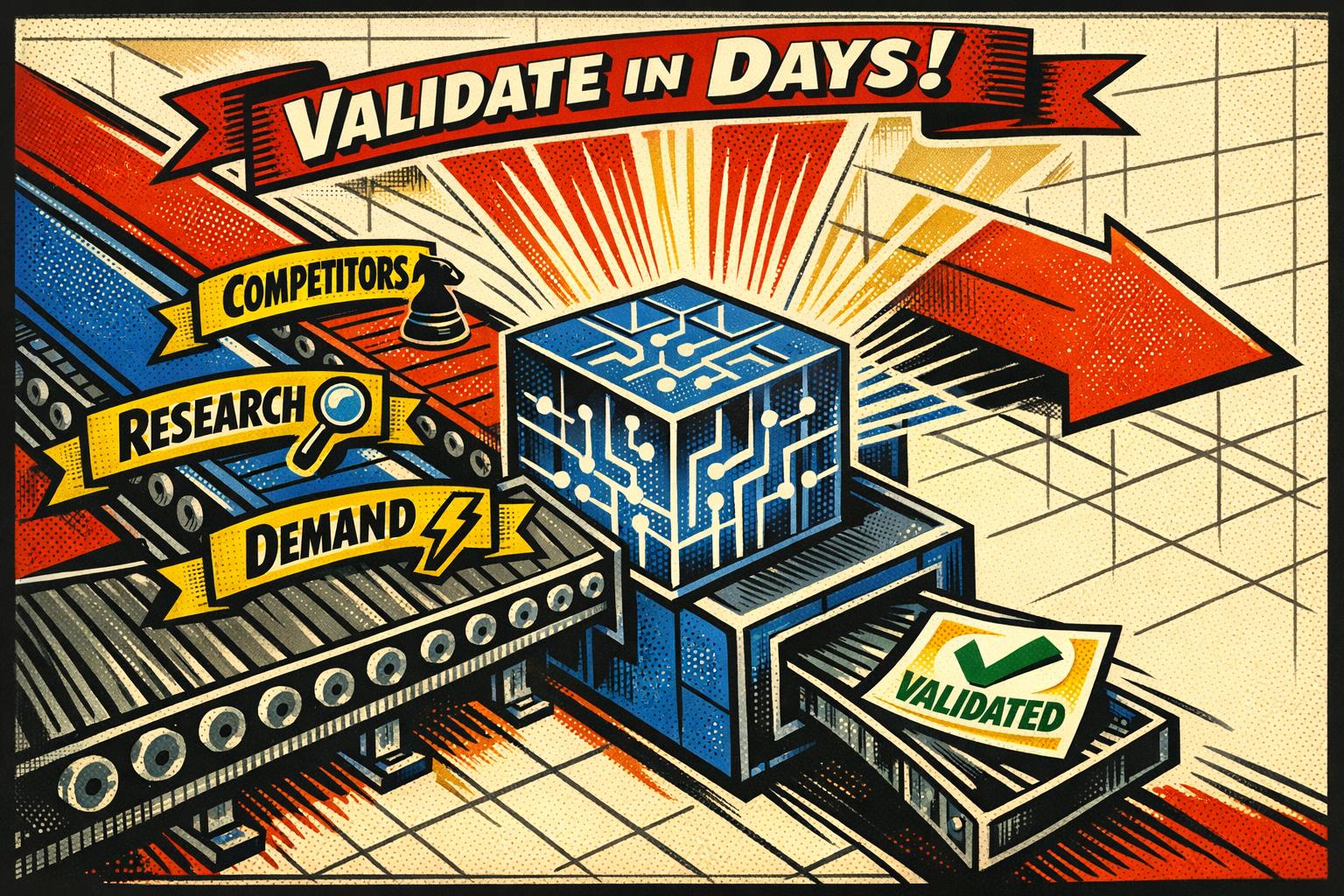
AI changes the game. Tasks that once took weeks – like customer research, competitor analysis, and demand testing – can now be done in just 24–48 hours for as little as $5–$20. AI tools analyze customer complaints, identify market gaps, and even test demand through small ad campaigns. This means you can make decisions based on data, not guesswork.
Here’s the bottom line: skipping validation is the most expensive mistake you can make. AI lets you validate faster, cheaper, and more effectively, so you can focus on building a product people actually want.
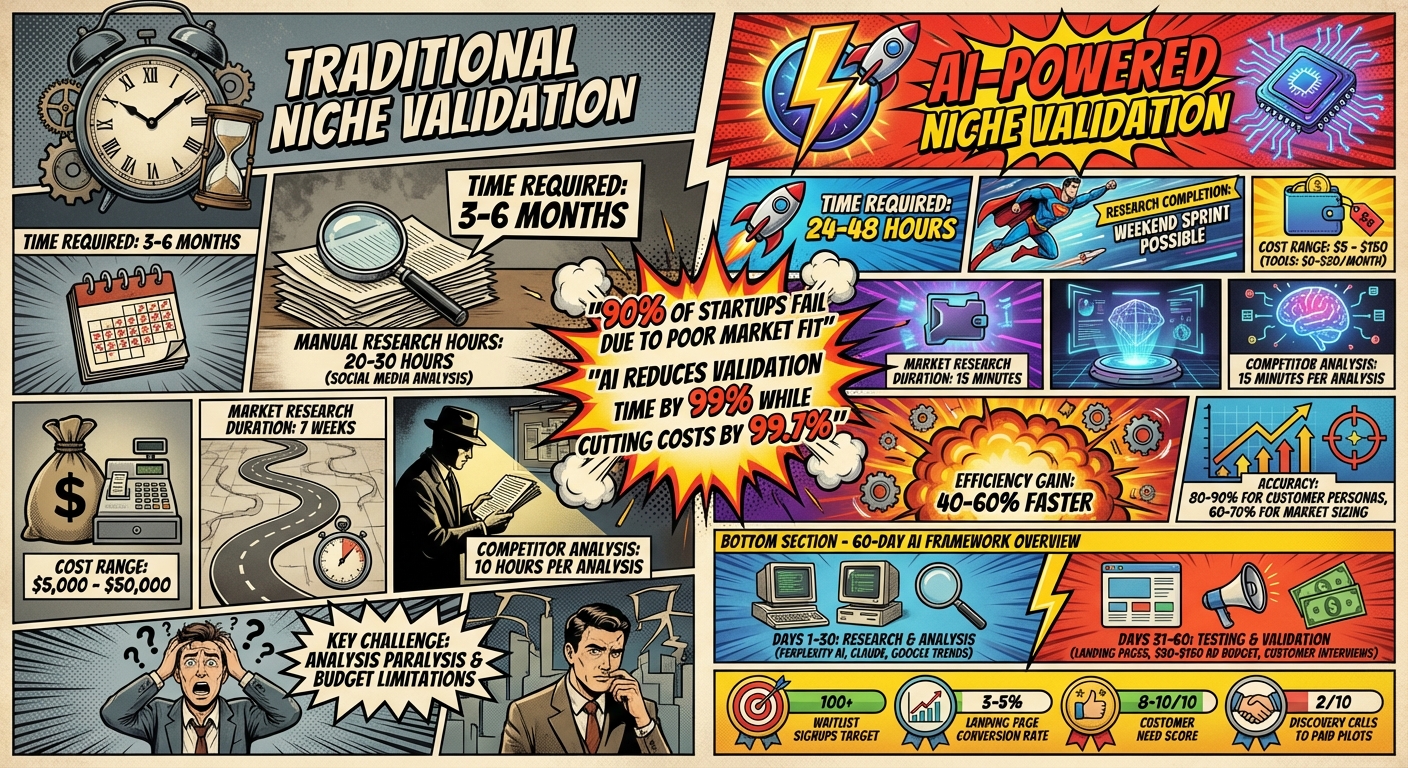
Traditional vs AI-Powered Niche Validation: Time and Cost Comparison
Why Niche Validation Is Hard for Solopreneurs
Common Problems with Traditional Niche Validation
The traditional approach to niche validation is a time sink. It can take anywhere from three to six months to complete. During this time, you might spend 20 to 30 hours combing through endless social media comments, trying to spot patterns in customer complaints. For solopreneurs, this is a huge challenge. Budget limitations often mean you can’t afford to hire research analysts or access pricey business databases.
What happens next? Analysis paralysis. The fear of picking the wrong niche can become so overwhelming that it freezes you in your tracks. Some solopreneurs skip validation entirely, gambling on an idea without proper research. Others attempt to push through, sinking months into research they can’t afford. Either way, the risks are high, and the missteps can be expensive.
What Happens When You Pick the Wrong Niche
Here’s a tough truth: 90% of startups fail because they create products for markets that simply don’t care. For solopreneurs, this often translates to months spent developing and launching a product that no one wants. The core issue? Building a solution that doesn’t solve an urgent or costly problem.
Ready to leave the job you hate and find the fastest path to online wealth? Learn the best asset you have right now to leverage income and build financial run way in my bestseller "Fire Your Boss." Click here to download the book for free.
Even worse, you might target a market that’s either too small to sustain a business or so expensive to reach that profitability becomes a distant dream. The numbers don’t lie – only about 3.6% of solopreneurs ever hit $83,000 in monthly revenue. Picking the wrong niche can be the difference between thriving and struggling to stay afloat.
How AI Makes Niche Validation Easier
Faced with these challenges, solopreneurs need a faster, smarter way to validate niches. That’s where AI steps in. With AI, the validation process can shrink from months to just days. These tools can analyze customer conversations, identify gaps in the competition, and estimate your market size – all in a matter of hours. This efficiency means you can complete validation tasks 40% to 60% faster than traditional methods.
What’s more, AI tools are surprisingly accessible. Many platforms cost as little as $0 to $20 per month, making them a realistic option for solopreneurs on tight budgets. These tools provide actionable insights, helping you decide whether to move forward, pause, or pivot – without risking your entire savings. At Serve No Master (https://servenomaster.com), we guide entrepreneurs in leveraging AI to streamline niche validation, transforming a daunting process into something quick and manageable.
Using AI for Market Research and Demand Analysis
How AI Collects Market Data
AI gathers information from a wide range of public sources. It pulls data from competitor websites, analyzes customer reviews on platforms like Amazon and Google, and even tracks live discussions on Reddit and TikTok. Tools like Perplexity AI combine advanced language models with live web searches to deliver current market statistics.
One of AI’s strengths lies in processing unstructured data – things like customer support tickets, forum posts, and product reviews. These are the kinds of data that would take weeks to analyze manually. AI can sift through this raw information to identify recurring complaints and uncover market gaps. While traditional market research might take seven weeks and cost anywhere from $5,000 to $10,000, AI can produce similar insights in just 15 minutes for about $5. This efficiency gives solopreneurs the ability to test market demand without the usual hurdles.
Practical Methods for Testing Demand
One straightforward way to start is by analyzing competitor reviews. Gather 10 to 20 reviews from similar products and use an AI tool with a prompt like "Identify repeated complaints and hidden frustrations". This helps you understand what customers dislike about current options. AI can also calculate a Serviceable Addressable Market (SAM) by analyzing customer profiles and realistic pricing, offering a more specific market size than broad global figures.
Another method is running a "smoke test" with a small advertising budget. Spending between $50 and $150 on targeted ads that direct traffic to a simple landing page can reveal whether there’s real interest in your idea. If you see a 3% to 5% conversion rate, it’s a strong sign of demand. AI can help you craft ad copy, optimize landing page content, and analyze the performance of different headlines. This low-cost experiment can quickly provide actionable insights, helping you refine your niche.
How AI Saves Time on Research
Tasks that used to take hours, like competitor analysis, are now done in minutes. What once required 10 hours of manual effort now takes just 15 minutes with AI. A full market research sprint – including identifying pain points, analyzing competitors, and testing demand – can be wrapped up in a single weekend. AI-generated customer personas, built from support data, are about 80% to 90% accurate, giving you a clear picture of your audience without the need for lengthy interviews. Even market sizing and opportunity assessments, while slightly less precise at 60% to 70% accuracy, provide enough clarity to make informed decisions about your niche.
At Serve No Master, we guide entrepreneurs in using these AI-driven research strategies to validate niches quickly. By saving time on market research, solopreneurs can focus on building and launching ventures with confidence and precision.
AI for Competitor Analysis and Finding Market Gaps
How AI Evaluates Your Competition
Tracking competitors manually is a time-consuming headache, but AI changes the game for solopreneurs looking to uncover opportunities. AI works around the clock, scanning competitor websites, social media, pricing pages, and job postings to spot changes as they happen. Whether it’s a new pricing model or a feature update, AI ensures you’re the first to know.
One standout feature is sentiment analysis. AI sifts through thousands of customer reviews on platforms like Trustpilot or G2, identifying common complaints and unmet needs. For instance, if reviews repeatedly highlight that a competitor’s onboarding process is confusing or their customer service is sluggish, you’ve just found a gap you can exploit. AI also identifies inconsistencies – like when a company’s claims don’t match their actual service policies – giving you an edge to address those weaknesses.
Hiring trends are another goldmine of insights. If a competitor suddenly starts recruiting enterprise sales reps, it’s a strong signal they’re shifting focus to larger clients, potentially leaving smaller businesses underserved. AI tools monitor job postings and LinkedIn updates, providing a six-month head start to adjust your strategy.
Getting Practical Advice on Positioning
AI doesn’t just collect data – it helps you act on it. By creating competitive positioning maps, AI compares competitors’ value propositions, pricing strategies, and target audiences to reveal where the market has room for a new player. For example, you can upload a competitor’s homepage, FAQ, or terms of service and ask the AI to critique it like a skeptical analyst. The AI will highlight friction points or weaknesses in their offer, giving you actionable insights for crafting your own unique value proposition.
Content and keyword gap analysis is another area where AI shines. These tools compare your website’s focus and search rankings to competitors’, flagging areas with high search intent that others are ignoring. Let’s say competitors are heavily focused on one part of a problem but neglect another – AI identifies that "white space" as an opportunity. In one example, a B2B SaaS company used AI monitoring to find a market gap, which led directly to $300,000 in new deals. Once you’ve spotted these gaps, you can refine your pricing and positioning to maximize your impact.
Affordable Competitor Research for Solopreneurs
Traditional competitor research is a slog – it can take weeks and cost anywhere from $5,000 to $20,000. AI flips that script, delivering equivalent insights in minutes for as little as $5. Tools like Competely AI start at $19 a month, while SE Ranking ranges from $65 to $239 monthly. Visualping, a tool for tracking website changes, offers free plans or premium options up to $39 per month. Even with basic tools like ChatGPT or Claude’s API, you can generate a detailed competitor analysis report for just $0.50 to $5.00.
At Serve No Master, we show entrepreneurs how to use these AI tools and techniques to uncover market gaps and position their businesses effectively. With the right tools and smart prompts, solopreneurs can tap into high-quality market intelligence without breaking the bank.
Finding Your Target Audience with AI
Building Detailed Customer Profiles
Once you’ve identified market gaps, the next step is pinpointing your target audience with precision. AI helps craft ideal customer profiles (ICPs) by analyzing four key areas: firmographic details, behavioral patterns, psychographic traits, and situational factors. A well-defined ICP filters out leads that aren’t a good fit. For instance, instead of targeting a massive group like "33 million small business owners", you could focus on remote architecture firms in Europe with 5–15 employees that recently adopted project management software. Tools like ChatGPT Plus or Claude Pro (both around $20 per month) can quickly process data to create these detailed profiles.
Beyond profiles, AI can also generate a "Customer Language Glossary" by analyzing common phrases and terminology from communities your audience engages with. This glossary fine-tunes your marketing copy, making it more relatable and impactful. By clearly defining your audience, you strengthen your market validation efforts and ensure your niche has real potential.
Locating Online Communities and Platforms
AI tools make it easier to find the digital spaces where your audience gathers. Instead of manually searching hashtags or forums, platforms like Stormy AI allow you to use natural language queries (e.g., "creators discussing productivity for remote architects in Europe") to uncover relevant communities. Perplexity AI takes it further by performing live web research to locate forums, LinkedIn groups, and other active spaces where your target audience discusses their challenges.
For a broader look at audience habits, SparkToro (priced at $50 per month) identifies which podcasts your audience listens to, the newsletters they subscribe to, and the social accounts they trust. These insights make outreach more efficient and targeted. By mapping these communities, you gain access to valuable spaces for lead generation and audience engagement.
Automating Lead Research
AI tools can take much of the grunt work out of lead research. For example, Clay (about $149 per month) enriches contact records with valuable details like firmographic data, technology usage, and even recent hiring trends. It also scores leads based on your ICP, factoring in signals like funding rounds or specific software adoption.
Other tools, like F5Bot, monitor platforms such as Reddit and niche forums, sending you alerts when prospects mention problems your product could solve. AI agents can also scrape mentions from these communities and compile weekly digests of potential leads and competitor insights. Discovery tools help identify influencers and community leaders, enabling you to create highly tailored email campaigns at scale. At Serve No Master, we show entrepreneurs how to set up these automated systems, so they can build focused lead lists while dedicating more time to strategic growth.
A 60-Day Niche Validation Framework Using AI
When it comes to turning an idea into a viable business, time is everything. This 60-day framework uses AI to simplify the process of niche validation, helping you test ideas quickly without wasting months on guesswork.
Breaking Validation into Phases
The framework is split into two 30-day phases. In the first phase (Days 1–30), AI tools help you dig into market gaps, examine competitors, and refine your broad ideas into something more specific. For instance, instead of a general niche like "stress management", you might focus on "co-parenting transition protocols." The second phase (Days 31–60) shifts to real-world testing. You’ll create simple landing pages, run small ad campaigns (budgeting $50–$150), and conduct customer interviews to gauge if people are willing to pay for your idea. By the end of this process, you’ll have clear signals to either move forward, pivot, or drop the idea altogether.
This two-phase system keeps things focused and efficient. Instead of spending months building something no one wants, you’ll have measurable outcomes at each stage to guide your decisions. Once the plan is in place, the next step is choosing the right AI tools to make it happen.
Which AI Tools to Use at Each Stage
Days 1–15: Start with Perplexity AI for up-to-date research and Google Trends to measure search interest. Use Claude to challenge your assumptions and refine your ideas further.
Days 16–30: Dive deeper into competitor analysis with SimilarWeb, and use PainOnSocial to uncover customer pain points through platforms like Reddit.
Days 31–60: Build landing pages using no-code tools like Lovable or Carrd. Test your idea with targeted ads on platforms such as Google, Meta, or LinkedIn. Finally, gather direct feedback with tools like Typeform or Tally. Many of these tools are accessible through free tiers or affordable subscriptions, typically around $20 per month.
Setting Metrics to Track Progress
Clear metrics are key to knowing if you’re on the right track. Aim for at least 100 sign-ups from strangers on your waitlist. A landing page conversion rate of 3–5% is a good sign; anything below 1% means you may need to rethink your offer. During customer interviews, look for feedback scores between 8 and 10 on how much they need your solution. A strong indicator of demand is converting 2 out of 10 discovery calls into paid pilots.
To evaluate your niche, use a weighted scoring matrix that considers factors like market demand, willingness to pay, and how complex it is to execute. A score above 70 out of 100 means you’re ready to move forward with an MVP. Anything below 50 suggests it’s time to go back to the drawing board.
At Serve No Master, we specialize in helping entrepreneurs build these tracking systems. This approach empowers solopreneurs to make smart, data-driven decisions instead of relying on gut instinct.
How AI and Human Judgment Work Together
AI takes care of the heavy lifting, leaving you free to focus on the strategic decisions that truly matter. The best approach combines 80% AI-driven research and data synthesis with 20% human-led customer conversations. This balance offers speed without losing the personal touch that builds lasting businesses. Let’s break down what AI excels at and where your judgment is essential.
What AI Should Handle
AI shines in tasks that require rapid data processing and organization. It’s great for synthesizing customer feedback and mapping out competitive landscapes. It can also handle market sizing by applying realistic filters – geographic, technological, and pricing – to produce credible revenue projections. AI is a pro at drafting interview scripts, outlining lean business plans, and crafting outreach messages, giving you more time to connect directly with customers. Additionally, when prompted correctly, AI can help identify critical flaws in your business idea.
Where Human Judgment Matters Most
While AI provides speed and efficiency, some areas demand human intuition and experience. For instance, AI can summarize online chatter, but it can’t predict whether people will actually change their behavior or invest in your solution. Your insight is especially critical when assessing "Founder Fit" – your personal background, network, and credibility, all of which can turn a so-so concept into a winning opportunity.
AI also has a tendency to agree with you – it’s designed to assist, not challenge. To counter this, push AI into an adversarial role. Ask it to "steelman" your business case or pinpoint potential weaknesses, often referred to as "kill shots". Then, use your judgment to weigh these risks alongside feedback from real customer interactions.
Using AI Without Losing Authenticity
To keep things authentic, think of AI as your research assistant – not the decision-maker. Use AI to draft outreach messages, but always rewrite them in your own voice. Let it analyze 1-star and 2-star competitor reviews to uncover market gaps. However, don’t stop there. Have at least 10 real conversations to capture the emotional nuances and specific language that AI might overlook. This approach ensures that your data-driven insights remain grounded in genuine human connections.
"The real advantage comes from building specialized AI systems trained on your expertise, data, and workflows. General-purpose AI yields generic output; specialized systems protect your competitive edge."
- Ken Yarmosh, Solopreneur Strategy Expert
At Serve No Master, we help entrepreneurs create specialized systems tailored to their expertise. This strategy keeps your business rooted in meaningful relationships while letting AI handle tasks where speed and efficiency are key.
Conclusion
AI has completely reshaped how solopreneurs validate their business ideas. Tasks that used to take months and cost thousands – anywhere from $5,000 to $50,000 – can now be done in just 24–48 hours for as little as $50–$150. This means quicker decisions, lower costs, and dependable data, all while avoiding wasted time and money on ideas that don’t hold water.
Think about it: nearly half of startups fail because they miss the mark on market fit. AI steps in to help you dodge that common mistake by giving you clear, data-driven insights before you pour resources into an untested idea. It pulls together information from countless sources – like Reddit discussions, competitor reviews, and market trends – and synthesizes it into actionable insights.
Even better, AI acts as a brutally honest advisor. It highlights weaknesses in your idea before you get too attached or invested. By taking over the heavy lifting of research, it gives you the freedom to focus on the bigger picture: talking to customers, evaluating the market fit, and making informed decisions.
"The single most expensive mistake in entrepreneurship is skipping validation. Building a product nobody wants costs time, money, and momentum that you cannot recover."
- Digital Applied
The real magic happens when you combine AI’s ability to process massive amounts of data with your own expertise and instincts. At Serve No Master, we’re committed to helping entrepreneurs find that sweet spot. Using AI for niche validation doesn’t just save you from costly errors – it sets your business up for long-term success.
FAQs
What’s the fastest way to validate a niche with AI?
The quickest way to test out a niche using AI is by leveraging AI-powered tools for market research and competitor analysis. These tools sift through data like search trends and social media activity to pinpoint market gaps, trending topics, and demand signals in record time. On top of that, entrepreneurs can use no-code AI platforms to whip up landing pages and collect feedback within hours. This approach speeds up decision-making while keeping risks low.
How do I know if my niche is big enough to be profitable?
To figure out if your niche has money-making potential, AI tools can help you dig into the numbers. They can analyze audience size, track what your competitors are up to, and highlight market trends. These tools are great for spotting untapped opportunities, pinpointing gaps in the market, and estimating demand. When you mix AI-driven insights with your own research, you’ll get a clearer picture of whether the niche is big enough and growing fast enough to support a thriving business. Plus, it helps you steer clear of markets that are either too tiny or completely overcrowded.
Which is more reliable for niche validation: AI research or customer interviews?
Customer interviews stand out as a dependable method because they deliver direct, firsthand insights into market demand and a customer’s willingness to pay. This kind of evidence is crucial when validating ideas or making informed decisions. While AI research can provide swift and surface-level insights, it often falls short in offering the depth and precision required for making critical business choices.
Ready to leave the job you hate and find the fastest path to online wealth? Learn the best asset you have right now to leverage income and build financial run way in my bestseller "Fire Your Boss." Click here to download the book for free.
Related Blog Posts
- How to Validate Business Ideas Before Quitting Your Job
- How ChatGPT Helps Identify Profitable Niches
- How to Build an AI Decision Framework
- AI Personalization for Subscription Models
Ready to leave the job you hate and find the fastest path to online wealth? Learn the best asset you have right now to leverage income and build financial run way in my bestseller "Fire Your Boss." Click here to download the book for free.