
AI Personalization for Subscription Models
AI personalization is changing the game for subscription businesses. Here’s the deal: keeping customers is much cheaper than finding new ones, but churn rates and rising customer expectations are eating into profits. AI steps in by predicting churn early, tailoring experiences to individual users, and boosting retention rates.
Key Takeaways:
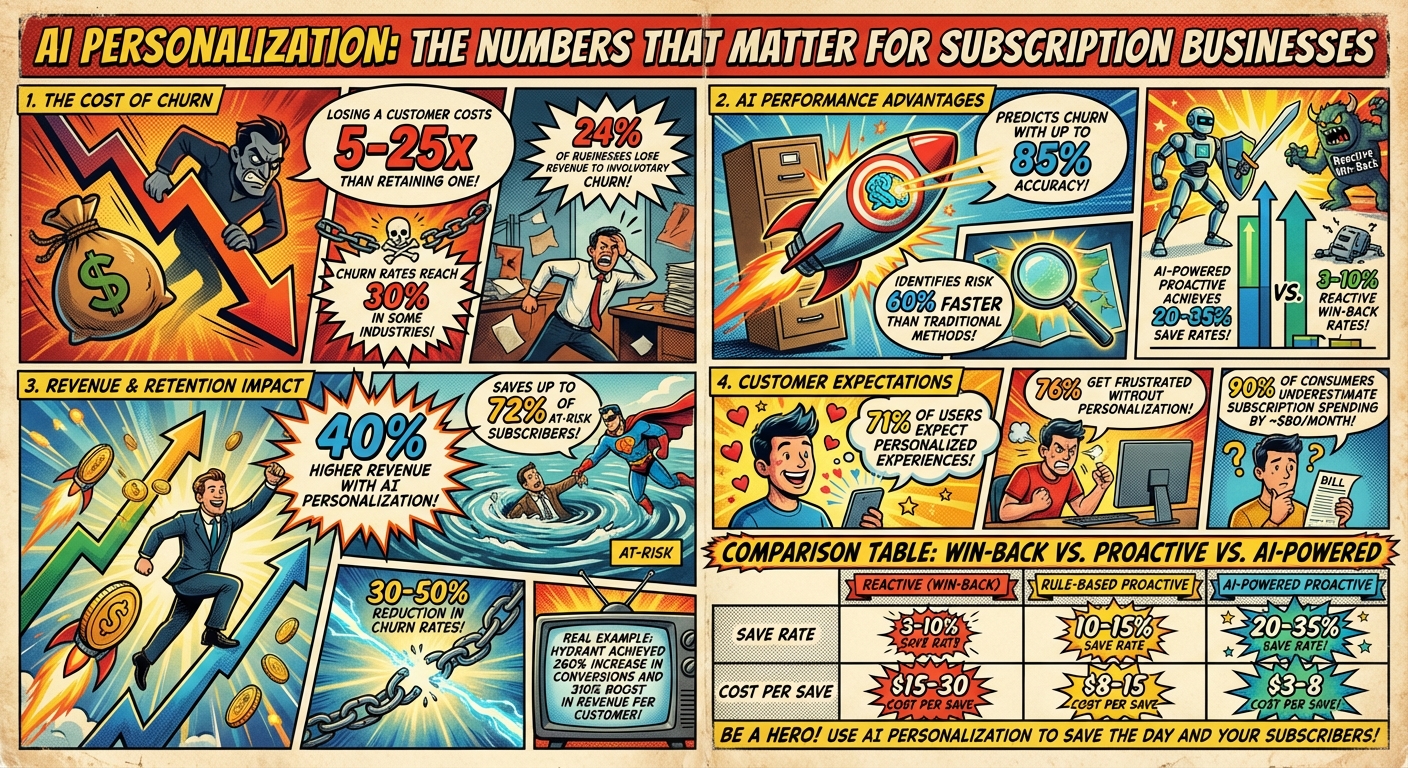
- Churn Costs: Losing a customer can cost 5–25x more than retaining one, and churn rates are as high as 30% in some industries.
- AI Benefits: AI predicts churn with up to 85% accuracy and identifies risk 60% faster than traditional methods.
- Revenue Gains: Companies using AI personalization see 40% higher revenue and save up to 72% of at-risk subscribers.
- Customer Expectations: 71% of users want personalized experiences, and 76% get frustrated without them.
AI-powered tools don’t just stop churn – they increase lifetime value by giving every subscriber exactly what they need, when they need it. Let’s break down how to use this for your business.
AI Personalization Impact on Subscription Business Retention and Revenue
Common Retention Problems in Subscription Businesses
Before diving into how AI can help, it’s crucial to understand the main challenges subscription businesses face when it comes to keeping customers.
How Churn Rates Impact Revenue
Churn doesn’t just shrink your subscriber base – it hits your bottom line hard. Replacing a lost customer can cost anywhere from 5 to 25 times more than keeping an existing one.
The numbers paint a clear picture: media and entertainment subscriptions typically face annual churn rates between 20% and 30%, while fitness and wellness services see churn closer to 10% to 15%. On top of that, 24% of businesses lose revenue to involuntary churn caused by issues like expired cards or failed payments.
Ready to leave the job you hate and find the fastest path to online wealth? Learn the best asset you have right now to leverage income and build financial run way in my bestseller "Fire Your Boss." Click here to download the book for free.
But the damage doesn’t stop there. High churn means fewer opportunities to upsell, and it often leads to negative word-of-mouth, which drives up the cost of acquiring new customers. Many businesses try to combat churn with blanket discounts, but this approach can backfire. Offering deals to customers who might have renewed at full price eats into profit margins instead of solving the root problem.
Rising Customer Expectations and Market Competition
The subscription market is more crowded than ever, and consumers are becoming pickier. By 2026, 77% of consumers are expected to keep their total number of subscriptions steady. This means businesses aren’t just competing for new customers – they’re also fighting for a bigger slice of their existing customers’ budgets.
Adding to the challenge is subscription fatigue. Nearly 90% of consumers underestimate their monthly subscription spending by around $80, which often leads them to review and cut services that don’t provide clear, personalized value. If your offering doesn’t stand out or feel indispensable, it risks being the first on the chopping block.
How AI Personalization Solves Retention Problems
AI personalization tackles retention issues by spotting potential problems early – long before they turn into cancellations. Instead of reacting after the damage is done, AI steps in while there’s still time to repair the relationship.
AI-Powered Preference Learning and Prediction
Most subscription businesses rely on broad customer segments, grouping people by demographics or purchase history. AI takes a more precise approach, creating a unique behavioral profile for every subscriber. It tracks patterns like login frequency, session length, feature usage, and even the tone of support tickets to build a detailed picture of each customer’s habits.
This matters because customer behavior isn’t one-size-fits-all. For instance, one subscriber might naturally shop every 30 days, while another prefers a 120-day cycle. AI learns these rhythms and flags any deviations that might signal a problem – something static rules would overlook. By combining behavioral, transactional, and engagement data, AI generates a real-time health score (usually on a 0–100 scale) to provide an up-to-the-minute view of the customer relationship.
Churn prediction models powered by AI can identify customers likely to leave within 30 days with 75–85% accuracy. This level of precision allows businesses to act quickly and effectively to keep those customers engaged.
Personalized Recommendations and Dynamic Content
Armed with detailed insights, AI tailors every interaction to meet the rising expectations of today’s subscribers. It goes beyond basic "customers who bought X also bought Y" suggestions. Instead, AI delivers custom offers and content based on real-time behaviors, such as how long a customer lingers on a page or which products they interact with most.
A great example comes from the Financial Times, which partnered with Vector Labs in October 2024 to tackle churn among trial subscribers. By offering personalized product recommendations and payment options to at-risk users, they boosted trial save rates by 113% and trial conversions by 165%.
Hydrant, a hydration brand, saw even bigger gains. Using AI to predict which subscribers were at risk and crafting re-engagement campaigns tailored to them, Hydrant achieved a 260% increase in conversion rates and a 310% jump in revenue per customer. These results highlight the power of treating each subscriber as an individual rather than as part of a generic group.
The trend is clear across industries. Companies leveraging advanced AI personalization see 40% higher revenue compared to those sticking with generic strategies. With 71% of consumers expecting personalized experiences – and 76% feeling frustrated when they don’t get them – this approach has become a necessity.
Preventing Churn with Predictive AI
One of AI’s strongest advantages in retention is its ability to spot subtle signs of disengagement – what’s often called "digital body language." These signs include declining email open rates, shorter session times, or reduced interaction with features.
AI doesn’t just highlight who’s at risk; it explains why and suggests the best course of action for each individual. Automated responses, such as tailored offers, subscription pauses, or targeted content, can be triggered to address the issue while the customer is still active. This proactive approach is far more effective than waiting to win back customers after they’ve already left.
| Approach | Timing | Typical Save Rate | Cost per Save |
|---|---|---|---|
| Reactive (Win-back) | 30–90 days after lapse | 3–10% | $15–$30 |
| Rule-based Proactive | When static thresholds are breached | 10–15% | $8–$15 |
| AI-powered Proactive | At early risk signals | 20–35% | $3–$8 |
The numbers speak for themselves. AI-powered proactive strategies can cut churn rates by 30–50% compared to traditional methods. These systems even calculate the ROI of retention offers before they’re made, ensuring that the cost of keeping a customer is justified by their future value. This avoids the common pitfall of offering unnecessary discounts, which can hurt profits without solving the real problem.
"AI allows us to respond dynamically to customer behaviour. It can adapt as patterns shift, which is a crucial capability in a fast-changing media landscape."
– Andrew Gale, FT
Next, we’ll explore how to put these AI-driven strategies into action for your subscription business.
How to Implement AI Personalization in Your Subscription Business
Turning AI personalization from concept into action involves three key steps: organizing your customer data, selecting the right tools, and continuously monitoring outcomes. Each step builds on the previous one, creating a system that evolves and gets better over time.
Collect and Organize Customer Data
Start by auditing the data you already have – from e-commerce platforms, CRMs, and help desk tools – and consolidate it into one reliable source. This "single source of truth" is essential for AI to make accurate predictions about customer behavior, such as identifying those at risk of canceling.
Focus on first-party data (customer actions) and zero-party data (preferences shared directly by customers). With third-party cookies on the decline and 76% of customers avoiding brands they don’t trust with their information, zero-party data is becoming increasingly important.
Track key engagement metrics that reveal shifts in customer activity. These behavioral signals tell you what customers are doing, not just who they are.
Before feeding this data into AI tools, remove sensitive personal information or use systems with zero-data-retention policies. Regular data audits ensure the information is clean and accurate, which is critical for reliable AI predictions. As Mailchimp puts it:
"A smaller, well-labeled data set will often outperform a massive but messy one".
Choose and Use AI Personalization Tools
The tools you select should align with your existing tech stack and resources. For example, Shopify users can leverage native apps like Rebuy or Stay AI for seamless integration. For more advanced needs, Customer Data Platforms (CDPs) like Simon AI can help create detailed customer profiles for targeted segmentation.
When implementing AI, think about the "4 D’s":
- Data: Use both first-party and contextual inputs.
- Decisioning: Apply machine learning to determine the next best action.
- Delivery: Ensure consistent messaging across email, mobile, and web.
- Dynamics: Adjust strategies as customer behavior shifts.
Feed AI insights into central data warehouses like Snowflake via APIs to get a complete view of customer activity. Alternatively, services like AWS Marketplace or Amazon Bedrock can help you manage AI models. The goal is to integrate these tools into your current systems without overhauling everything.
Automate tasks where it makes the most impact. For instance, use AI to create personalized onboarding tutorials during the first month – a critical period for reducing churn. Sentiment analysis on support tickets and social media mentions can flag frustration before it leads to cancellations. Dynamic offers based on real-time customer behavior can replace outdated batch campaigns.
Start small by segmenting customers into groups like "At-Risk" or "New Subscribers" to test the ROI of personalization efforts. Once you see results, scale up to individual-level customization.
After deploying these tools and strategies, ongoing tracking ensures that your personalization efforts deliver measurable results.
Track Results and Improve Performance
AI personalization isn’t a one-and-done deal – it requires constant refinement as customer behavior evolves.
Keep an eye on predictive accuracy as a key metric. Measure how often your AI correctly identifies customer risks or intentions by tracking indicators like save rates (the percentage of at-risk customers retained), lifetime value (LTV) growth, and churn scores (risk ratings for individual users). Better predictions mean more effective interventions.
For example, in October 2024, the Financial Times partnered with Vector Labs for an eight-week trial to improve retention. They tested AI-driven offers against traditional business rules. The AI group achieved a 113% boost in save rates, a 51% increase in LTV per person, and a 165% jump in trial conversion rates.
"Start small, test rigorously, and always keep the customer at the center."
– Andrew Gale, FT Strategies
Create feedback loops so every customer interaction – whether it’s saving an account or processing a cancellation – feeds back into your AI model for better future predictions. Update your models regularly to account for seasonal trends and changing preferences. Tools like Natural Language Processing (NLP) can help analyze customer feedback and support interactions, spotting dissatisfaction before it escalates.
Don’t forget to audit your AI models for bias. Since algorithms can reflect biases in historical data, regular reviews ensure your recommendations remain fair and balanced. Using a CDP can automate data pulls and segmentation, speeding up iterations without relying heavily on your tech team.
This continuous cycle of improvement strengthens your retention strategy by sharpening AI precision over time. Companies that use AI personalization effectively can generate up to 40% more revenue by building systems that adapt and evolve with every customer interaction. Following this process sets you on the same trajectory.
Conclusion
AI personalization has reshaped subscription models by shifting the focus from damage control to proactive customer engagement. Instead of reacting to cancellations, AI detects churn signals up to 60% earlier than traditional methods, giving businesses the opportunity to step in with tailored solutions. This predictive strategy doesn’t just help retain customers – it also boosts their lifetime value by delivering experiences that adapt to their evolving preferences.
The numbers speak for themselves: brands using AI-driven personalization see 40% higher revenue compared to those sticking with generic, one-size-fits-all approaches. With 71% of consumers expecting personalized interactions and 76% expressing frustration when those expectations aren’t met, personalization powered by AI has become a game-changer. Companies like Hydrant have proven this, achieving a 260% increase in conversion rates and a 310% boost in revenue per customer through predictive modeling and customized re-engagement campaigns.
To tap into these benefits, start by gathering clean, reliable data, integrate AI tools that work seamlessly with your systems, and refine your approach based on measurable results. Begin small – focus on one retention challenge, test it with control groups, and expand what works. As Sam Horton from Firework puts it:
"AI-powered personalization transforms every touchpoint into a retention magnet, yielding tangible results".
Ready to take the next step? Serve No Masters offers in-depth courses on AI tools and business automation to help you implement these strategies. Whether you’re launching a new subscription service or improving an existing one, using AI for personalization equips you to build systems that not only retain customers but also drive profitability. The brands that succeed won’t just attract customers – they’ll keep the right ones coming back for more.
FAQs
What data do I need for AI personalization?
To bring AI-powered personalization into subscription models, start by collecting data that sheds light on customer preferences and behaviors. This includes details like purchase history, browsing patterns, email interactions, product reviews, and payment trends. Real-time signals, such as skipped surveys or ignored videos, can also reveal signs of disengagement. With this information, AI can step in to predict when a customer might cancel, suggest customized offers, and craft strategies to keep them engaged and subscribed.
How do I prevent involuntary churn with AI?
To tackle involuntary churn, AI can be your secret weapon. By analyzing customer behavior, it identifies early warning signs of potential cancellations – think fewer logins, shorter session times, missed payments, or a drop in engagement. Once these at-risk customers are flagged, AI steps in to trigger automated retention strategies. These might include personalized offers or targeted outreach designed to re-engage users and address their concerns. This proactive method taps into AI’s strength of handling massive data sets with precision, helping you keep more customers on board.
How can I quickly prove AI personalization ROI?
To show ROI fast, aim for results you can measure within 30–60 days. Keep an eye on metrics like better conversion rates, stronger retention, and higher engagement. AI-driven tactics – such as targeted upsells, win-back campaigns, and personalized messaging – can lead to 5–15% revenue growth and 10–30% improvements in marketing efficiency when applied at scale. Showcasing these quick wins helps prove the impact of AI personalization right out of the gate.
Related Blog Posts
- AI Chatbots for E-Commerce: ROI and Benefits
- How to Validate Business Ideas Before Quitting Your Job
- 5 Mindset Shifts for AI Career Success After 40
- How to Build an AI Decision Framework
Ready to leave the job you hate and find the fastest path to online wealth? Learn the best asset you have right now to leverage income and build financial run way in my bestseller "Fire Your Boss." Click here to download the book for free.