How to Become a Certified Fractional AI Officer
Becoming a Fractional AI Officer is your path to earning $8,000–$12,000 per month while working part-time with multiple clients. This role combines AI expertise with business leadership to help companies implement AI solutions that align with their goals. Certification elevates your credibility and ensures you can deliver results in a market where 95% of AI pilots fail due to poor adoption strategies.
Key Steps:
- Build Your Skills: Understand AI tools like machine learning, NLP, and data governance. Pair this with leadership experience in managing change and aligning technology with business goals.
- Get Certified: Enroll in programs like Serve No Master’s Fractional Officer Method, which offers training in AI strategy, compliance, and leadership.
- Create a Portfolio: Showcase measurable results such as reducing costs or improving deployment timelines.
- Pass the Exam: Demonstrate your ability to lead AI initiatives, manage risks, and deliver ROI.
Companies are seeking certified Fractional AI Officers to navigate the upcoming EU AI Act deadline in August 2026. This is your chance to step into a flexible, high-paying role that leverages your expertise in AI and business strategy.
What You Need Before Starting
Before diving into certification, it’s crucial to have expertise in three key areas. This isn’t a beginner-level role – most candidates bring over 10 years of digital leadership experience to the table. While you don’t need to be a data scientist or software engineer, you must excel at connecting technology with business strategy. These core skills lay the groundwork for the broad knowledge certification demands.
AI and Technical Tool Knowledge
A solid understanding of key AI concepts is non-negotiable. This includes machine learning algorithms, deep learning, natural language processing (NLP), and tools like Large Language Models. You don’t need to code neural networks from scratch, but you should understand how these technologies work and when to use them.
Familiarity with platforms such as TensorFlow, PyTorch, IBM Watson, and cloud services can give you an edge. Equally important is data literacy – the ability to collaborate effectively with data science teams and navigate analytics or big data systems.
Business and Leadership Experience
Technical know-how only gets you halfway there. As Jonathan Lasley, Fractional AI Director, points out:
Ready to leave the job you hate and find the fastest path to online wealth? Learn the best asset you have right now to leverage income and build financial run way in my bestseller "Fire Your Boss." Click here to download the book for free.
"AI adoption is a people problem, not a technology problem. Companies that skip change management end up with tools nobody uses." – Jonathan Lasley
You’ll need experience in strategic planning, financial management, and project leadership to align AI efforts with business objectives. Change management is especially critical – AI adoption is about 20% technology and 80% organizational culture. This role requires steering cross-departmental transformation, impacting areas like sales, marketing, operations, legal, and HR – not just managing tech stacks.
Other key responsibilities include ensuring compliance with regulations like GDPR and the EU AI Act, as well as managing both internal teams and external vendors. Successful fractional officers often structure their work to deliver measurable results within the first 30 days.
Helpful Degrees and Certifications
Building on your technical and leadership skills, formal qualifications can further demonstrate your readiness for certification. Advanced business degrees like an MBA can provide a strong strategic foundation. Ahmed Noureldeen, PhD, MBA, and AI & Industry Lead at Esri SA, highlights how combining an MBA with AI certifications sharpens strategic thinking and drives innovation.
Role-specific certifications are also worth exploring. Foundational programs like AI+ Ethics™ (focused on governance and risk management), AI+ Project Manager™ (for implementation skills), or AI+ Product Manager™ (aligning AI tools with business goals) are excellent starting points. These certifications cost about $156, offering self-paced learning and an exam. Stacking these credentials before tackling a Chief AI Officer certification can strengthen your knowledge base and boost your chances of success.
How to Get Certified: Step-by-Step Process
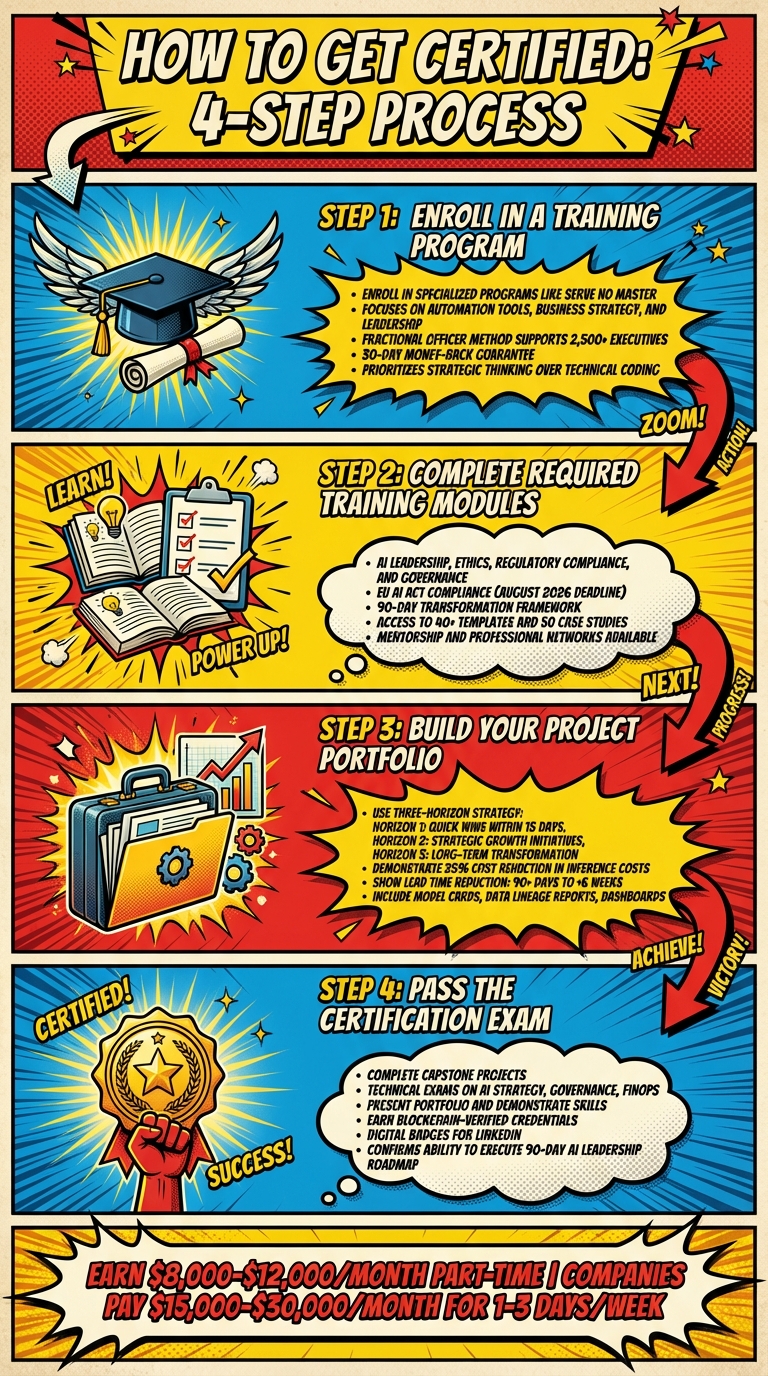
4-Step Process to Become a Certified Fractional AI Officer
Once you’ve established a strong foundation, it’s time to follow a structured, multi-month path from enrollment to certification. These steps are designed to align your skills with the certification’s practical demands.
Step 1: Enroll in a Training Program
Start by enrolling in a specialized program tailored to professionals with AI and leadership experience. One such program is Serve No Master, which offers certification specifically for executives integrating AI into their roles. This program features coursework on automation tools, business strategy, and leadership techniques. The Fractional Officer Method has already supported a community of over 2,500 Fractional Executives and includes a 30-day money-back guarantee. Consultant Jeri Solomon shared her experience:
"The Fractional Officer Method course was very helpful as a transition from a small business owner… to a consultant and fractional officer… It gave me so much practical information in the form of downloadable resources".
The curriculum prioritizes strategic thinking over technical coding, allowing you to use your business expertise to its fullest potential.
Step 2: Complete Required Training Modules
Once enrolled, dive into the training modules, which cover topics like AI leadership, ethics, regulatory compliance, and governance. For example, the program addresses compliance with laws such as the EU AI Act, which takes effect in August 2026. You’ll follow a 90-day transformation framework aimed at delivering measurable business outcomes. The program also includes access to over 40 templates and 50 case studies to help you tackle real-world challenges efficiently.
To navigate complex regulations and operational hurdles, you’ll have the chance to collaborate with mentors or professional networks like the International Chief AI Officers Association. The phased structure ensures you meet all compliance and operational goals systematically.
Step 3: Build Your Project Portfolio
Your portfolio is a critical component, showcasing tangible results. Use the Three-Horizon Strategy to structure your projects:
- Horizon 1 focuses on quick wins within 15 days.
- Horizon 2 targets strategic growth initiatives.
- Horizon 3 aims for long-term, transformative opportunities.
Document your achievements in areas like AI governance, model-risk policies, and compliance. Highlight your FinOps skills by demonstrating cost reductions – most successful portfolios show at least a 25% drop in inference costs per user within two quarters. Additionally, include operational improvements, such as cutting experiment-to-production lead times from over 90 days to less than six weeks. As Umbrex explains:
"A fractional CAIO is not a senior data scientist on an hourly retainer; they are the executive custodian of AI value, risk, and capital efficiency".
Your portfolio should also include technical documentation like model cards, data lineage reports, and automated dashboards to emphasize your leadership and technical expertise.
Step 4: Pass the Certification Exam
The final step involves completing capstone projects and passing technical exams that test your ability to lead AI initiatives effectively. These exams cover AI strategy, governance, FinOps, and operational practices. You’ll also undergo performance assessments where you present your portfolio and demonstrate your skills in areas like chairing AI governance boards, signing off on model-risk policies, and managing key performance indicators such as compliance readiness and experiment-to-production timelines.
Upon passing, you’ll earn blockchain-verified credentials and digital badges for platforms like LinkedIn, positioning you as a certified AI leader. This certification confirms your ability to execute a 90-day AI leadership roadmap and establishes your expertise in the field.
Required Skills and Knowledge Areas
To earn your certification and lead successful AI initiatives, you’ll need to develop a range of essential skills. These include advanced technical expertise, strong leadership abilities, and a firm grasp of compliance protocols. Together, these skills enable you to deliver AI solutions that produce measurable business results.
Technical AI Skills
To excel, you need to master key AI technologies like machine learning (ML), natural language processing (NLP), retrieval-augmented generation (RAG), and generative AI (GenAI). David Mathison, CEO of Chief AI Officer Summit, highlights the importance of this technical breadth:
"A CAIO should have a strong technical background and a deep understanding of various AI technologies, including machine learning, natural language processing, retrieval-automated generation (RAG), and robotics".
Your expertise should also extend to data science, statistical analysis, and predictive modeling – essential tools for transforming raw data into actionable insights. Skills in Deep Learning, Computer Vision, and MLOps are equally critical for refining and managing production models. Additionally, you’ll need the ability to evaluate AI tools and vendors, ensuring the solutions you recommend align with specific business needs. With AI expected to contribute up to $15.7 trillion to the global economy by 2030, these technical capabilities position you to seize emerging opportunities.
However, technical expertise alone isn’t enough. The ability to communicate AI’s business value effectively is just as crucial.
Leadership and Communication Abilities
Strong leadership is key to aligning AI initiatives with business goals and managing the changes they bring. As Faye Digital explains:
"AI is here to augment people, not eliminate roles. By framing AI adoption as an investment in the team and involving employees, the fractional CAIO reduces resistance".
Your communication skills will help bridge gaps between departments, transforming scattered AI projects into unified, strategic initiatives. Implementing structured 90-day cycles can demonstrate quick wins and establish your credibility early on. Orla Daly, CIO at SkillSoft, underscores the importance of collaboration:
"It’s not just about the role of the CAIO, but how they can leverage broader skills and knowledge within an organization".
In addition to leadership and communication, you’ll need a firm grasp of ethics and compliance to ensure your strategies are both effective and responsible.
Ethics and Compliance Understanding
Governance expertise is essential for protecting organizations from regulatory risks and reputational harm. This includes preventing unauthorized AI use and addressing algorithmic bias while maintaining full compliance with regulations. You’ll need to establish AI use inventories, conduct regular impact assessments, and implement Human-in-the-Loop (HITL) systems for autonomous technologies. Frameworks like the NIST AI Risk Management Framework (Map, Measure, Manage, and Govern) for U.S. operations and ISO/IEC 42001 for global standards provide valuable guidance.
With 63% of leaders admitting their organizations lack AI-ready data foundations, your governance skills will address a critical need. Brit Certifications and Assessments emphasizes the CAIO’s role in safeguarding organizations:
"The CAIO is a ‘business-first’ technologist focused on… ensuring the organization does not face regulatory or reputational ruin due to ‘Shadow AI’ or algorithmic bias".
Conclusion
Becoming a certified Fractional AI Officer opens the door to earning high retainers while working fewer hours. With companies willing to pay $15,000 to $30,000 per month for just 1–3 days of work per week, you can manage 2–3 clients at a time and create a lucrative, flexible career path.
The timing couldn’t be better. The upcoming August 2026 EU AI Act deadline is creating a surge in demand for certified professionals who can help businesses avoid steep non-compliance penalties. Companies are actively searching for leaders who can navigate compliance, maximize ROI, and ensure ethical AI practices.
What sets successful fractional officers apart is their ability to position themselves as strategic leaders rather than just service providers. As solopreneur coach Ken Yarmosh points out:
"Most aspiring fractional CMOs fail because they sell availability instead of executive authority".
Certification transforms your role from a technical implementer to a strategic decision-maker, shifting the focus to delivering outcomes rather than clocking hours. This elevated positioning makes you an indispensable partner to organizations.
The "Parallel Exit Plan" provides a smart way to transition into this role without financial risk. By securing your first 1–2 clients while still employed, you can build a diversified income stream and reduce reliance on a single employer.
To succeed, a strong foundation in training is key. Serve No Master offers resources to help you master AI-driven entrepreneurship and automation, giving you the tools to establish a location-independent consulting practice. Explore their training at https://servenomaster.com to learn how to automate lead generation, position yourself as a strategic C-suite peer, and thrive in this rapidly evolving field.
FAQs
How long does certification take?
The path to becoming a Fractional AI Officer usually takes around 30 days. Most programs, including flexible online courses, are structured to walk you through the training in a clear, step-by-step manner within this period. That said, the actual time can differ based on the course or program you select.
What kind of portfolio projects count?
To become a Certified Fractional AI Officer, your portfolio projects should highlight your expertise in steering AI strategy, governance, and execution in practical settings. Examples of impactful projects could include designing AI governance frameworks, crafting enterprise-level AI strategies, implementing AI risk management policies, or leading initiatives aimed at delivering ROI through AI. The key is to demonstrate how you’ve aligned AI efforts with business objectives and achieved measurable results through solid project management.
How do I get my first clients?
To land your first clients as a fractional AI officer, start by zeroing in on lead generation and positioning. Networking is your best friend here – tap into your existing connections and expand them through LinkedIn. Use targeted outreach campaigns to put yourself on the radar of mid-market companies.
Show you’re the real deal by sharing content that highlights your expertise. This could be through blog posts, LinkedIn articles, or even short videos. Join community groups, speak at webinars, and engage in content marketing to build trust and credibility. The goal is to align your services with what these businesses actually need, proving you’re the right person to help them navigate AI solutions.
Related Blog Posts
- How to Quit Your Job and Work for Yourself in 2026
- Ultimate Guide to Fractional Chief AI Officer Certification
- 5 Mindset Shifts for AI Career Success After 40
- How to Build an AI Decision Framework
Ready to leave the job you hate and find the fastest path to online wealth? Learn the best asset you have right now to leverage income and build financial run way in my bestseller "Fire Your Boss." Click here to download the book for free.