
Top 7 AI Tools for Blog Performance Tracking
AI tools have transformed how bloggers track performance, shifting from manual data analysis to automated insights. These tools identify traffic trends, engagement patterns, and SEO opportunities without the need for coding or spreadsheets. Whether you’re optimizing for search engines, tracking AI-generated mentions, or connecting content to revenue, there’s a tool for every need.
Key Highlights:
- Google Analytics 4 (GA4): Free, with AI-driven insights like anomaly detection and predictive metrics.
- Semrush: Tracks SEO rankings and AI-driven traffic, with tools to optimize for AI-generated citations.
- Surfer SEO: Combines SEO and AI visibility scores to improve content’s performance and AI mentions.
- Nightwatch: Merges traditional rank tracking with AI citation analysis for a complete performance view.
- AI Results Tracker: Monitors your blog’s presence in AI-generated answers like ChatGPT and Google AI Overviews.
- Profound: Focuses on AI brand monitoring with tools to track citations, sentiment, and prompt volumes.
- Serve No Master Analytics Framework: Links blog metrics directly to profitability, focusing on revenue per post.
Quick Comparison:
| Tool | Focus | Best For | Pricing (Starting) |
|---|---|---|---|
| GA4 | Traffic insights | Bloggers needing free data insights | Free |
| Semrush | SEO & AI visibility | SEO teams managing large-scale efforts | $99/month |
| Surfer SEO | Content optimization | Writers fine-tuning blog posts | $99/month |
| Nightwatch | Rank & AI citation tracking | Agencies tracking SEO and AI mentions | $32/month |
| AI Results Tracker | AI search visibility | Brands monitoring AI-generated answers | $74/month |
| Profound | AI brand monitoring | Enterprises safeguarding AI visibility | $99/month |
| Serve No Master | Profit-driven blog tracking | Entrepreneurs linking content to profit | Custom |
AI tools save time, uncover hidden insights, and help you focus on strategies that drive results. Whether you’re a solo blogger or managing a team, these tools simplify analytics and boost your blog’s effectiveness.
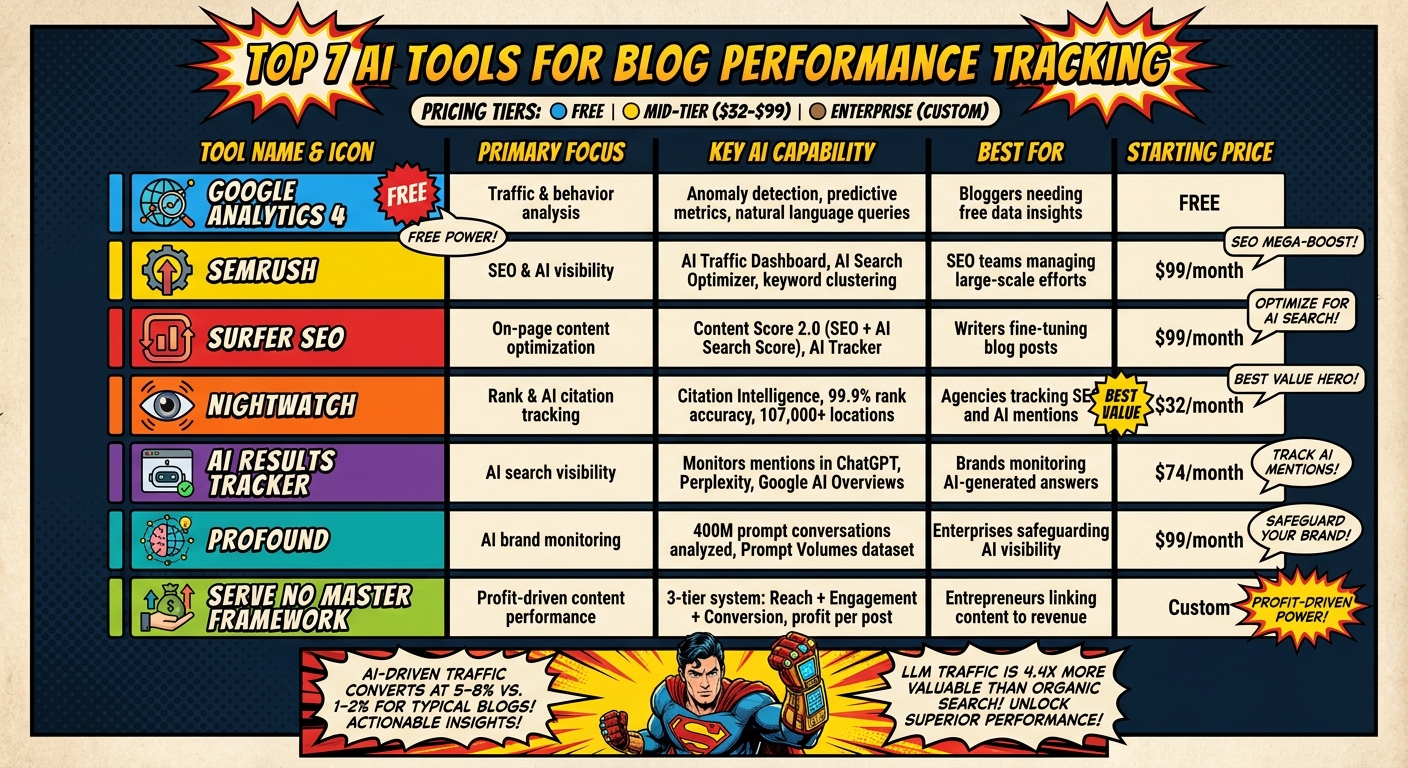
Top 7 AI Tools for Blog Performance Tracking: Feature & Pricing Comparison
How AI Changes Blog Performance Tracking
Traditional analytics tools focus on showing you what happened, but AI-powered tools take it a step further. They explain why it happened and even suggest what to do next. Instead of drowning in dashboards, you get automated alerts, easy-to-understand insights, and action plans delivered straight to you.
One major game-changer is how AI handles trend detection and anomaly alerts. Imagine this: an AI tool flags a 2.4× spike in direct traffic and identifies an 87% chance that it’s bot activity – something standard dashboards wouldn’t catch. This kind of precision doesn’t just save time; it ensures your data stays accurate.
AI also uncovers metrics that traditional tools often miss. Take ChatGPT referrals, for instance. By 2025, these grew by 52% year-over-year, yet most analytics platforms mislabel this traffic as "Direct" or "Unknown". Modern AI tools now track traffic from specific large language models (LLMs) like ChatGPT, Claude, Perplexity, and Gemini, giving you a clearer view of where your audience is coming from. Why does this matter? AI-driven traffic typically converts at 5–8%, far outperforming the typical blog conversion rate of 1–2%.
But it doesn’t stop at traffic. AI also enhances engagement metrics and content performance insights. These tools can monitor scroll depth in 10% increments, identify where readers lose interest, and highlight underperforming pages that need attention. Priya K., CTO of a SaaS platform, shared her experience with one such tool:
Ready to leave the job you hate and find the fastest path to online wealth? Learn the best asset you have right now to leverage income and build financial run way in my bestseller "Fire Your Boss." Click here to download the book for free.
"Content Health flagged 38 pages worth pruning or consolidating… Organic clicks are up 31% in two months." – Priya K., CTO, SaaS Platform
These capabilities set the stage for deeper dives into the tools that make this possible.
1. Google Analytics With AI Insights
Google Analytics 4 (GA4) is still one of the best free tools to track how your blog is performing, and its AI features make it even more powerful. These AI tools are split into two main types: Automated Insights, which spot unusual trends on their own, and Generated Insights, which explain those trends in plain English right on your Home page or within reports.
One standout feature is GA4’s Contribution Analysis, which doesn’t just flag anomalies – like a 47% spike in organic pageviews – but also pinpoints the specific cause, whether it’s a traffic source, region, or finding the perfect topic to write about. This makes troubleshooting much faster. A senior SEM expert at DevaGroup summed it up well:
"The tool clearly shows which segments and metrics have been checked, making it easy to quickly identify where traffic or conversions have dropped… This is a huge time saver."
Another useful tool is GA4’s AI Assistant channel, which tracks traffic from large language models (LLMs) like ChatGPT, Claude, and Perplexity. Since around 70% of this traffic often gets mislabeled as "Direct", creating a custom "AI Search" channel is key. You can do this by heading to Admin > Data Display > Channel Groups and setting up a regex filter. This is especially important as AI-driven referrals are growing by 40–60% year-over-year.
For quick answers, GA4’s Analytics Advisor (marked by the lightbulb icon) allows you to ask plain-language questions like, "Why did my active users drop last Tuesday?" It then breaks down the reasons for you. Rob Tindula, Director of SEO at NP Digital, puts it simply: "Google’s automating the diagnostics. You still handle the strategy."
Most of GA4’s AI tools, like Automated Insights and Predictive Metrics, are free to use. However, to activate predictive metrics, you’ll need at least 1,000 positive and 1,000 negative examples over a 28-day period. For those looking for even deeper analysis, third-party tools like AnalyticsAssistant.ai offer advanced AI features starting at $19.99/month. With all these capabilities, GA4 is an essential starting point before diving into more specialized AI analytics tools.
2. Semrush
Semrush takes performance tracking to the next level, building on tools like GA4 with advanced AI-driven metrics.
It doesn’t just stop at keyword tracking anymore. Now, Semrush monitors SEO rankings, referral traffic, and even how frequently generative AI assistants like ChatGPT, Gemini, and Perplexity cite your content. These days, being visible in AI-generated responses is becoming just as important as ranking on page one of Google.
Their AI Traffic Dashboard uses clickstream data to estimate referral traffic from over 20 generative AI assistants. According to Semrush’s research, traffic from large language models (LLMs) is about 4.4 times more valuable than traditional organic traffic. Why? Because users coming from LLMs have typically done their research and are ready to take action.
"Traffic from LLMs is worth 4.4 times more than organic search visitors. That’s because once someone from an LLM lands on your site, they’ve done their research and are ready to take the next step." – Carlos Silva, Editorial Lead, Semrush
The AI Search Optimizer helps fine-tune your content to increase citation rates. It highlights the importance of clear summaries, scannable takeaways, and well-structured Q&A formats. These techniques have been linked to improvements of 32.83% and 25.45% in citation rates, respectively. For example, creating posts with direct H2 or H3 questions and concise 40–60 word answers can make a big difference. A great case study is fintech company Chargeblast, which used Semrush’s AI Visibility Toolkit in early 2026. They identified niche prompts like "Are there chargeback solutions specifically for subscription-based businesses?" and created targeted blog content around them, successfully tapping into emerging AI-driven queries.
Semrush also ensures your site is AI-friendly. The Site Audit tool checks that AI crawlers like ChatGPT-User or Claude-SearchBot aren’t accidentally blocked by your robots.txt file. The free plan includes a 100-page AI-readiness audit, while the full AI Visibility Toolkit starts at $99/month. For those looking for an all-encompassing solution, the Semrush One plan begins at $199/month.
3. Surfer SEO

Surfer SEO has taken content optimization to a new level, focusing not just on search engine performance but also on how often your content is cited by AI models like ChatGPT, Gemini, and Perplexity. It’s not just about ranking anymore – it’s about visibility in the AI landscape.
The platform’s Content Score 2.0 blends two critical metrics: the SEO Score, which evaluates traditional ranking factors, and the AI Search Score, which measures how well your content aligns with facts and intent. A score over 66 suggests your content is highly competitive, while anything under 33 signals room for improvement. Surfer SEO processes over 500 web and AI signals to provide real-time optimization, and content fine-tuned with Surfer is 25% more likely to be cited by AI models.
The AI Tracker is another standout feature, running daily queries across various AI platforms to deliver a Visibility Score and Mention Rate. It also includes a Mention Gap Analysis, which compares your citations to those of competitors. This makes it an invaluable tool for professionals who want actionable insights without spending hours digging into data. Michał Leszczyński, Head of Content & SEO at GetResponse, sums it up perfectly:
"Before this, we had no way to measure how our brand showed up in AI tools. Now we can spot gaps, monitor growth, and adjust our strategy in real time."
Surfer SEO also offers a Content Audit tool that works with Google Search Console to pinpoint underperforming pages. For quick improvements, focus on pages with an SEO Score below 70 and rankings between 4 and 20. The Auto-Optimize feature further simplifies the process by automatically adding missing entities, keywords, and internal links.
Pricing starts at $99/month (billed annually) for the Standard plan, which includes 25 tracked AI prompts with weekly updates. The Pro plan costs $182/month and offers 50 tracked prompts with daily updates, while the Peace of Mind plan at $299/month provides API access and tracks 100 prompts.
Up next, we’ll dive into another tool designed to sharpen AI-driven blog performance metrics.
4. Nightwatch
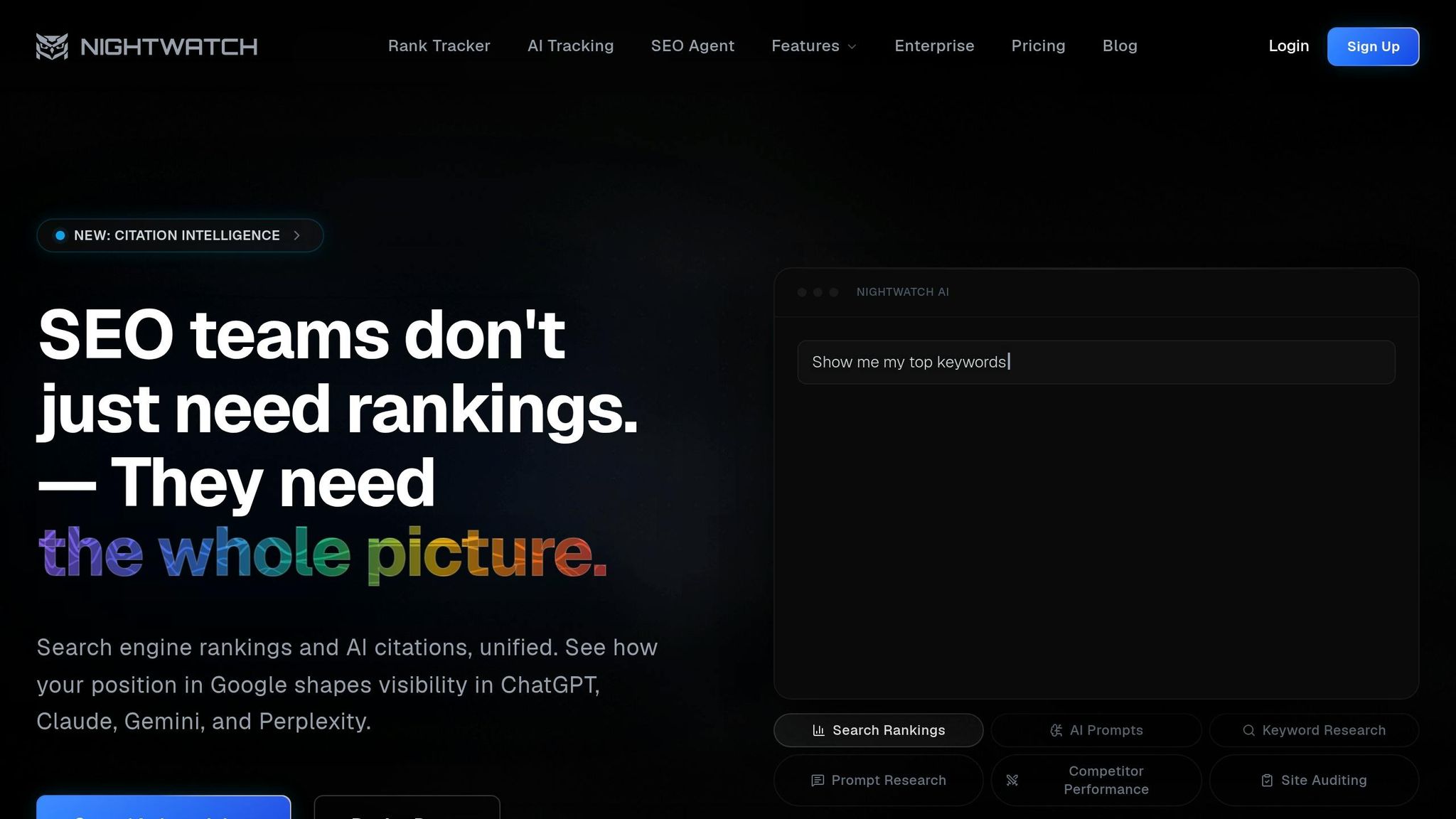
Nightwatch goes beyond just tracking Google rankings – it combines traditional search engine data with insights from AI platforms like ChatGPT, Claude, Gemini, and Perplexity. This integration provides a full picture of how your content performs across both standard search engines and emerging AI-driven tools. By leveraging earlier insights from tools like GA4 and Semrush, Nightwatch connects traditional rank tracking with real-time AI citation analysis.
One of its standout features is Citation Intelligence. This tool pinpoints the exact source URLs referenced by AI platforms, helping you identify which of your posts are being recommended. Coupled with the NightOwl SEO Agent, which highlights competitor gaps and content opportunities, Nightwatch ensures your SEO strategy stays sharp without constant manual adjustments.
The platform claims 99.9% rank tracking accuracy, thanks to its storage of raw HTML snapshots, which allow users to manually verify data when needed. It also tracks rankings in over 107,000 locations, drilling down to the ZIP code level – an invaluable feature for blogs targeting specific cities or regions.
One notable success story comes from the digital agency The215Guys. After integrating Nightwatch to unify Google ranking and AI citation tracking, the agency saw a 30% jump in keyword visibility and a 43% increase in search volume within just six months. Henrik Russell, the SEO Specialist who spearheaded the project, praised the tool:
"Nightwatch has an impressive set of features, super competitive pricing, great API, and the best rank tracking accuracy in the industry. The UI is very intuitive and the smart use of small diagrams, sparklines and graphs make it easy to follow the progress of your SEO work."
Pricing starts at $32/month (billed annually) for the Starter plan. The Professional plan, which includes AI tracking and Citation Intelligence, costs $79/month. For agencies, the $199/month plan offers unlimited user seats and white-label reporting. A 14-day free trial is available, and no credit card is required to get started.
Up next, we’ll dive into another tool that pushes AI-driven analytics even further for tracking blog performance.
5. AI Results Tracker
SE Ranking‘s AI Results Tracker combines traditional metrics with AI insights to change the way you monitor your blog’s presence in AI-driven answers. As part of the AI Search Toolkit, it keeps an eye on how your content appears in responses generated by platforms like ChatGPT, Gemini, Perplexity, Google AI Overviews, and Google AI Mode.
Here’s how it works: when someone asks an AI chatbot a question, the tool determines if your content is being cited by tracking both linked and unlinked mentions of your brand. It also logs your content’s average position, identifies the prompts that make your content visible, and stores cached AI responses to show how your brand is being presented.
One of its most useful features is the competitive gap analysis. This allows you to compare your AI visibility with competitors and identify prompts where their content is cited, but yours isn’t. SE Ranking sums it up perfectly:
"Crack Answer Engine Optimization (AEO) with real data and actionable insights." – SE Ranking
The tool goes further by categorizing the domains that AI cites most often – whether they’re media outlets, blogs, or forums – helping you fine-tune your content strategy. You can integrate this visibility data with platforms like Google Data Studio, AgencyAnalytics, or Whatagraph, or use automation tools like Zapier, Make.com, or n8n to streamline checks.
For those curious to try it out, SE Ranking offers a free AI visibility checker on its website, allowing up to 5 checks per day. Plus, you can explore the full AI Search Toolkit with a trial – no credit card required.
6. Profound
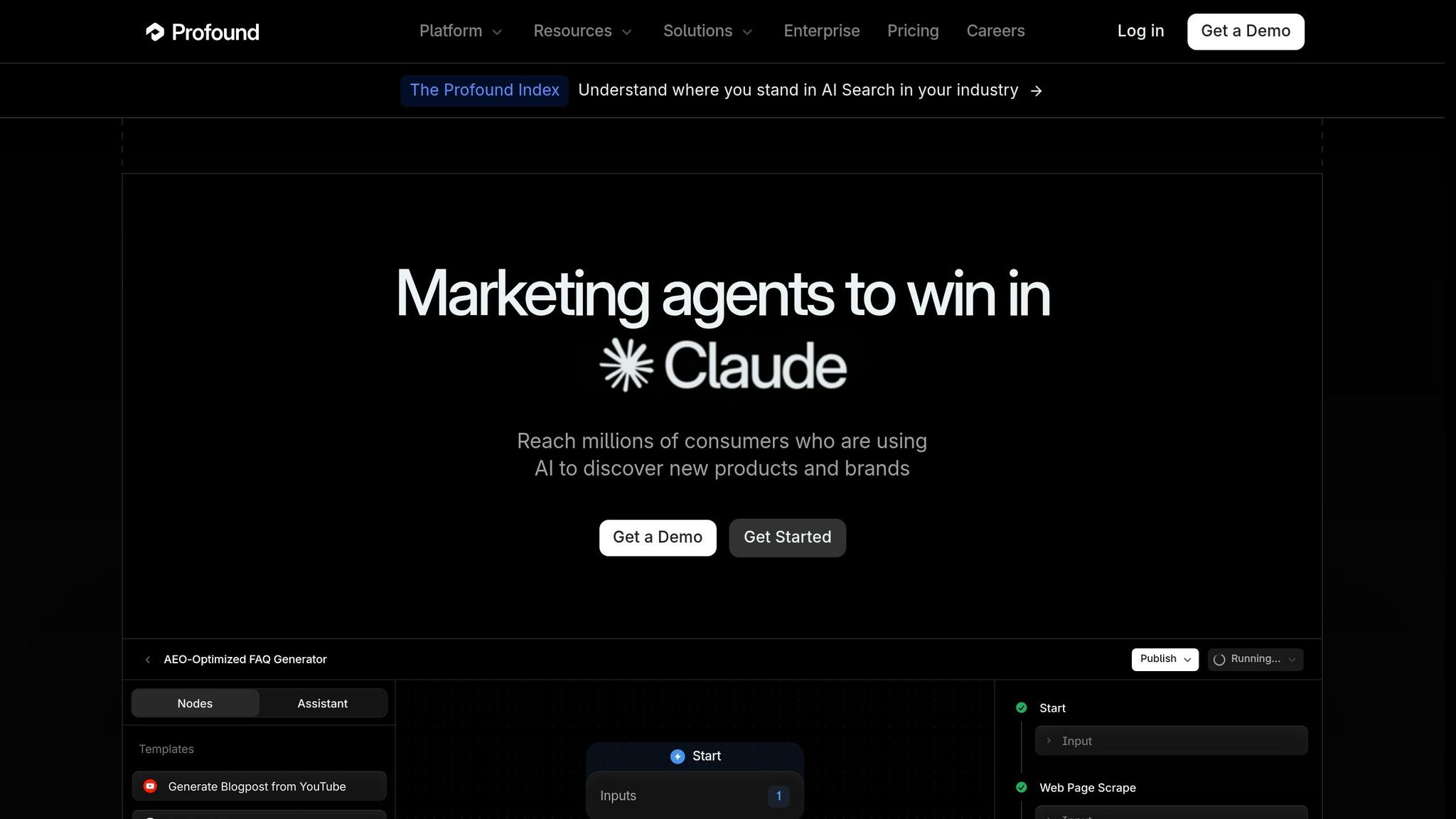
Profound focuses on Answer Engine Optimization (AEO), helping you track how your blog content performs in AI-generated responses across more than 10 major AI platforms. These include tools like ChatGPT, Perplexity, Gemini, and Google AI Overviews, with insights drawn from analyzing 400 million prompt conversations and 1.3 billion user interactions.
Key features include the Visibility Score and Share of Voice, which measure how often your content appears in AI-generated answers. Its Citation Analysis digs deeper, identifying the URLs referenced in AI responses and spotlighting influential third-party sources. A notable example? OpusClip used this data to boost its AI visibility by 800%, becoming the most-cited source in its niche.
Another standout feature is Agent Analytics, which tracks AI crawler activity – like GPTBot and ClaudeBot – via server logs. This tool helps you identify frequently visited pages and uncover issues like rendering problems or gaps in structured data that might limit your content’s visibility.
Profound also introduces Prompt Volumes, a proprietary dataset that estimates how often specific questions are asked within AI engines. Think of it as the AI equivalent of keyword search volume – perfect for prioritizing blog topics based on real demand. These insights make Profound a strong tool for anyone aiming to optimize their content for AI-driven platforms.
Natalie M., a Head of Growth, shared her experience:
"I love how it turns a very abstract concept of GEO/AEO into something I can plan, track, measure, and report on." – Natalie M., Head of Growth
Pricing starts at $99/month (billed annually) for the Starter plan, which includes ChatGPT monitoring for 50 tracked prompts. The Growth plan, at $399/month, expands coverage to multiple AI engines, supports 100 tracked prompts, and includes content optimization tools. Enterprise plans are custom-built, covering over 10 engines, offering full API access, and providing SOC 2 compliance. Profound has earned a 4.6/5 rating on G2 from 320+ reviews, though smaller teams might find the Starter plan’s scope limited and the platform’s learning curve challenging.
7. Serve No Master Analytics Framework
The Serve No Master Analytics Framework is built for entrepreneurs running automated, remote businesses. It works hand-in-hand with AI insights by connecting content performance metrics directly to profitability and audience growth.
This system breaks down performance into three key tiers: Reach (like sessions and impressions), Engagement (such as scroll depth and time spent on a page), and Conversion (leads and revenue attribution). By separating these metrics, it becomes much easier to identify where things are falling short. For example, if your reach is solid but conversions are lagging, the problem likely lies in the offer, not the traffic.
One standout feature of this framework is its focus on profit per post, rather than just chasing traffic numbers. By factoring in revenue streams like ads, affiliate income, and digital products – and subtracting direct costs – it pinpoints the 20% of content driving 80% of your profit. This approach aligns perfectly with the goal of building a loyal audience you actually own.
Speaking of audience ownership, the framework emphasizes email subscribers as a key metric. For remote businesses, growing your email list is more valuable than expanding social media reach. Why? Because email subscribers are yours to keep, unaffected by algorithm updates or platform shutdowns.
Another strength of this framework is its use of automated measurement. For instance, it can trigger alerts if a post underperforms in traffic or if a trending, high-converting topic creates an opportunity for new content. This automation ensures your content strategy stays on track without constant manual intervention.
Comparison Table
The seven tools each bring something different to the table. Here’s a quick breakdown of their focus, capabilities, and where they might fall short.
Ready to leave the job you hate and find the fastest path to online wealth? Learn the best asset you have right now to leverage income and build financial run way in my bestseller "Fire Your Boss." Click here to download the book for free.
| Tool | Primary Focus | Key AI Capabilities | Best Use Case | Data Types Tracked | Strength | Limitation |
|---|---|---|---|---|---|---|
| Google Analytics with AI Insights | Traffic & behavior analysis | Predictive metrics, anomaly detection, natural language queries | Bloggers looking for free, detailed traffic data | Sessions, bounce rate, conversions, audience demographics | Free and seamlessly tied to the Google ecosystem | AI-driven traffic often miscategorized as direct traffic |
| Semrush | SEO & competitive intelligence | AI-powered keyword clustering, content gap analysis, rank tracking | Content teams managing large-scale SEO efforts | Keyword rankings, backlinks, organic traffic, competitor data | Comprehensive SEO suite with broad data insights | Can feel overwhelming for solo users; higher pricing |
| Surfer SEO | On-page content optimization | Real-time content scoring, NLP-based keyword suggestions | Writers fine-tuning posts pre- and post-publication | Content score, keyword density, structure recommendations | Practical, in-editor guidance tied to ranking factors | Focuses only on on-page optimization; lacks traffic analytics |
| Nightwatch | Rank tracking & SERP monitoring | AI-driven rank fluctuation alerts, local SEO tracking | Agencies and bloggers tracking rankings across regions | Keyword positions, SERP features, visibility trends | Detailed rank tracking, especially for local SEO | Limited in content optimization and engagement metrics |
| AI Results Tracker | AI search visibility | Monitors brand mentions in ChatGPT, Perplexity, and Google AI Overviews | Brands tracking their presence in AI-generated answers | Brand mentions, share of voice, sentiment | Targets the shift from traditional search to AI-driven answers | Attribution to revenue is still evolving in this newer space |
| Profound | Enterprise AI brand monitoring | High-frequency prompt sampling (up to 100x per query), SOC 2 compliant | Enterprise teams safeguarding brand visibility in AI searches | AI citations, sentiment, ChatGPT Shopping visibility | Statistically robust; rated 4.5/5 on G2 | Starts at $499/month; no free trial available |
| Serve No Master Analytics Framework | Profit-driven content performance | Automated alerts, three-tier metric system (Reach, Engagement, Conversion) | Entrepreneurs running automated, remote content businesses | Profit per post, email subscribers, revenue attribution | Links content metrics directly to revenue | Requires setup and ongoing fine-tuning |
This table highlights each tool’s strengths and limitations to help you evaluate them at a glance.
Some trends stand out: Google Analytics and Semrush provide extensive data but may not fully capture AI-driven traffic – a growing challenge. Profound and AI Results Tracker address this gap with a focus on AI visibility, though they lean more toward tracking mentions than tying results to revenue. Surfer SEO and Nightwatch excel at execution for rankings, while the Serve No Master Analytics Framework shifts the focus to profitability over vanity metrics.
Pick the tool that aligns with your goals – whether it’s improving SEO, tracking AI visibility, or focusing on revenue-driven results.
Conclusion
Trying to track blog performance without AI is like navigating in the dark. The seven tools discussed – from Google Analytics with AI Insights to the Serve No Master Analytics Framework – each tackle a specific challenge, whether it’s improving search rankings, optimizing content, or linking posts directly to revenue.
The key takeaway? Shift your focus from vanity metrics to what truly impacts your bottom line. As the EarnifyHub editorial team wisely said:
"Total revenue is vanity; profit per post is sanity."
This perspective is what separates bloggers who merely stay busy from those who actually grow their businesses. Yet, a surprising 73% of bloggers fail to track profit per post, meaning many are chasing numbers that don’t translate into income.
While these tools offer powerful insights, remember that data alone won’t build your business – a well-organized workflow will. If you’re ready to take the leap and automate your processes, Serve No Master offers AI-powered training to streamline your entire content distribution, from social media to email newsletters.
FAQs
How do I track traffic from ChatGPT and other AI tools in GA4?
GA4 doesn’t automatically sort traffic from AI tools like ChatGPT, Claude, or Perplexity. This means visits from these platforms often get lumped into the wrong categories. To fix this, you can set up a custom channel group in GA4. Here’s how:
- Go to GA4 Admin and navigate to Data settings.
- Create a new channel group and name it AI Search.
- Use the following regular expression for the Session source field:
chatgpt.com|chat.openai.com|perplexity.ai|claude.ai|gemini.google.com|copilot.microsoft.com|grok.com - Make sure to place this channel group above Referral in the hierarchy so it gets prioritized.
This ensures AI-driven traffic is tracked properly, giving you a clearer picture of where your visitors are coming from.
What’s the difference between SEO tracking and AI citation tracking?
SEO tracking zeroes in on where your website stands in Google’s search rankings – a position determined by a fixed algorithm. On the other hand, AI citation tracking looks at how AI models like ChatGPT or Google AI include your content in their responses. While SEO deals with static rankings, AI citation tracking dives into whether an AI trusts your URL enough to cite it in real-time. Optimizing for these two requires entirely different approaches.
Which metrics matter most if I want profit per post, not just traffic?
To measure profit per post, you need to look beyond simple metrics like pageviews and focus on financial performance. Start by calculating profit per post: subtract all associated costs – like content creation, hosting fees, and promotional expenses – from the total revenue generated through ads, affiliate sales, or digital products.
Keep an eye on Revenue Per Visitor (RPV) to evaluate the quality of your traffic and how well it converts into meaningful actions, like purchases or sign-ups. It’s also important to track assisted conversions and content-attributed revenue. These metrics help you understand how individual posts contribute to your overall business goals.
Related Blog Posts
- AI Tools for Personal Branding and Networking
- AI Blog Editing: Key Benefits for Professionals 40+
- Ultimate Guide to AI Analytics for Outreach
- Ultimate Guide to AI Goal Tracking Systems
Ready to leave the job you hate and find the fastest path to online wealth? Learn the best asset you have right now to leverage income and build financial run way in my bestseller "Fire Your Boss." Click here to download the book for free.