
Ultimate Guide to AI Goal Tracking Systems
Traditional goal trackers are outdated. AI goal tracking systems are changing the game by turning tedious tasks into natural conversations. Forget endless forms and manual updates – these systems handle the heavy lifting, offering smarter, more personalized support to help you hit your targets. Here’s why they work:
- Conversational Input: Talk to your AI like a coach, not a spreadsheet.
- Proactive Support: Get suggestions and adjustments tailored to your progress.
- Long-Term Memory: AI remembers your past goals, challenges, and wins.
- Actionable Insights: Real-time feedback, like success probability scores, keeps you on track.
For entrepreneurs, especially those over 40, these tools simplify goal management, reduce decision fatigue, and free up time for what matters most. Whether you’re building a business, improving personal habits, or balancing both, AI tools like FlowCoach AI or Ripple AI can help you stay focused and productive.
Quick Tip: Start small. Pick one AI tool, define 3–5 clear goals, and let the system do the rest.
Core Features of AI Goal Tracking Systems
How AI Improves Goal Setting and Tracking
The real challenge with traditional goal setting isn’t motivation – it’s the lack of structure. Most people start with a vague ambition like "grow my business" but fail to break it down into actionable steps. AI goal tracking systems solve this by turning those broad ideas into clear roadmaps, complete with milestones, weekly targets, and daily tasks – all through simple, conversational input.
What sets these systems apart is their adaptive planning. If you miss a milestone or your schedule changes, the AI doesn’t just note the disruption – it reconfigures your entire plan. Unlike spreadsheets or traditional apps, these tools use continuous memory to learn from your past adjustments, refining future recommendations in real time.
A standout feature is the Success Probability Score, which provides a live 0–100% rating of your momentum, not just a checklist of completed tasks. As one GoalFlow user put it:
Ready to leave the job you hate and find the fastest path to online wealth? Learn the best asset you have right now to leverage income and build financial run way in my bestseller "Fire Your Boss." Click here to download the book for free.
"GoalFlow is the first one that actually tells me if I’m going to make it. That changes your behavior." – James T., Side Project User
This constant feedback loop is what makes AI-powered systems so much more effective than older tracking methods.
Types of AI Goal Tracking Tools
AI goal tracking tools are not one-size-fits-all. The best tool for you depends on whether you’re managing a team, forming personal habits, or running a solo business. Each type of tool brings unique capabilities tailored to specific needs.
| Tool Category | Primary Use Case | Key AI Feature |
|---|---|---|
| OKR Platforms | Team alignment and strategy | Auto-sync with Jira, Salesforce, and HubSpot |
| Habit Trackers | Personal consistency and health | Success probability scores and XP gamification |
| AI Assistants | Solo founders and daily focus | Daily priority surfacing and "drift" detection |
| Task Managers | Date-centric execution | AI Plan (forward-looking) and AI Review (backward-looking) |
For solo entrepreneurs, AI assistants like Copreneur.ai (starting at $9/month) act as a virtual co-founder. They handle tasks like triaging your inbox, managing your calendar, and highlighting your top priority for the day. On the other hand, OKR platforms like MasterGoal are ideal for small teams, where aligning goals across individuals is a major hurdle. In 2026, Nguyen Thanh Phong, CEO of TVT Tech Solutions, reported a 30% boost in company-wide goal achievement rates after using MasterGoal to align team priorities with measurable KPIs.
These tools don’t just simplify goal management – they’re designed to address the unique challenges faced by entrepreneurs at different stages of their careers.
Key Benefits for Entrepreneurs Over 40
For mid-career entrepreneurs, AI-driven tools offer distinct advantages. They help bridge the gap between big-picture vision and day-to-day execution, especially when time and mental energy are limited. One standout feature is automated decomposition, which breaks down long-term goals into manageable weekly tasks.
"The roadmap feature broke my overwhelming goal into weekly chunks. I stopped procrastinating because I knew exactly what to do each day." – Amira L., Career Goal User
AI tools also tackle decision fatigue by providing structured frameworks for making choices. For example, energy-optimized scheduling arranges your workday around your peak focus hours by syncing with Google Calendar or Outlook. This ensures you’re tackling your most demanding tasks when you’re at your sharpest, rather than simply filling available time slots. For entrepreneurs running location-independent businesses, this kind of intelligent time management can quickly become a game-changer, keeping the focus on actionable progress rather than wasted effort.
Setting Up Your AI Goal Tracking System
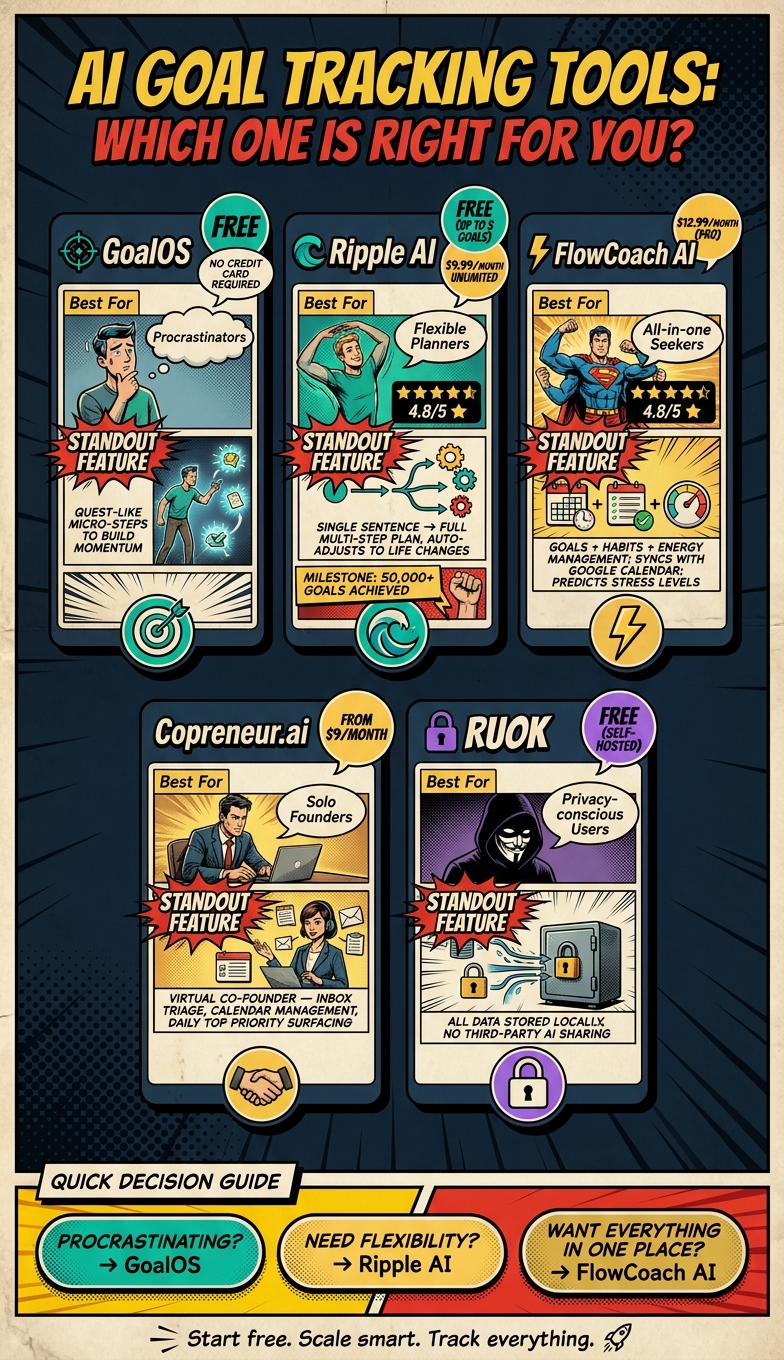
AI Goal Tracking Tools Compared: Find the Best Fit for Your Needs
Defining Goals and Metrics
Before diving into any tools, it’s crucial to get clear about what you’re aiming for. Start by breaking your goals into categories – like boosting business revenue, improving personal health, or creating more lifestyle freedom. Then, figure out your constraints: how much time can you realistically dedicate each week? What’s your budget? Are there any non-negotiable commitments?
Pick a framework that suits your style. If you’re looking for precision, SMART goals (Specific, Measurable, Achievable, Relevant, Time-bound) are ideal. For a broader focus, OKRs (Objectives and Key Results) help you set a clear direction and track progress toward key outcomes. The key is to track two types of metrics: outcome metrics (lagging indicators like monthly revenue or weight loss) and process metrics (leading indicators like daily sales calls or weekly workouts). AI systems thrive on process metrics – they’re the ones the system can monitor and nudge you on every day.
For goals that feel harder to measure – like becoming a better communicator – use a behavioral proxy. For instance, track something like “initiate two feedback conversations per week.” And to avoid overwhelming yourself, stick to 3–5 main goals for the year. Anything extra can go into a backlog for later.
Once your goals and metrics are clear, it’s time to pick an AI tool that fits your approach.
Choosing the Right AI Tools
The tool you choose should match the type of support you need. If you’re prone to procrastination, GoalOS is a great starting point. It breaks big objectives into small, quest-like steps to keep you moving forward – and it’s free to try without needing a credit card. If flexibility is a priority, Ripple AI might be your best bet. This tool turns a single sentence into a detailed, multi-step plan and even adjusts it automatically when life throws you off track. With over 50,000 goals achieved and a 4.8/5 rating, it’s available for free (up to 3 goals) or $9.99/month for unlimited plans.
For an all-in-one solution, FlowCoach AI ($12.99/month Pro) combines goals, habits, and energy management into one dashboard. It syncs with Google Calendar, predicts stress levels, and eliminates the need for multiple apps. It also boasts a 4.8/5 rating, making it a strong contender for anyone seeking a streamlined system.
If privacy is a top concern, especially for business-related goals, RUOK offers a self-hosted, free option. It keeps all your data local and avoids sharing anything with third-party AI models.
Before committing to a tool, check two things: does it integrate with apps you already use (like Google Calendar, Notion, or Slack)? And how long does it take to set up? Most modern AI goal trackers promise onboarding in under two minutes through natural language chat. If a tool feels like it requires hours of setup, it’s likely to gather dust.
Once you’ve chosen your tool, focus on integrating it smoothly into your daily routine.
Configuring and Onboarding
To make the most of your AI goal tracker, connect it to your existing workflow. Many systems now support the Model Context Protocol (MCP), which allows AI assistants to access and update your goal data seamlessly – no manual copy-pasting required. For desktop setups, this might mean tweaking a configuration file (like claude_desktop_config.json) to point to the MCP server URL. You’ll then complete a quick OAuth sign-in to grant access to your data.
After connecting, run a simple verification prompt, such as “Show me my dashboard summary,” to ensure everything is working correctly without risking data errors. Next, import your goals or describe them in plain language. Tools like Ripple AI and FlowCoach AI will automatically transform these into actionable milestones and weekly tasks.
Set your notification preferences carefully. Start with daily check-ins – they’re more effective than hourly pings, which can become distracting. Keep your daily or weekly logging quick – two minutes or less is ideal. If it takes longer, you’re more likely to abandon the habit. Miss a day? No problem. Just log a zero or a quick note and move on – there’s no need to start over.
Finally, schedule regular reviews. Spend 15 minutes each week making small adjustments and 45 minutes each month for bigger strategic updates. These habits will keep your system running smoothly, helping you stay consistent without adding extra friction.
Best Practices for Effective AI Goal Tracking
Writing Effective AI Prompts for Goal Tracking
Once your AI goal tracker is set up, the next step is refining your prompts to get the best results. The quality of your prompts directly impacts the usefulness of the AI’s output. For instance, a vague prompt like "help me reach my goals" will only produce generic advice. On the other hand, a well-crafted, specific prompt can lead to a detailed and actionable plan.
Here’s an example of a strong prompt: instead of asking, "How do I grow my business?" try something like this:
"I’m a solo consultant, 12 months into building a coaching business, with a $500/month tool budget and 15 hours per week available. Help me build a 90-day revenue plan with weekly milestones."
This level of detail gives the AI enough context to deliver practical strategies and insights.
To dig deeper into the why behind your goals, you can use the "5 Whys" technique. This involves prompting the AI to ask "why" five times, helping you uncover the deeper motivations that sustain long-term commitment.
Another effective strategy is using "If-Then" logic to anticipate challenges. For example:
"If I miss my Tuesday content deadline, then I will complete it first thing Wednesday before checking email."
Studies show that people who prepare for obstacles with this kind of pre-planning are 2–3 times more likely to follow through on their goals.
"If you don’t schedule the work, you’re scheduling failure." – Rui Sousa, The AI Break
Different AI tools excel in different areas. For example, GPT-4.1 is great for breaking goals into SMART milestones, Claude Sonnet 4 shines at identifying hidden challenges with psychological insights, and Grok 3 provides direct feedback on whether your goals are realistic.
Balancing Work and Personal Goals
Separating work and personal goals might seem logical, but it often leads to unintended competition for your limited time and energy. A better approach is to integrate both into a unified system with three tiers of focus:
- Core Goals: 1–2 primary goals that receive dedicated, non-negotiable time blocks.
- Active Goals: 2–3 goals supported by consistent habits.
- Maintenance Goals: Lower-priority goals reviewed monthly to ensure steady progress.
During demanding periods, like a product launch, you can shift less critical goals to maintenance mode. This approach, known as planned neglect, helps you avoid the guilt that comes with unplanned neglect. A simple monthly AI prompt can also help you assess whether your health, business, and personal goals are clashing for the same energy reserves.
"Goals fail not from too much ambition but from too little connection between them." – Ramon Landes, Strategic Marketing Professional
Pre-set "If-Then" rules can help resolve conflicts between goals. For instance:
"If a work deadline conflicts with my 6 PM workout, I will move the workout to 7 AM the next day."
By making these decisions in advance, you reduce the mental friction when conflicts arise. Regular reviews will then help you stay on track and ensure your priorities remain clear.
Building Review and Feedback Routines
Just like AI systems adapt over time, regular reviews are essential for refining your daily strategies. Without consistent reviews, goals are often abandoned. In fact, regular goal reviews can boost your likelihood of success by 42%.
Consider implementing a review system with three layers of focus:
| Review | Duration | Focus |
|---|---|---|
| Daily | 5–10 mins | Identify one "win" that connects today’s tasks to a milestone |
| Weekly | 15–30 mins | Evaluate progress, address blockers, and adjust plans for the coming week |
| Monthly | 30–60 mins | Look for patterns in habits and outcomes, and check for potential goal conflicts |
For daily reviews, try the "Traffic Light" method. Label each active goal as Red (stalled), Amber (slipping), or Green (on track). This simple system makes it easier to spot and address issues before they escalate.
Here’s a real-world example: In February 2026, Alesia Zakharova used Claude to analyze her Substack growth journal. She discovered that while she felt busy, only 40% of her time was spent on direct growth activities (like writing and engagement), with the other 60% going to less effective tasks. Armed with this insight, she shifted her focus to content creation, which significantly improved her results.
If you miss a review, don’t stress about catching up. Use the "Two-Day Rule": instead of trying to reconstruct more than two days of missed activity, do a quick "what happened" review and move forward. This keeps the habit intact without overwhelming you.
"A daily OKR review is not about doing more – it is the smallest possible ritual that keeps your quarterly Goals and Milestones in contact with today’s calendar, every single day." – Beyond Time Editorial
Advanced Strategies for AI Goal Tracking
Using Data to Improve Your Goals
Once you’ve nailed down your review routines, it’s time to use the data you’ve gathered to refine your goals. Earlier, we touched on lagging and leading indicators, but now we’re going deeper – tracking behavioral drivers like focus quality or consistency. These are the habits that can hint at changes in outcomes long before they show up in metrics like revenue.
Every 4–6 weeks, upload your tracking logs to identify patterns between your behaviors and results. AI tools can combine qualitative context – like energy levels, a packed schedule, or stressful periods – with quantitative data to uncover connections you might miss on your own. If you find yourself falling behind, try this recovery prompt: "What is recoverable? What should I reset? What is the most important behavior change for the next 30 days?" This approach helps you keep moving forward without getting bogged down in overthinking.
Once you’ve got these insights, the next step is to eliminate manual effort by integrating automation.
Automating Goal Updates and Workflow Integration
To further streamline your process, automation can handle goal updates and reduce the manual logging that often derails tracking systems. A solid automation setup follows a clear pipeline: trigger, retrieve, reason, and act. For instance, a trigger could be a completed task or calendar event. The system then retrieves relevant data from tools like your CRM, uses AI to interpret the information, and takes action – whether that’s updating a database or sending a notification.
Take the "Momentum" project as an example. Built on Notion MCP in March 2026, it allowed users to set natural language goals like "gym 5x/week." The system automatically created supporting databases, synced fitness data from Garmin and Strava, and used Claude to deliver daily briefings and evening scorecards. The result? A live, color-coded dashboard tracking streaks and milestones – without any manual input.
If you’re new to automation, start with a read-only setup. Let the AI gather data and generate briefings, but keep control over updates. For more critical changes – like pausing a campaign or adjusting a quarterly target – add a human approval step. This way, the AI can suggest changes but waits for your confirmation. Tools like Make.com (around $34/month for 10,000 operations) and n8n ($20/month for cloud or free when self-hosted) make this accessible, even if you don’t have a tech background. By 2026, it’s expected that 80% of tech products will be built by non-developers, showing how automation is becoming mainstream.
Ready to leave the job you hate and find the fastest path to online wealth? Learn the best asset you have right now to leverage income and build financial run way in my bestseller "Fire Your Boss." Click here to download the book for free.
Building a Long-Term AI Goal System
Once your workflow is automated, the next challenge is to create a system that adapts and evolves over time. The key to lasting success is maintaining persistent context. AI systems that remember your past challenges, wins, and adjustments can provide sharper, more tailored recommendations as they learn from you.
"The moment you stop operating the database and start authoring through conversation, your relationship with the work changes." – Beyond Time
A sustainable system also requires abandoning static annual planning. Nikita B., founder of drawleads.app, warns, "The assumption that market conditions, competitor actions, and internal capabilities remain stable for a 12-month period is now a dangerous fallacy." Instead, think of your goals as hypotheses – flexible targets that you test and adjust based on real-world data, not rigid commitments. This mindset, combined with the data habits and automation tools we’ve discussed, creates a self-reinforcing system.
The real advantage lies in how quickly you can respond to change. Entrepreneurs who can adapt their goals in days instead of weeks gain a lasting edge. AI frameworks help compress this reaction time, turning agility into a competitive strength that grows over time.
Conclusion
Key Benefits of AI Goal Tracking Systems
AI goal tracking transforms how we approach productivity. Instead of relying on outdated, manual methods, it offers a system that retains context and identifies potential problems before they derail your progress. Studies show that consistent tracking boosts success rates, and AI eliminates the frustrations of traditional systems. Forget clunky forms – AI enables natural, proactive conversations that keep you on track between sessions.
The productivity impact is undeniable. With a full AI agent stack, a solopreneur can reclaim around 22.5 hours each week. Those who reinvest this time into strategic planning often experience revenue growth averaging 34%, compared to just 8% for those who don’t. As Jonathan Mast, founder of White Beard Strategies, aptly states:
"AI used as a productivity tool makes you faster at the same work. AI used as a margin-creating technology gives you your life back."
For entrepreneurs aiming to build location-independent businesses, this level of efficiency is a game-changer. Automated workflows ensure smooth operations no matter where you are. With these advantages in mind, the next step is putting these strategies into action with reliable resources.
Next Steps with Serve No Master
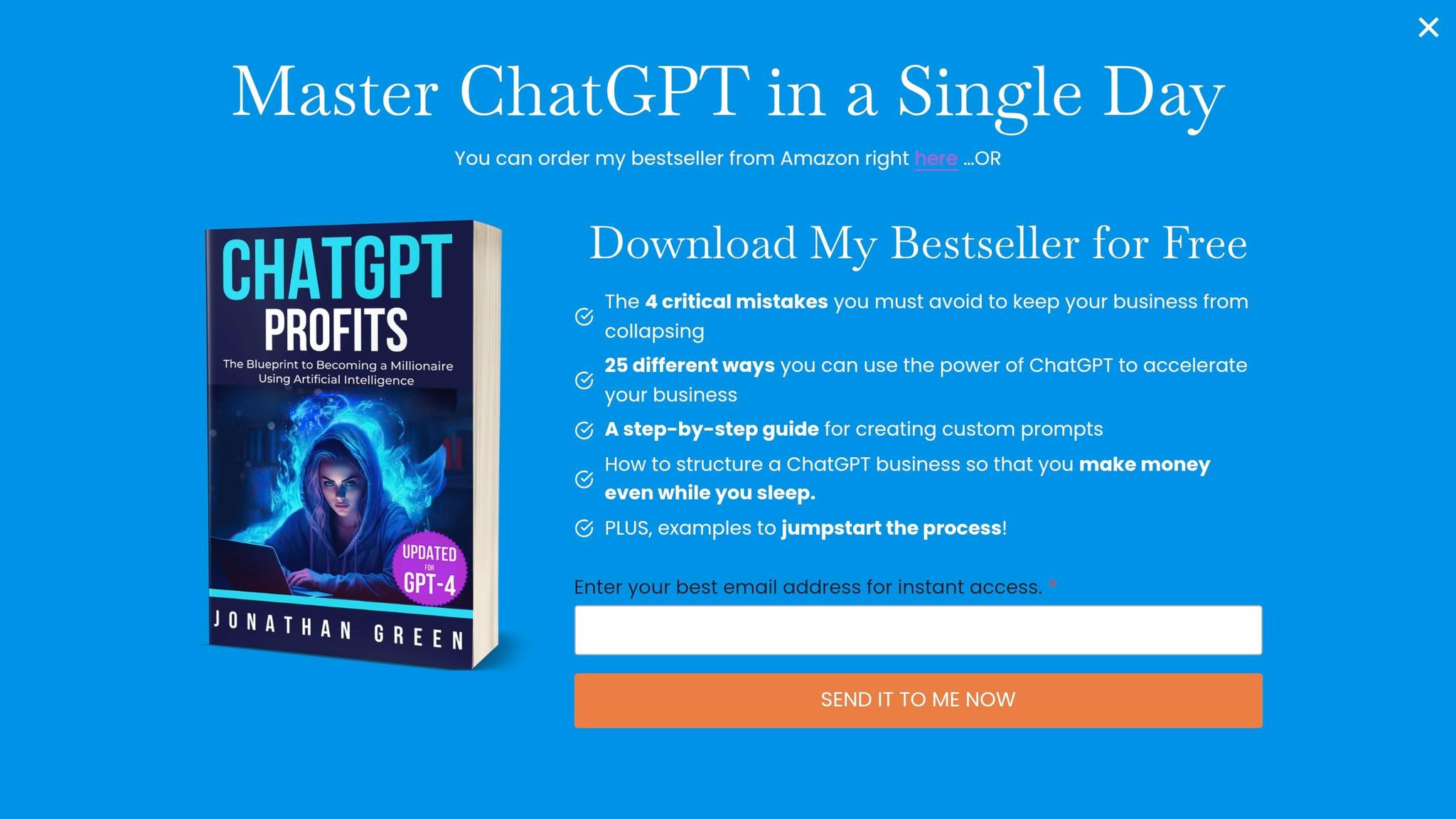
Now that you see the potential of AI goal tracking, Serve No Master offers the tools you need to turn these insights into tangible results. Through resources like Jonathan Green’s ChatGPT Profits – a free 400-page guide with 25 actionable AI strategies for business growth – you’ll gain access to ready-to-use prompts and practical advice. For a deeper dive, the Fire Your Boss blueprint walks you through calculating your break-even point, quit-job income, and ultimate lifestyle costs.
"The problem isn’t the AI itself. The problem is the lack of strategy. Throwing random tools at random problems is like trying to build a house with a scattered pile of bricks and no blueprint." – Jonathan Green, Bestselling Author, Serve No Master
Start small: dedicate just 15 minutes this week to tracking one outcome and two process metrics. The entrepreneurs who succeed aren’t the ones with the fanciest tools – they’re the ones who create workflows they can refine and repeat over time.
FAQs
How do I pick the right AI goal tracker for my needs?
When picking an AI goal tracker, focus on how well it helps you define, monitor, and tweak your goals. Look for tools that offer clear metrics, easy logging, and AI-powered weekly reviews to keep you on track. Choose systems that save your progress automatically, so you’re not stuck re-entering the same information.
If you need something that fits into your daily routine, prioritize trackers that integrate seamlessly with your calendar or task management apps. For those who thrive on numbers, go for options with strong analytics and predictive features. Aligning your milestones with your weekly schedule can make hitting your goals feel more achievable.
What should I track: outcomes or daily actions?
To keep your goals on track, pay attention to both outcomes (like revenue or hitting milestones) and daily actions (such as habits or outreach tasks). The secret lies in focusing on process metrics – things you can control and that set the stage for success. Keep it simple: track daily habits with a yes-or-no approach, and review your outcomes weekly to check your progress. Outcomes may define where you want to go, but it’s the steady, consistent actions that actually get you there.
How can I automate updates without losing control?
Automate updates by establishing clear guardrails in your workflow. Incorporate continuous monitoring to keep changes confined to structured diffs and targeted rewrites. Begin with a semi-autonomous approach – generate drafts that require human approval – then expand automation only after confirming it’s reliable. Introduce quality checks, like verifying required data, and always run dry tests before pushing updates live. Keep a detailed log of every change, and make sure critical sections are routed for human review to avoid unintended large-scale modifications.
Related Blog Posts
- How to Start a Side Hustle While Working Full Time
- How to Validate Business Ideas Before Quitting Your Job
- 5 Mindset Shifts for AI Career Success After 40
- How to Build an AI Decision Framework
Ready to leave the job you hate and find the fastest path to online wealth? Learn the best asset you have right now to leverage income and build financial run way in my bestseller "Fire Your Boss." Click here to download the book for free.