

Fractional AI Officer Rates: Hourly vs. Retainer
When hiring or becoming a Fractional Chief AI Officer (fCAIO), the choice between hourly rates and retainer models can significantly impact your budget and results. Here’s what you need to know upfront:
- Hourly Rates: Best for short-term tasks like audits or troubleshooting. Costs range from $700–$1,500/hour, but expenses can be unpredictable.
- Retainer Models: Ideal for ongoing, in-depth AI leadership. Monthly fees range from $3,000–$40,000, offering consistent support and predictable costs.
Quick Overview:
- Hourly: Flexible, low commitment, but costs can spiral without clear scope.
- Retainer: Fixed monthly cost, deeper involvement, but requires a longer-term commitment.
If you’re unsure of your AI needs, start with hourly engagements. For sustained projects or compliance-heavy industries, a retainer offers better long-term value.
Hourly Rates for Fractional AI Officers
How Hourly Pricing Works
Hourly pricing means you’re only paying for the time spent on your specific tasks. Typically, engagements kick off with a diagnostic audit to gauge your AI readiness, and from there, the officer charges based on pre-defined time blocks.
To prevent unexpected costs, many professionals set a maximum cap on hours for a given task. For example, a workflow review might be capped at "up to 8 hours", so you know the upper limit before work begins. Keep in mind that standalone hourly rates are often 30–50% higher than retainer rates because of lower volume commitments and added administrative overhead.
Pros of Hourly Pricing
The biggest draw of hourly pricing is its flexibility. You’re not locked into a monthly agreement, allowing you to test the waters and pay only for the work that gets done.
For businesses still figuring out how AI fits into their operations, this model provides a low-risk entry point. As AI Systems Engineer Jahanzaib from AgenticMode explains:
Ready to leave the job you hate and find the fastest path to online wealth? Learn the best asset you have right now to leverage income and build financial run way in my bestseller "Fire Your Boss." Click here to download the book for free.
"Pick hourly if your scope is undefined and you need to explore first."
For instance, a one-week AI audit priced at $2,000–$3,000 gives both parties a chance to evaluate the working relationship before committing to anything larger. However, there are some downsides to consider.
Cons of Hourly Pricing
One major downside is the unpredictability of costs. Without a clear ceiling, invoices can balloon if the scope expands – a common concern flagged by many professionals.
Another issue is that hourly billing prioritizes time spent over actual results. This can mean less motivation for the officer to work efficiently or focus on long-term benefits. In some cases, companies have spent upwards of $30,000 on strategy documents that never lead to functional AI systems.
When Hourly Pricing Makes Sense
Hourly pricing works well in certain situations, such as:
- AI Readiness Audits: Assessing your current capabilities before diving into a larger strategy.
- Troubleshooting: Fixing broken AI workflows or refining prompt guardrails.
- One-off Advisory Sessions: Preparing for board meetings or reviewing vendor proposals.
- Regulatory Assessments: Handling tasks like risk classification required under the EU AI Act.
If your company’s annual AI budget is nearing $1M–$2M and you need senior-level expertise to justify that spend to leadership, starting with a short hourly engagement can be a smart move before transitioning to a retainer.
Retainer Models for Fractional AI Officers
How Retainer Pricing Works
A retainer is a flat monthly fee that gives your business ongoing, part-time access to a fractional AI officer. This typically covers anywhere from 8 to 40 hours of work each month. Instead of charging per task, the officer becomes an integral part of your operations – joining leadership meetings, managing vendors, and fine-tuning AI systems as your needs evolve. Many retainers follow a Strategy, Transformation, and Education (STE) framework, which includes working with executives, delivering technical solutions, and training your team. Often, there’s a base fee with a bonus tied to specific KPIs, ensuring results are aligned with the time invested. This model provides consistency and predictability, unlike the fluctuating costs of hourly work.
Here’s a breakdown of typical retainer tiers:
| Retainer Tier | Monthly Cost | Hours Included | Best For |
|---|---|---|---|
| Advisory | $3,000–$5,000 | 5–10 hours | Strategic guidance, monthly check-ins, and asynchronous support |
| Fractional | $8,000–$15,000 | 16–32 hours | Hands-on implementation, vendor management, and team training |
| Embedded | $15,000–$40,000 | 3–5 days/week | Large-scale AI projects, regulated industries, and board-level leadership |
Pros of Retainer Pricing
One of the biggest advantages of retainer pricing is predictability. You’ll know exactly what your monthly costs are, making it easier to plan your budget. Plus, as Daniel Bilsborough, an AI Advisor, points out:
"A fractional AI officer’s knowledge of your business compounds over time. Every month they work with you, their advice gets more specific and more valuable because they have deeper context."
This ongoing relationship makes a fractional leader much more effective than a consultant who delivers a report and moves on. As AI Smart Ventures explains:
"A consultant tells you what to do. A fractional CAIO is responsible for making sure it gets done."
The financial benefits can be substantial. For instance, a $3,000–$5,000/month retainer can save a business $15,000–$25,000/month in labor costs. Additionally, companies with dedicated fractional leadership often see AI adoption timelines improve by 40%.
Cons of Retainer Pricing
The biggest downside is the risk of underutilization. Without a clear scope of work, you might end up paying for hours you don’t fully use. For example, if there’s no structured plan – like a set number of experiments or a prioritized task list – costs can quietly pile up without delivering enough value.
Another challenge is the "availability trap." Some officers may end up becoming informal, around-the-clock support, which can dilute their focus and reduce the return on your investment. Retainer contracts also require more management than hourly arrangements, and the upfront monthly cost can feel steep for smaller businesses still figuring out their AI strategy.
When Retainer Pricing Makes Sense
Retainer pricing works best when your AI efforts shift from experimentation to execution. It’s especially effective if your company has multiple AI projects in production or an annual AI budget of $1M–$2M or more. At this scale, you’ll need consistent oversight rather than one-off consulting.
Retainers are also ideal for compliance-heavy industries. Regulations like the EU AI Act and Colorado AI Act, set to take effect in 2026, will require companies with high-risk AI systems to have a designated officer for risk management and oversight. A retainer-based fractional officer can fill this role, ensuring compliance even outside of audit periods.
Take these examples. A California staffing firm brought in Fractional CAIO John Cheney on a retainer costing about 1% of their annual revenue. His team developed an AI-powered voice agent and intake platform, cutting staff involvement from three people to one and reducing incident resolution times from 39 to 11 days. This saved the company over $140,000 annually. Similarly, a wholesale distributor working with Dmytro Negodiuk on a $4,000/month retainer reduced manual order processing from 60 hours a week to 15 hours by the third month. This generated $4,687 in monthly labor savings – more than covering the cost of the retainer.
Hourly vs. Retainer: Side-by-Side Comparison
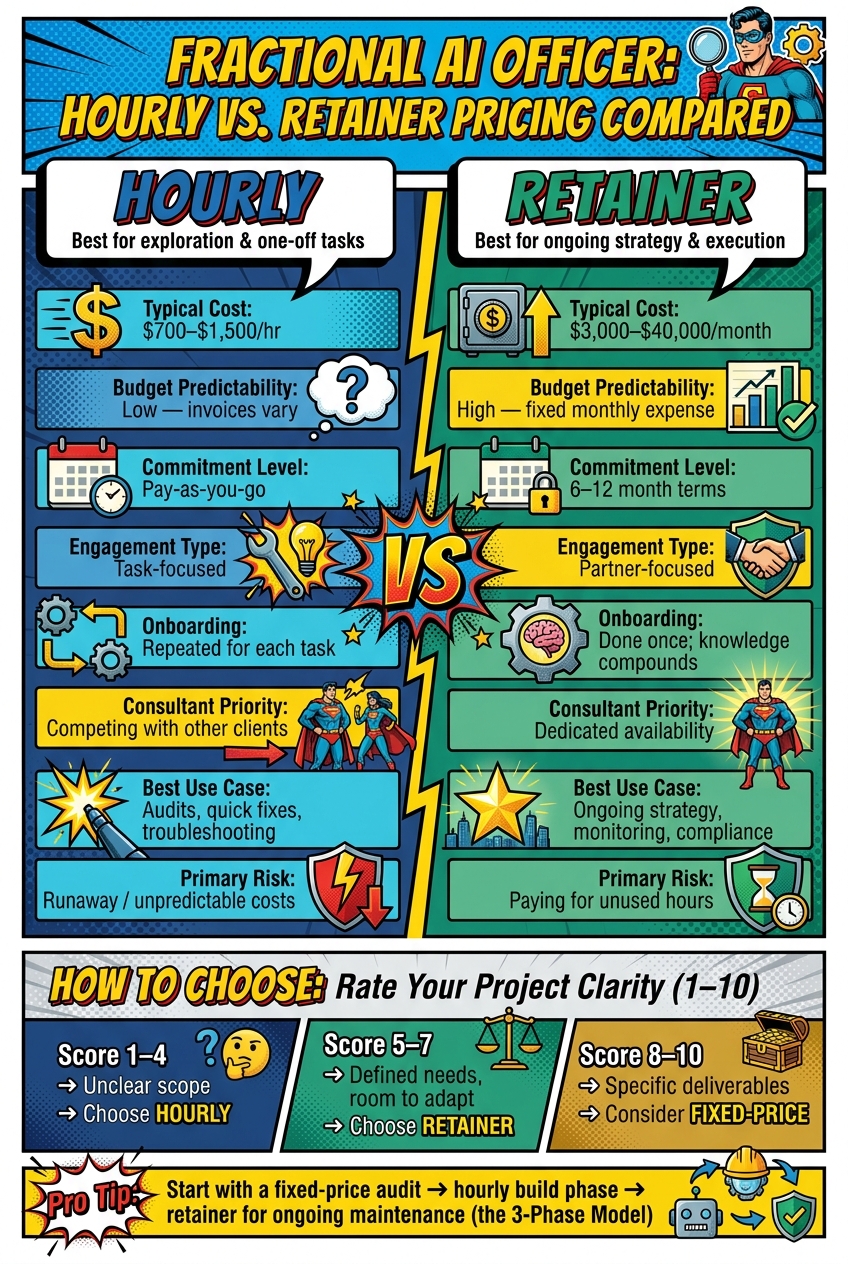
Fractional AI Officer: Hourly vs. Retainer Pricing Compared
Key Differences Between Hourly and Retainer Models
When comparing hourly billing and retainer agreements, the real difference isn’t just about cost – it’s about incentive alignment. With hourly billing, consultants may unintentionally benefit from taking longer to complete tasks. Retainers, on the other hand, reward efficiency and focus on long-term results.
"Hourly billing disincentivizes efficiency and creates misaligned incentives." – Ciela AI
Another major distinction is cost predictability. Hourly rates, which typically range between $150 and $500 per hour, can quickly add up, especially with open-ended work. Retainers, however, offer a fixed monthly fee, making it easier to budget and justify expenses within an organization.
Retainers also encourage a deeper, ongoing partnership. Instead of starting from scratch with each project, the consultant builds institutional knowledge over time, leading to smoother and more efficient work.
The following table highlights these differences more clearly:
Comparison Table: Hourly vs. Retainer
| Factor | Hourly | Retainer |
|---|---|---|
| Typical Cost | $150–$500/hr | $3,000–$15,000/mo |
| Budget Predictability | Low; invoices vary | High; fixed monthly expense |
| Commitment Level | Pay-as-you-go | 6–12 month terms |
| Engagement Type | Task-focused | Partner-focused |
| Onboarding | Repeated for each task | Done once; knowledge builds |
| Consultant Priority | Competing with other clients | Dedicated availability |
| Best Use Case | Audits, quick fixes | Ongoing strategy, monitoring |
| Primary Risk | Runaway costs | Paying for unused hours |
How to Choose the Right Model
A simple way to decide is to evaluate your project’s clarity on a scale from 1 to 10. If your project scores between 1 and 4 (unclear scope or goals), hourly billing may be the better choice. For scores between 5 and 7 (defined needs but with room to adapt), a retainer works well. If your project is at an 8 to 10 (specific deliverables and outcomes), consider a fixed-price arrangement.
"The pricing model determines your vendor’s incentives, your budget predictability, and who carries the risk when delivery slips." – Mukesh Ram, CEO, Acquaint Softtech
For businesses just starting to explore AI, hourly engagements are often the safest bet. You can begin with a single audit or scoping session to test the waters before committing to a larger project. Once your AI system is live and requires ongoing maintenance, monitoring, and updates, a retainer becomes more practical. A good rule of thumb: if the ROI – calculated as (hours saved × effective hourly rate) + revenue gained − retainer cost – isn’t positive within three months, it’s time to reassess the arrangement.
An increasingly popular approach in 2026 is the three-phase model: start with a fixed-price audit, move to hourly billing for the build phase, and then transition to a retainer for ongoing maintenance and optimization. This phased strategy allows you to test the relationship with minimal risk before committing long-term.
Conclusion and Recommendations
Matching Your Pricing Model to Your Business Needs
Choosing the right pricing model starts with understanding your AI needs and the stage of your project. Whether you opt for hourly billing or a retainer, the decision should align with your project’s scope and maturity. These models don’t just impact cost predictability – they also shape the success of your partnership.
For those just starting out or exploring AI possibilities, hourly billing is a safer bet. It keeps risks low while you figure out what works. But as your project moves into repeatable tasks – like monitoring models, fine-tuning prompts, or training internal teams – a retainer becomes the smarter financial choice. The rule of thumb? High uncertainty calls for hourly rates; ongoing work calls for retainers. This approach ensures you’re not overcommitting too soon but can transition to stability when the time comes.
Early-stage teams often thrive with short, fixed-price discovery sprints, while companies with established AI systems see better results with monthly retainers. A minimum three-month retainer is often recommended, giving both sides enough time to see measurable results before deciding on next steps.
Here’s a key insight: mature AI agencies earn about 70% of their revenue through monthly retainers. Retainers not only reward efficiency but also strengthen client relationships and provide the predictable income needed for long-term growth.
How Serve No Master Supports AI Entrepreneurs

Understanding these pricing strategies is essential, and Serve No Master is here to help you put them into action. Created by bestselling author Jonathan Green, Serve No Master offers training tailored for AI entrepreneurs. The platform focuses on teaching you how to package and sell AI services, automate workflows, and build a business that doesn’t tie you to one location.
Whether you’re a consultant transitioning from hourly work to retainer-based packages, or a professional looking to monetize your AI expertise independently, Serve No Master provides the tools and guidance you need. From selecting the right AI tools to automating your business and developing digital products, their courses are designed to help you succeed. They’re especially beneficial for professionals over 40 who want to use AI to create both client services and the backbone of their business.
FAQs
What should I focus on in the first 30 days?
In your first month as a fractional AI officer, your priority should be to establish trust by delivering results that matter. Join leadership meetings to pinpoint where AI can either save money or drive revenue. Align AI initiatives with the company’s key performance indicators (KPIs) and outline a 90-day plan for meaningful change. Keep track of major accomplishments, such as creating AI governance policies or identifying areas for cost savings, to demonstrate your impact right from the start.
How can I avoid scope creep with hourly work?
To keep hourly work from spiraling out of control, it’s essential to set clear limits from the start. Define exactly what the work will cover or set a cap – like an 8-hour package tied to specific deliverables. Make sure your contract includes terms that require written approval for any extra hours, which should be billed at a pre-agreed overage rate. Also, share detailed time reports regularly to keep everything transparent and avoid confusion.
What should a retainer contract include?
When setting up a retainer contract for a fractional AI officer, clarity is everything. Start by defining the scope of work – whether it’s tied to a set number of hours or specific deliverables. Be sure to include an hour cap to prevent scope creep from derailing the agreement.
Payment terms should be straightforward, such as requiring monthly payments upfront. You’ll also want to address rollover policies for unused hours and set clear rates for any additional hours or overages. Don’t forget to outline termination terms, like requiring a 30-day notice.
The contract should also cover critical areas like intellectual property rights, confidentiality agreements, and non-compete clauses. Finally, set expectations for communication, such as relying on asynchronous messaging to streamline interactions.
Related Blog Posts
- Ultimate Guide to Fractional Chief AI Officer Certification
- 5 Mindset Shifts for AI Career Success After 40
- How to Become a Certified Fractional AI Officer
- Cost-Benefit Checklist for AI Tools
Ready to leave the job you hate and find the fastest path to online wealth? Learn the best asset you have right now to leverage income and build financial run way in my bestseller "Fire Your Boss." Click here to download the book for free.