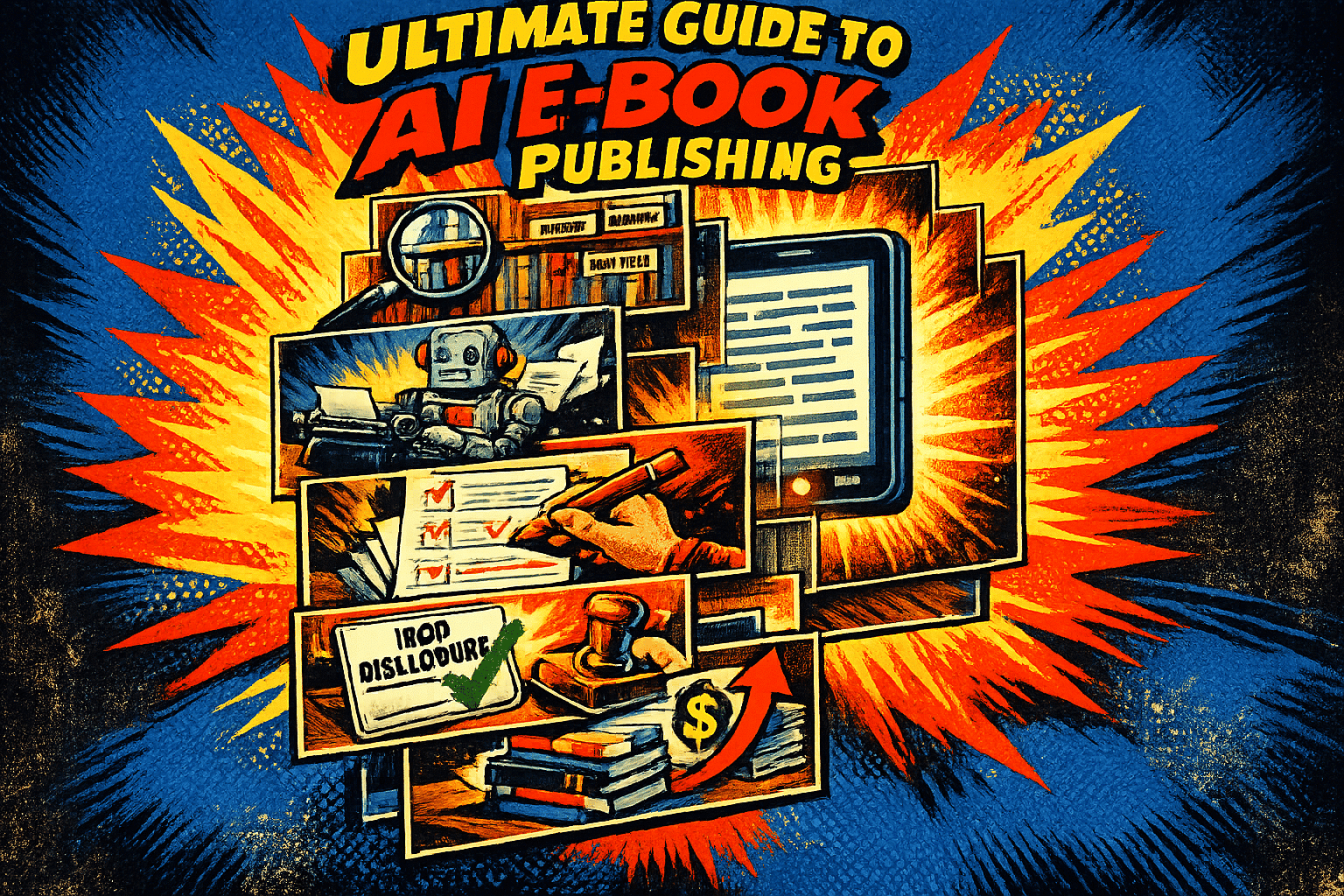
Ultimate Guide to AI E-Book Publishing
AI has made publishing e-books faster, cheaper, and more accessible in 2026. Professionals can now create high-quality e-books in hours instead of months, cutting production costs by 60%-70% and saving over 30 hours per book. Platforms like Amazon KDP offer royalty rates of 35%-70%, meaning even modest sales can generate passive income. For example, a $4.99 e-book can earn $3.44 per sale – 100 sales a month equals $344 in income. Multiply this across multiple titles, and the potential grows.
Key takeaways:
- AI tools streamline the entire process: From generating outlines and drafts to designing covers and marketing.
- Legal and ethical compliance is critical: To secure copyright, authors must show human contribution and disclose AI usage on platforms like Amazon KDP.
- Focus on quality over quantity: Poorly made AI books have led to stricter platform rules, including reduced royalties for low-priced books.
- Niche research is essential: AI tools like NicheFlow and BookBeam help identify profitable, underserved markets.
- Scaling is achievable: Publish multiple books and automate marketing to build a steady income stream.
AI isn’t replacing human creativity; it’s a tool to amplify it. By blending AI assistance with personal expertise, you can turn your knowledge into profitable digital products.
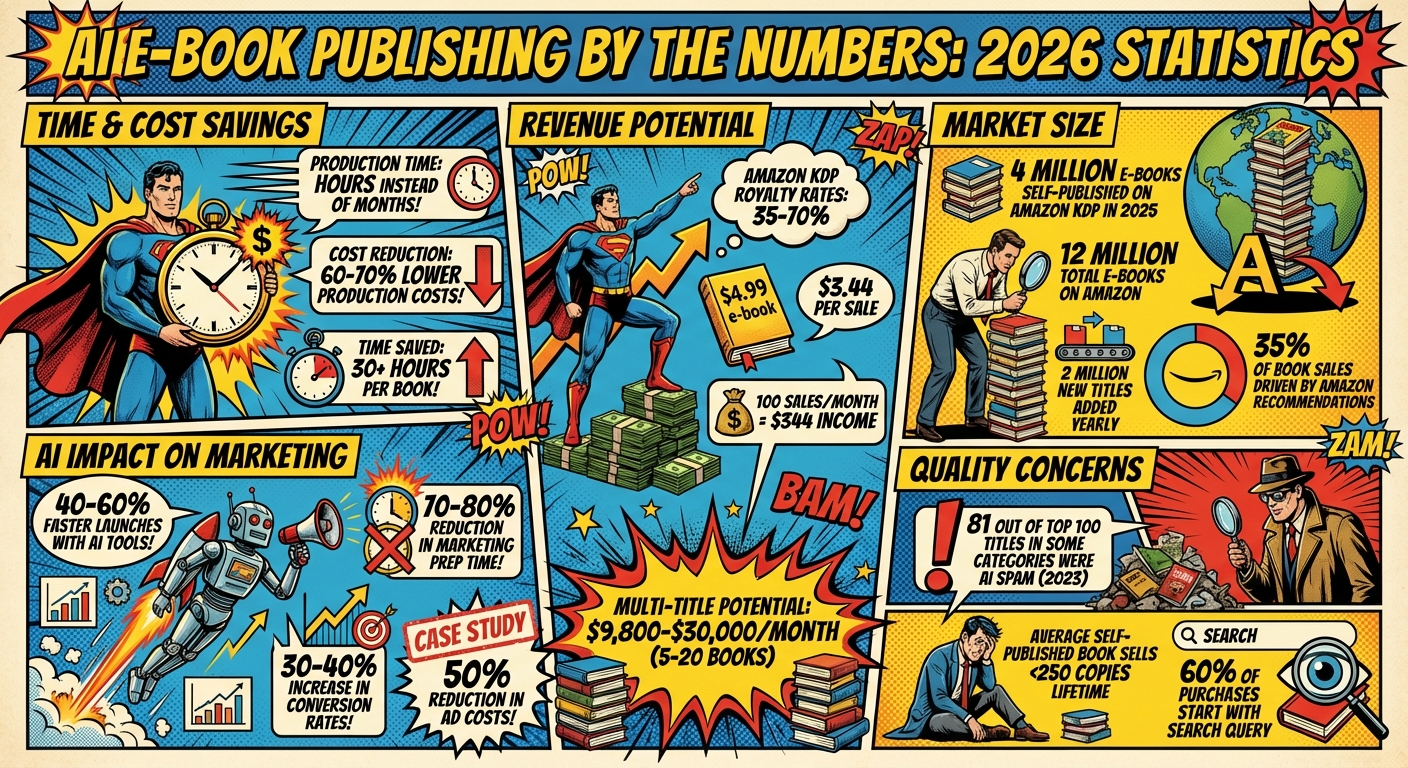
AI E-Book Publishing Statistics: Time Savings, Costs, and Revenue Potential in 2026
The AI E-Book Publishing Landscape
The e-book world is undergoing a transformation, with AI tools now playing a major role – but not without strict rules. Navigating this space means understanding what’s allowed, what’s ethical, and how platforms like Amazon KDP enforce their policies. Ignoring these guidelines can lead to account suspensions and leave your content vulnerable to being copied or reused without protection.
In mid-2023, the industry saw a massive influx of poorly made AI books. A study revealed that 81 out of the top 100 titles in some Amazon bestseller categories were essentially AI-generated spam. Amazon responded quickly by introducing upload limits, requiring authors to disclose AI usage, and reducing royalties for lower-priced books. Starting June 10, 2025, books priced under $9.99 will see royalties drop from 60% to 50%. The message is clear: platforms prioritize quality over quantity.
Legal and Ethical Requirements
One key fact to remember: copyright only protects the human-created portions of your e-book. According to the U.S. Copyright Office, "Copyright protects only works of human creation". If your book is entirely AI-generated and unedited, it essentially becomes public domain. This means anyone can legally copy, sell, or republish it.
Ready to leave the job you hate and find the fastest path to online wealth? Learn the best asset you have right now to leverage income and build financial run way in my bestseller "Fire Your Boss." Click here to download the book for free.
To secure copyright protection, you must show evidence of "meaningful human authorship." That means actively shaping the content – rewriting drafts, adding personal touches, and making creative decisions beyond just typing prompts. AI should be treated as a drafting assistant, not the sole creator. Keep detailed records of your process, like outlines, edits, and prompt logs, in case the Copyright Office questions your work.
There’s also the risk of infringement. AI models can sometimes reproduce content that closely resembles copyrighted material from their training data. This happens when the AI "memorizes" and outputs text that’s nearly identical to existing works. Always run AI drafts through plagiarism checkers before publishing. The same goes for cover images – using prompts that mimic celebrity faces or logos can lead to trademark or right-of-publicity claims.
"AI-generated ebooks raise five primary risks: unclear copyright ownership, inadvertent infringement, fair-use miscalculations, third‑party rights… violations, and platform policy breaches." – Ameya Deshmukh, Director of Content Marketing, Integrail Corp.
Disclosure is required on major platforms like Amazon KDP. If AI contributed to your book’s prose, cover design, or translation, you must check "Yes" in the AI-generated content field. Not disclosing this can result in your book being removed or your account being permanently banned. However, you don’t need to disclose AI use for brainstorming, outlining, or grammar corrections with tools like Grammarly. The distinction lies in how much of the content was directly created by AI versus how much was guided and refined by you.
| Content Type | Disclosure Required on KDP? | Classification |
|---|---|---|
| AI wrote the book text | Yes | AI-Generated |
| AI generated cover image | Yes | AI-Generated |
| AI translated the book | Yes | AI-Generated |
| AI edited/proofread text | No | AI-Assisted |
| AI suggested ideas/outlines | No | AI-Assisted |
Platform Policies for AI-Generated Content
Amazon KDP has become a strict gatekeeper, and their rules leave little room for error. To curb spam, they’ve implemented a limit of 3 book uploads per day per account. Books flagged as AI-generated go through a review process that takes 24-72 hours. Amazon also actively monitors for "poor customer experience", which includes issues like factual inaccuracies, repetitive phrases, or nonsensical text – common pitfalls of AI-generated books.
"Amazon is not banning AI books. They are selling millions of them. They are banning authors who lie." – Ibrahim Benali Ettoubal, Founder, AIBoxTools
While Amazon doesn’t currently display a public "AI-generated" label on product pages, they use disclosure data internally to ensure compliance and quality. Authors who fail to disclose risk severe penalties, but those who follow the rules face no such consequences. When in doubt, always disclose.
Pricing is another critical factor. To keep the 60% royalty rate on paperbacks, authors must price physical copies above $10.00. Books priced below this threshold now earn only 50%, a deliberate move to discourage low-effort AI spam. For e-books, the 70% royalty rate still applies to titles priced between $2.99 and $9.99.
Some authors are now labeling their works as "100% Human-Written" to stand out in a market increasingly wary of AI content. This reflects a growing demand for transparency and originality. The shift is clear: success in this new landscape will depend on blending human creativity with AI’s capabilities, ensuring that the author’s voice remains front and center.
Next, discover how AI can streamline your topic research and idea validation.
AI Tools for Topic Research and Idea Validation
Before you start writing, it’s smart to confirm there’s actual market demand for your idea. AI tools can analyze millions of data points in seconds, giving you instant niche validation based on sales trends, competitor insights, and buyer behavior.
The difference between a successful e-book and one that flops often boils down to identifying content gaps – those high-demand topics where current books fall short with weak covers, vague descriptions, or poor reviews. AI tools make spotting these opportunities easy, helping you find niches where you can thrive without competing against established bestsellers. With over 4 million e-books self-published on Amazon KDP in 2025, picking the right topic has never been more important.
Researching Audience Demand
AI-powered platforms like NicheFlow analyze over 10 million Amazon data points daily to uncover niches with strong demand and manageable competition. These tools track metrics like Best Seller Rank (BSR), review counts, pricing trends, and sales velocity across every category. Instead of relying on outdated information, you get real-time insights into which topics are trending right now.
One key strategy is targeting sub-categories where top-selling books have fewer than 100 reviews, signaling a market with room to grow. Take Sarah Mitchell, for example: in early 2026, she used NicheFlow to replace five separate research tools, cutting her research time by 90% and earning $12,500 in her first month of publishing. Her secret? She focused on micro-niches using this formula: [Broad Topic] + [Specific Audience OR Constraint OR Tool] = Micro-Niche Gold. Instead of writing a generic productivity guide, she zeroed in on "Productivity for ADHD Brains", a niche with urgent demand and minimal competition.
Some high-growth niches for 2026 include AI Workflow Guides (+420% demand growth), Climate Career Transition (+280%), and Mental Health for Men (+220%). These aren’t random trends – AI tools track year-long patterns to spot rising topics before they get oversaturated. Content creator James Rodriguez used this approach to find a niche with a success score of 89/100 based on Amazon data. He admitted, "I would have never discovered this through manual analysis".
"NicheFlow replaced five different tools for me. I now spend 90% less time researching and 100% more time publishing profitable KDP books." – Sarah Mitchell, KDP Publisher
Other tools like BookBeam and BookForge provide even deeper insights. BookBeam uses Amazon’s API to calculate average monthly earnings, sales, and rankings for the first three search result pages. Meanwhile, BookForge’s Niche Discovery Engine analyzes over 50 million Amazon products, Google Trends, and social signals to pinpoint lucrative topics with a claimed 95% accuracy rate. For instance, Sarah Chen, a self-help author, used these tools to jump from $200/month to $3,500/month in royalties.
When assessing demand, don’t just look at sales numbers. Pay attention to whether the top competitors have quality gaps – like poor covers, thin content, or vague descriptions – that you can improve on. Also, ensure your target audience is willing to pay $9.99 or more, as this price point boosts royalties and attracts serious buyers. Books that solve specific, urgent problems – like "7-Day Email Marketing Setup for Coaches" – consistently outperform broad, generic guides.
Once you’ve validated your niche, the next step is refining your strategy with targeted keyword research.
Keyword and Trend Analysis
After narrowing down your niche, AI tools can help you uncover the exact phrases buyers are typing into Amazon’s search bar. Since 70% of book sales on Amazon come from search results, and the top three results capture 75% of all clicks, keyword optimization is critical.
AI excels at identifying long-tail keywords – specific 3-5 word phrases like "second chance small town romance" instead of just "romance." These longer phrases convert 2.5x better than single-word terms. AI tools analyze metadata from top books and use semantic analysis to find high-performing keywords and related terms, helping your book appear in more search results.
Here’s a five-step process for effective keyword validation:
- Brainstorm seed keywords.
- Expand those ideas using Amazon Autocomplete.
- Analyze metadata from the top 10 competitors.
- Use an AI keyword tool to generate long-tail variations.
- Prioritize keywords with moderate search volume and low competition.
AI tools can also flag banned or trademarked terms like "Kindle" or "Bestseller", preventing account suspension.
Strategic keyword placement can boost your book’s BSR by 30–50% within weeks. Focus on placing your best keyword in the title (Amazon’s algorithm weights this 3-5x higher), followed by the subtitle and backend keyword boxes. Avoid repeating keywords across these fields – Amazon indexes them only once, and repetition could hurt your ranking. To stay competitive, update your keywords every 90 days to align with changing trends and seasonal demands.
"The competition analysis is incredibly accurate, scoring potential niches based on real-time Amazon data. I found a low-competition niche with high demand that I would have never discovered on my own. It’s like having an AI market analyst on my team." – James Rodriguez, Content Creator
For maximum impact, time your launch strategically. Publish AI-validated topics 4–6 weeks before their seasonal peak. For example, release financial planning books by mid-December to capture the January surge. Combining smart timing with data-driven topic selection and keyword optimization gives your e-book the best chance to succeed.
Creating and Structuring Your E-Book with AI
After validating the perfect topic to write about and keywords, it’s time to build the framework for your e-book. AI tools can take a simple idea and turn it into a complete blueprint – chapters, key points, the works – in just minutes. Think of this as your "roadmap" to keep your writing focused and prevent unnecessary detours that dilute your main message.
For non-fiction books, readers tend to prefer 8–12 well-structured chapters. This range strikes a balance between depth and readability. Before you start writing, lock in your structure. Author Billie Lucas advises, "Start editing AI output by locking the structure first: chapters, logical flow, and a clear table of contents". Once your outline is set, you can focus on expanding each chapter, weaving in your voice, and showcasing your expertise.
Generating Outlines and Chapter Structures
Just like keywords guide market research, well-crafted prompts shape a strong outline. AI tools such as Squibler and Automateed (used by over 65,000 authors to create more than 350,000 e-books) can generate chapter frameworks tailored to your topic, audience, and tone – whether professional, friendly, or educational. As author Sophia Alvarez puts it, "I was able to generate a complete book and then add my own knowledge and personal touch as I reviewed it".
Different e-book formats call for different structures. Here’s a quick breakdown of some common types:
- Quick-start Lead Magnet: A compact 10–20 page guide focused on solving a specific problem, offering quick wins, and ending with a checklist.
- Framework Playbook: A 20–40 page step-by-step guide with a detailed rollout plan for a specific method or strategy.
- Workbook: A 20–50 page interactive resource with lessons, prompts, and progress trackers, ideal for coaching or educational content.
- Case Study Guide: A 20–60 page format that introduces a method and backs it up with 3–5 real-world examples.
| Blueprint Type | Purpose | Length | Key Components |
|---|---|---|---|
| Quick-start Lead Magnet | Newsletter growth | 10–20 pages | Problem, quick wins, steps, mistakes, checklist |
| Framework Playbook | Business/Marketing | 20–40 pages | Framework overview, step-by-step chapters, plan |
| Workbook | Coaching/Education | 20–50 pages | Lessons, prompts, worksheets, progress tracker |
| Case Study Guide | Proof-first positioning | 20–60 pages | Method, case studies, patterns, implementation |
To ensure your outline hits the mark, use specific prompts that include your audience, their goals, and their pain points. For example, instead of asking, "Write a book about marketing", try, "Create an e-book outline for Shopify store owners about email marketing." This approach results in a much more targeted structure.
After generating your outline, refine it. Look out for repetitive sections or filler content, merge similar ideas, and make sure each chapter has a clear "Chapter Promise" – a one-sentence takeaway that tells readers exactly what they’ll gain. Adding actionable elements like checklists or worksheets to each chapter can also boost the book’s value and help readers put what they’ve learned into practice.
Combining AI Assistance with Human Creativity
Once your outline is ready, the next step is refining the AI-generated draft with your expertise. AI drafts are a starting point, not the finished product. To create a polished e-book that feels authentic, plan to manually edit around 20–30% of the AI-generated content. This process transforms raw AI output into a piece that reflects your unique voice and authority.
Start by varying sentence structures. AI tends to produce repetitive rhythms, so mix short, punchy sentences with longer, more detailed ones to keep readers engaged. Replace generic anecdotes with real-world case studies, personal stories, or specific examples that resonate with your audience. These details build trust and make your content stand out.
Fact-checking is another crucial step. AI often invents data, so verify all dates, names, and statistics against reliable sources. If something can’t be confirmed, reframe it as an opinion or remove it altogether. Reading your draft aloud can also help you catch awkward phrasing or transitions that might have slipped through.
To streamline editing, create a style guide before you begin. Define your preferred tone, tense, and level of formality to maintain consistency across chapters.
| Task | AI Strength | Human Necessity |
|---|---|---|
| Outlining | Generating logical frameworks quickly | Ensuring the flow aligns with your goals and audience |
| Drafting | Producing basic prose and overcoming writer’s block | Adding personal anecdotes and unique insights |
| Editing | Fixing grammar, spelling, and syntax errors | Refining tone, depth, and emotional resonance |
| Consistency | Tracking details like names and timelines | Ensuring an authentic voice and emotional connection |
| Fact-Checking | Providing plausible-sounding data | Verifying accuracy to avoid misinformation |
A hybrid approach – combining AI with human creativity – can dramatically improve your results. Authors who use this method for sales copy report 15–25% higher conversion rates compared to relying solely on AI. While AI handles grammar and consistency, you can focus on thematic flow and storytelling. This teamwork can cut production costs by 60–70% and save over 30 hours per book.
For non-fiction, your voice is your most powerful tool. If your text feels robotic, readers will disengage. To keep them hooked, include one personal story per chapter, swap vague claims for concrete metrics, and end with a clear call-to-action – whether it’s signing up for a newsletter or booking a consultation. These personal touches turn a basic AI draft into a professional e-book that readers trust and recommend.
Editing, Formatting, and Designing Your E-Book
After finishing your draft, it’s time to turn your manuscript into a polished, professional e-book that meets platform standards and grabs readers’ attention. AI tools can handle much of the technical work – correcting errors, applying formatting, and even designing covers – so you can focus on the creative aspects. This process highlights how AI tools simplify e-book creation, saving time and effort.
AI-Powered Editing and Quality Control
AI editing tools can cut editing time in half while catching around 80% of grammatical errors automatically. The right tool depends on your specific needs.
- Grammarly ($12–$30/month) is a favorite for non-fiction writers, offering real-time corrections across platforms like Google Docs, Microsoft Word, and browsers.
- ProWritingAid ($20–$36/month) goes deeper, analyzing pacing, overused words, and sentence structure – perfect for refining your writing style. Authors using these tools report a 72% boost in clarity and say they help identify and fix recurring issues.
Fiction writers often need tools that preserve their voice. editGPT ($12–$40/month) focuses on intent, polishing grammar and consistency without losing your tone. It’s ideal for long manuscripts, supporting works over 200,000 words. For consistency in details like character traits or timelines, Galleys.ai ensures everything aligns across chapters.
The best results come from combining AI with human judgment. Use AI for technical edits like grammar and spelling, but trust your instincts for emotional depth and creative choices. If the AI flags a deliberate stylistic choice, don’t hesitate to override it.
Once your text is polished, automated formatting tools can prepare it for publishing.
Automated Formatting and Layout
Formatting requirements – like margins, table of contents, and front matter – can be tedious, but AI formatters handle these tasks quickly and accurately. These tools are especially helpful for non-fiction e-books, ensuring proper heading levels, generating table of contents links, and fixing awkward page breaks. They also check image quality, flagging issues like low resolution and ensuring visuals fit correctly within margins.
Start with a clean DOCX or EPUB file to avoid import errors. Many platforms let you manage content, layout, and cover design in one project file, reducing duplicate work when updating editions. Export separate files for digital and print formats – like a reflowable EPUB for e-readers and a PDF with bleed settings for print.
Always preview your final output. Use Kindle Previewer to check how your EPUB file looks on various devices, and order a print proof to confirm margins, gutters, and image quality translate well to paper.
Creating E-Book Covers with AI
Covers are critical – readers often decide whether to buy a book in just a few seconds. In fact, 60% of purchasing decisions are based on the thumbnail image alone. AI tools can create professional-quality covers in under a minute for as little as $0.10–$0.20 each, compared to the $300–$2,000 cost of traditional designers.
- CoverDesignAI (Pro Pack at $9.99 for 30 credits) uses your input – like title, genre, and mood – to generate print-ready covers and 3D marketing mockups.
"It was incredibly quick and easy to get help in reflecting the image I had in mind for the cover – specifically, a very close representation of my book’s main character"
- Hatice Dırmıkcı
- Coverly specializes in genre-specific styles, from minimalist designs to bold sci-fi visuals, with high-resolution exports optimized for platforms like KDP and IngramSpark.
"The AI perfectly captures the essence of my stories. The styles are wild and imaginative, exactly what my sci-fi readers love."
- Jamal R., award-winning sci-fi writer
If you’re working on a series, upload previous covers to ensure the AI maintains a consistent look across your books. Tools like BookCoverMaker.org use models trained on bestselling covers to create designs that align with reader expectations and technical standards. You can generate over 100 variations in minutes to test different designs with your audience. Most AI cover tools also grant full commercial rights, making them suitable for Amazon KDP, IngramSpark, and even merchandise.
Ready to leave the job you hate and find the fastest path to online wealth? Learn the best asset you have right now to leverage income and build financial run way in my bestseller "Fire Your Boss." Click here to download the book for free.
Since AI typography isn’t perfect yet, many authors download the 2D design and add text using tools like Canva or Photoshop for precise adjustments. Once your 2D cover is finalized, convert it into a 3D mockup for social media and promotional use.
With your e-book polished, formatted, and professionally designed, you’re ready to move on to publishing and promoting it. AI tools will continue to play a key role in streamlining those steps.
Publishing and Promoting Your E-Book
Once your e-book is polished and formatted, it’s time to dive into publishing and promotion. Serve No Master equips professionals with tools to simplify publishing and make promotion more effective.
Submitting to Publishing Platforms
When uploading to Amazon KDP, you’ll need to disclose any AI-generated content and ensure your text is free of redundant AI phrases. AI can sometimes produce inaccurate information, especially in non-fiction, so double-check your content. Amazon closely monitors books for quality, so aim for 10,000+ words for non-fiction and 25,000+ words for fiction to avoid being flagged.
For digital platforms, submit your e-book in EPUB format, and for paperbacks, upload your book to Amazon using a print-ready PDF with proper trim sizes and margins. Use all seven keyword slots with long-tail phrases instead of single words and select niche categories. For example, opting for "Self-Help > Creativity > Writing Skills" instead of just "Self-Help" can significantly boost your chances of ranking #1 in that subcategory. Keep in mind that the review process may take up to 72 hours.
Consider enrolling in KDP Select for 90 days to access Kindle Unlimited readers and promotional tools like Countdown Deals. Start with an introductory price of $0.99 for 3–5 days to attract initial buyers and reviews, then adjust to $2.99–$4.99 to qualify for the 70% royalty rate – books priced outside this range only earn 35% royalties.
AI-Powered Marketing Methods
AI tools can quickly analyze your manuscript to generate reader personas, identify similar titles, and craft emotional hooks for marketing. Use AI to create 5–7 variations of your book description and improve your book listing to see which version resonates best. A strong description should be 150–300 words, include your main keyword in the first sentence, and use bullet points for easy scanning.
Leverage AI to transform chapters into content for social media, blogs, and email campaigns. Authors using AI marketing tools have reported 40–60% faster launches while cutting marketing prep time by 70–80%. For example, Ross and Deborah, fantasy authors from Milwaukee, used ManuscriptReport in 2025/2026 to manage marketing for their 7-book series. By generating comparative titles for BookBub ads and crafting ad copy, they reduced marketing prep time from 20–30 hours per book to just minutes, growing their newsletter to over 5,000 subscribers.
"I was shocked at how well it analyzed the book… It was the first time I realized AI is something different." – Ross Hightower, Author
For Amazon Advertising, AI tools can automate bid management and keyword research, helping you maintain an Advertising Cost of Sales (ACoS) of 30–50%. Budgets can range from $0–$100/month (using free AI tools and basic Amazon Ads) to $550–$1,480/month for premium setups with automated tools. These strategies can increase conversion rates by 30–40%.
Monetization and Reader Engagement
Set up a welcome sequence (3–5 emails) and a launch sequence (5–7 emails) to maximize subscriber conversions – some authors see up to a 10× improvement. After launch, use AI sentiment analysis on reader reviews to identify popular themes and refine your ad targeting based on what readers love most.
If you’re writing a series, AI-generated Book Bibles can help track character arcs and world-building, ensuring consistency across multiple titles. This is crucial for retaining readers. Successful publishers in 2026 are using AI to create 3–5 related books in a niche, building a "revenue ecosystem" where each book promotes the others. This approach takes advantage of Amazon’s recommendation engine, which drives about 35% of all book sales.
Don’t forget to update your metadata quarterly. AI tools can analyze search trends to help you refresh keywords and categories. Over 60% of e-book purchases start with a search query, and adding schema markup to your e-book landing page can boost click-through rates by 30–50%. With more than 12 million e-books on Amazon and 2 million new titles added each year, standing out requires smart, AI-driven strategies. Without them, many self-published books sell fewer than 250 copies over their lifetime.
Scaling Your AI E-Book Publishing Business
Once you’ve nailed the process of creating and promoting e-books, it’s time to think bigger. Scaling your AI-driven publishing business is where things get exciting. Many successful publishers crank out 5–20 books in their first year, creating multiple streams of passive income. For example, a $4.99 e-book brings in around $3.44 per sale. Multiply that across a catalog, and you’re looking at monthly earnings between $9,800 and $30,000.
AI can supercharge your scaling efforts by acting as a full-service system. It handles everything – research, writing, cover design, and even marketing – cutting production time by up to 50% while improving the final product.
Big players in publishing are already using AI to scale. HarperCollins, for instance, partnered with ElevenLabs to turn their entire catalog into audiobooks, making their content more accessible across formats. Similarly, Dutch publisher Veen Bosch & Keuning used AI-assisted translation to expand their titles into international markets quickly. These examples show how AI is reshaping the industry and making scaling more efficient.
Before you dive into scaling, establish quality control. Create a "Brand DNA" guide for your AI tools. This should include tone guidelines, banned phrases, and readability standards to ensure consistency across all your books. AI-generated Book Bibles, which cost about $25 per book, can also help you keep track of characters, settings, and storylines – especially useful if you’re working on a series. Romance author Jean Joachim used ManuscriptReport to refine her ad copy and metadata, cutting ad costs by 50% and boosting sales by 60%.
A solid 90-day roadmap can set you up for success:
- Month 1: Build your foundation.
- Month 2: Use A/B testing to refine AI-generated descriptions and covers.
- Month 3: Automate ad campaigns and repurpose content.
Focus on underserved niches like survival guides or niche self-help topics instead of diving into saturated markets. Aim to publish 10–15 e-books in those first three months.
Automation is the backbone of scaling. AI algorithms can manage Amazon Ads, tweaking bids to hit a target ACoS of 30–50%. Turn your chapters into a month’s worth of social media posts and schedule them with tools like Buffer or Hootsuite. This keeps your online presence active without constant manual effort. Many publishers also repurpose their top-performing e-books into other formats – blog posts, email sequences, or social media carousels – to get more mileage out of each manuscript.
With AI reducing costs and speeding up production, building a multi-title publishing business has never been more achievable.
FAQs
How do I make an AI-assisted e-book eligible for U.S. copyright?
To ensure your AI-assisted e-book qualifies for U.S. copyright, you need to include meaningful human input – whether through editing, adding creative elements, or shaping the content. U.S. copyright law mandates that works must originate from a human creator. Be upfront about the role AI played in the process to align with platform rules, and keep detailed records of your sources to steer clear of any copyright violations. Following these steps will help your e-book stay compliant and transparent.
What must I disclose about AI use when publishing on Amazon KDP?
When publishing through Amazon KDP, it’s mandatory to indicate if any part of your work – be it text, images, or illustrations – was created using AI. This is done by filling out the AI-Generated Content field during the publishing process. If you fail to disclose this, your content could be removed. Stick to Amazon’s guidelines to ensure your work remains available without complications.
How can I tell if a niche is profitable before I write the book?
Figuring out if a niche can make money comes down to research. Start by diving into market demand and sales trends. Certain topics – like health, finances, relationships, and personal development – tend to stay in demand.
One smart move is to explore best-selling categories on platforms like Amazon Kindle. This gives you a clear picture of what’s selling, how frequently, and at what price points. Beyond that, take time to analyze the competition. Are there too many players in the space? Or is there room for your unique angle? Pay attention to what readers are buzzing about and keep an eye on emerging trends. This kind of analysis will help you figure out whether your niche has real earning potential.
Related Blog Posts
- How to Validate Business Ideas Before Quitting Your Job
- How ChatGPT Helps Identify Profitable Niches
- How to Build an AI Decision Framework
- How AI Simplifies Niche Validation
Ready to leave the job you hate and find the fastest path to online wealth? Learn the best asset you have right now to leverage income and build financial run way in my bestseller "Fire Your Boss." Click here to download the book for free.