5 Mindset Shifts for AI Career Success After 40
Think you’re too old for AI? Think again. If you’re over 40, your experience is your edge in today’s AI-driven world. But staying ahead means rethinking how you work. Here’s what you need to know:
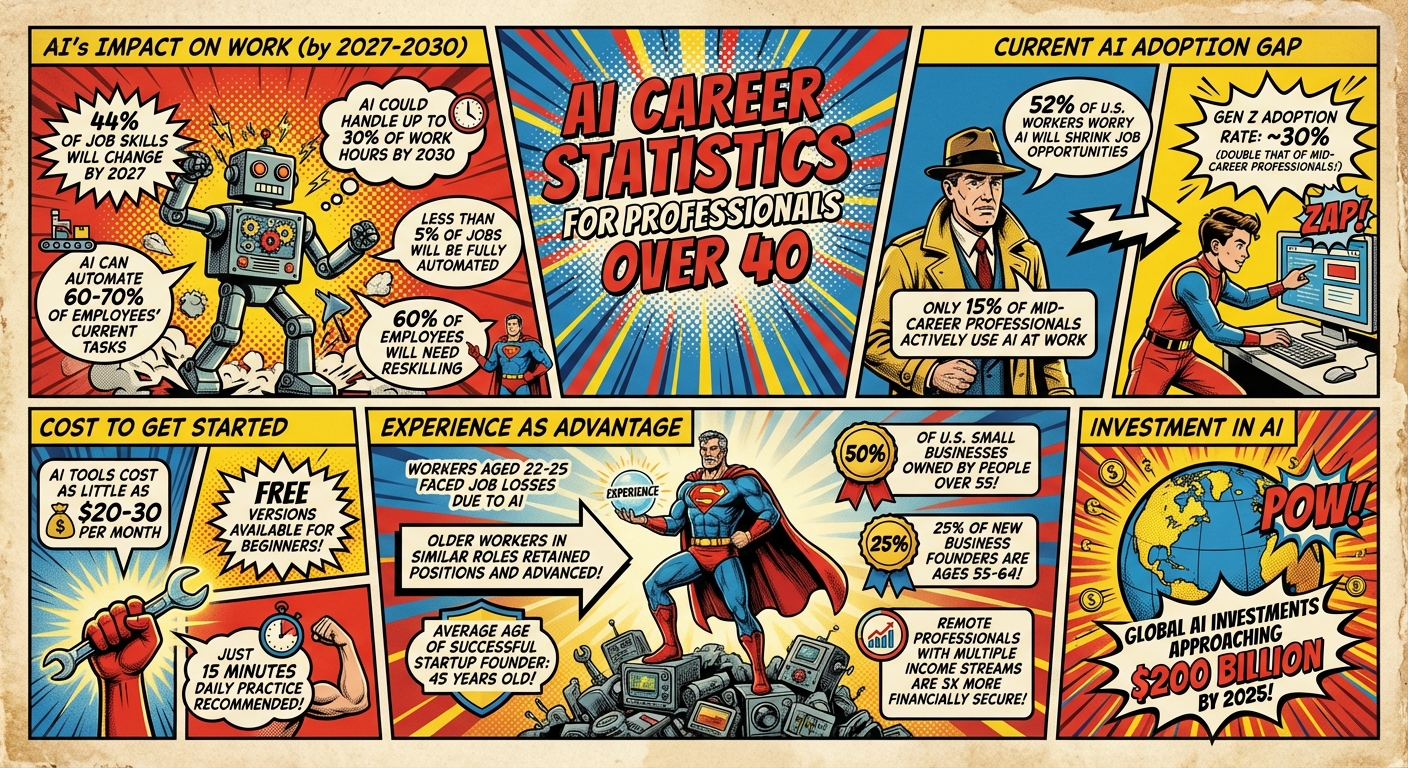
- AI won’t replace you, but someone who knows how to use it will. By 2027, 44% of job skills will change, and AI could handle up to 30% of work hours.
- Your expertise matters more than ever. AI is great at repetitive tasks, but it can’t match decades of judgment, relationship-building, or decision-making.
- Small steps make a big difference. Spend just 15 minutes a day learning tools like ChatGPT or Claude to build confidence and skills.
- Entrepreneurial freedom is the new job security. AI lets you turn your knowledge into scalable income streams by becoming your own fractional AI officer, consulting, or creating digital products.
This isn’t about starting over – it’s about working smarter. Tools like ChatGPT cost as little as $20 a month and can save hours of time. The key? Use AI to amplify your skills, not replace them.
AI Career Statistics for Professionals Over 40: Job Impact and Adoption Rates
1. From Fear to Familiarity
The real hurdle with AI isn’t the technology itself – it’s the fear that stops people from even trying. Right now, 52% of U.S. workers worry that AI will shrink job opportunities in the next few years, yet only 15% of mid-career professionals actively use AI at work. That’s nearly half the adoption rate of Gen Z. This isn’t about skill; it’s about hesitation.
The best way to get past this hesitation? Start small. Choose a single tool like ChatGPT or Claude and spend just 15 minutes a day experimenting in a low-pressure setting where mistakes don’t matter. Use it to tackle tasks you’re already familiar with – like summarizing email threads, drafting meeting agendas, or brainstorming ideas. As one expert explains:
People do not fear technology; they fear irrelevance. Five minutes of focused practice can flip that anxiety into curiosity.
You don’t even need to spend much to get started. While tools like ChatGPT Plus cost $20–$30 per month, their free versions are more than enough for beginners. Focus on consistency, not perfection. A simple strategy like “rough prompt, review, tweak” can help you build confidence and intuition over time.
If you’re looking for step-by-step guidance, platforms like Serve No Master offer training tailored for professionals over 40. These programs focus on real-world applications, skipping the abstract theory, so you can quickly integrate AI into your daily work. They even offer a free “ChatGPT Profits” book with 25 practical ways to use AI and tips to avoid common beginner mistakes.
Ready to leave the job you hate and find the fastest path to online wealth? Learn the best asset you have right now to leverage income and build financial run way in my bestseller "Fire Your Boss." Click here to download the book for free.
After just four weeks of consistent 15-minute practice sessions, you’ll go from feeling like an outsider to an active user. That’s when AI stops being intimidating and starts becoming a tool you can control.
2. From Solo Expert to Lifelong Learner
Once you’ve tackled your initial concerns about AI, the next step is to shift gears and commit to ongoing learning.
Your two decades of experience are invaluable, but staying relevant means adding new skills to your toolkit. By 2027, nearly half – 44% – of workers’ core skills are expected to change. This constant evolution in the workplace means you’ll need to actively update your expertise to stay ahead.
Let’s be honest – starting fresh at 40 or 50 can feel daunting. But adopting a lifelong learning mindset doesn’t mean tossing aside everything you’ve built. Instead, it’s about combining your well-earned judgment and expertise with AI tools that can handle repetitive or time-consuming tasks. Recruiters today are looking for professionals who can blend their existing knowledge with the ability to grow and adapt.
The good news? Structured learning makes this transition a lot smoother. Platforms like Serve No Master are tailored for professionals over 40, offering courses on AI tools, business automation, and content creation with AI. These programs focus on practical, actionable lessons you can implement immediately in your work.
The secret to success isn’t cramming – it’s consistency. Dedicating just 15–30 minutes a day to focused learning can help you close a 1% daily gap. Over time, these small, steady efforts add up. Your experience is your foundation, and with regular learning, you’ll keep building on it.
3. From Task-Doer to AI Collaborator
Once you’ve picked up new skills, it’s time to rethink how you approach work. The real game-changer isn’t just using AI – it’s shifting your role from doing everything yourself to orchestrating how the work gets done. This approach builds naturally on the learning mindset we talked about earlier.
Generative AI has the potential to handle tasks that currently take up 60% to 70% of employees’ time. By 2030, AI could automate as much as 30% of total work hours across the U.S. economy. But here’s the catch: AI is expected to fully automate fewer than 5% of jobs. So, while your tasks may change, your role remains essential.
The professionals who succeed are the ones who let AI handle the heavy lifting – like drafting, data crunching, and repetitive processes – while they focus on the final 10%. That last bit is where your expertise, judgment, and strategy come into play. Think of it like conducting an orchestra: AI plays the instruments, but you’re the one setting the tempo and ensuring harmony. For instance, AI can transcribe meetings and pull out action items, but you step in to confirm accuracy and make decisions. AI might draft a proposal based on your notes, but you refine the pricing and add the personal touches that seal the deal.
"You aren’t going to lose your job to an AI, but you are going to lose your job to a human who knows how to use AI." – Greg Isenberg, CEO of Late Checkout
Start by identifying your biggest time-wasters. Look for tasks that take more than 15 minutes and happen often, like sorting emails, creating reports, or entering data between systems. These are your "time thieves." Prioritize automating these repetitive and routine tasks first. AI tools can handle things like drafting pipeline emails or preparing meeting minutes. By offloading these duties, you’ll have more time to focus on strategic projects that actually move the needle in your career.
This collaborative approach is especially powerful for seasoned professionals over 40. It lets you combine your experience with AI’s efficiency to stay ahead. Programs like Serve No Master offer step-by-step training to help you integrate automated systems into your workflow, turning scattered tools into a streamlined, high-performance setup.
4. From Age as Barrier to Experience as Advantage
By incorporating AI into your skill set, your decades of experience become a powerful asset in today’s fast-changing job market. Interestingly, AI often disrupts younger professionals while amplifying the value of seasoned expertise. A Stanford University study from 2025 revealed that workers aged 22–25 faced job losses due to the rise of generative AI, whereas older workers in similar roles not only retained their positions but sometimes even advanced. The reason? AI thrives on performing straightforward, entry-level tasks but falls short in replicating the depth and complexity that comes with years of experience. This shift highlights the distinct advantage your expertise brings to the table.
Your experience isn’t a hurdle – it’s your competitive advantage. While AI can process massive amounts of data in seconds, it can’t interpret the subtle reasons behind market shifts or gauge the dynamics of a tense meeting. That’s where you shine. Think of AI as a tool for enhanced decision-making: it delivers quick insights, while you provide the judgment and strategic foresight.
Take the example of Stuart Morris, a 60-year-old IT Program Manager who drew on three decades of expertise to lead successful IT integrations for a global law firm. Similarly, studies reveal that older entrepreneurs frequently outperform their younger counterparts. Nearly 25% of new business founders in recent years have been between the ages of 55 and 64. In late 2024, Matthew Grzybowski used his 20 years of consulting experience to launch Southampton Dog, a holistic dog care facility in New York. The business became profitable shortly after opening, proving how leveraging expertise can outmatch competing on age alone.
To stay ahead, refine your professional profile to highlight the combination of deep experience and AI proficiency. For instance, update your LinkedIn headline to something like "Senior [Role] | Driving Results with AI" to showcase your tech readiness. On your resume, use terms like "prompt engineering" or "human-in-the-loop" to navigate algorithmic biases that may favor younger candidates. When using AI tools, treat them like junior team members – give them clear instructions, context, and constraints for better results. This ability to guide AI effectively is what sets experienced professionals apart from those who settle for surface-level answers.
Platforms like Serve No Master are designed to help professionals over 40 blend AI literacy with their existing expertise, turning years of knowledge into scalable, automated income streams. Instead of starting over, you’re enhancing what you’ve already built – transforming your career into one shaped by independence and opportunity. That’s not just adapting to change; it’s thriving on your terms.
5. From Job Security to Entrepreneurial Freedom
Your experience is your secret weapon, and it’s time to rethink what "job security" really means.
The days of stable corporate jobs guaranteeing lifelong security are fading fast. By 2030, 40% of employers plan to cut staff, and 60% of employees will need to reskill – yet many won’t get the support they need from their companies. The reality? Stability isn’t tied to one employer anymore; it’s about how well you can adapt.
AI is your ally here. It can take over time-consuming tasks like research, drafting, scheduling, and responding to inquiries, giving you the freedom to focus on what really matters – strategy. This means you’re no longer tied to a single role. Instead, you can juggle multiple high-value consulting gigs, embracing what’s known as a "portfolio career." This shift, from traditional roles to AI-augmented work, makes you more agile and financially resilient. In fact, remote professionals with multiple income streams are three times more financially secure.
Your experience gives you a massive advantage. Did you know the average age of a successful startup founder is 45? Even more impressive, a 50-year-old founder is 1.8 times more likely to create a thriving company than someone younger. Half of small businesses in the U.S. are owned by people over 55. Pair that expertise with AI tools, and you can turn your knowledge into scalable digital products – think consulting bots, specialized workflows, ebooks, or automated newsletters – that bring in income with minimal effort.
"AI has shifted the focus from technical skills to domain expertise and effective communication, areas where older workers often excel." – Katerina Stroponiati, Founder, Brilliant Minds
This shift isn’t just about staying relevant – it’s about turning everything you’ve learned into something bigger. Your journey from employee to entrepreneur builds on the foundation of experience and continuous learning, allowing you to innovate in ways that feel natural and impactful.
Platforms like Serve No Master are designed specifically for professionals over 40, helping you turn your career expertise into passive income streams. Rather than starting from scratch, you can refine and expand on what you already know, creating automated, location-independent businesses. With AI handling the grunt work and your expertise steering the ship, you’re not just working – you’re building your future on your terms.
Conclusion
The five mindset shifts we’ve discussed aren’t just suggestions – they’re the foundation for staying relevant and thriving in a fast-changing world. The AI revolution is accelerating, and adapting to it is no longer optional. Skills that are essential today could be outdated within five years, with 60% of employees expected to need reskilling due to AI’s impact. The question isn’t whether change is coming – it’s whether you’ll step up to lead it.
Your years of experience hold immense value in ways AI simply can’t replicate. Tacit knowledge, emotional intelligence, and the ability to handle complex, ambiguous situations are uniquely human strengths. Even as global investments in AI approach $200 billion by 2025, the technology still depends on human judgment and strategic thinking. Greg Isenberg, CEO of Late Checkout, captures it perfectly:
"You aren’t going to lose your job to an AI, but you are going to lose your job to a human who knows how to use AI".
Now’s the time to take action. Dedicate a few minutes each day to mastering AI tools. Experiment with prompts, refine your skills, and update your professional profile to highlight your ability to collaborate with AI. With advanced AI tools available for as little as $20 to $30 per month, the cost of entry has never been so accessible.
If you’re looking to turn your expertise into a sustainable, location-independent income, platforms like Serve No Master can help. They offer targeted training to guide professionals through AI tools, automation, and digital business creation. You don’t have to tackle this alone – there are resources to help you navigate this shift and unlock new opportunities.
Your experience is your greatest asset. Combine it with AI-driven tools to reshape your career and create the freedom to live and work on your terms. The future is here – make it yours.
FAQs
Which AI skills should I learn first after 40?
Begin by focusing on AI skills that you can put to use right away – no coding required. Start with the basics: grasp key AI concepts, learn how to ask precise and effective questions, and explore tools that can streamline your daily tasks.
One critical skill is prompt fluency, which means crafting clear, detailed instructions for AI tools like ChatGPT. This can make all the difference in getting useful results. You’ll also want to understand how AI can support better decision-making, whether it’s analyzing data or identifying patterns you might miss on your own.
Mastering these skills allows you to automate repetitive tasks, tailor AI solutions to your specific needs, and gain the confidence to make AI work for you. It’s all about learning how to integrate AI into your workflow to save time and improve outcomes.
How can I use AI at work without risking mistakes or privacy issues?
To integrate AI responsibly into your work, here are some essential steps to keep in mind:
- Emphasize Human Strengths: Focus on skills like emotional intelligence, sound judgment, and creative thinking – areas where AI falls short. These will remain your edge in a tech-driven environment.
- Learn AI Tools Inside Out: Dive into how AI works, especially for tasks like automation or decision-making. But don’t just rely on it blindly – always maintain control and review its outputs.
- Keep Learning: Stay in the loop with the latest AI advancements and privacy practices. This helps you navigate risks while staying competitive.
By following these steps, you can protect sensitive information, avoid common pitfalls, and still use AI to enhance your efficiency.
What’s a realistic first AI-based side income I can start with my experience?
A practical way to dip your toes into AI-based side income is by using AI tools to craft simple automation projects or micro-SaaS solutions. For example, you could create a ChatGPT-powered booking bot in just a few minutes and potentially bring in around $400 a month. Another option? Automate time-consuming tasks like taking meeting notes or generating content, then turn those efficiencies into services people are willing to pay for. Begin with straightforward, high-demand tasks, and expand as you gain more experience.
Related Blog Posts
- How to Start a Side Hustle While Working Full Time
- How to Quit Your Job and Work for Yourself in 2026
- Ultimate Guide to Fractional Chief AI Officer Certification
- How to Validate Business Ideas Before Quitting Your Job
Ready to leave the job you hate and find the fastest path to online wealth? Learn the best asset you have right now to leverage income and build financial run way in my bestseller "Fire Your Boss." Click here to download the book for free.