
AI Chatbots for E-Commerce: ROI and Benefits
AI chatbots are changing how e-commerce businesses interact with customers. The bottom line? They save money, boost sales, and deliver results fast. Here’s what you need to know:
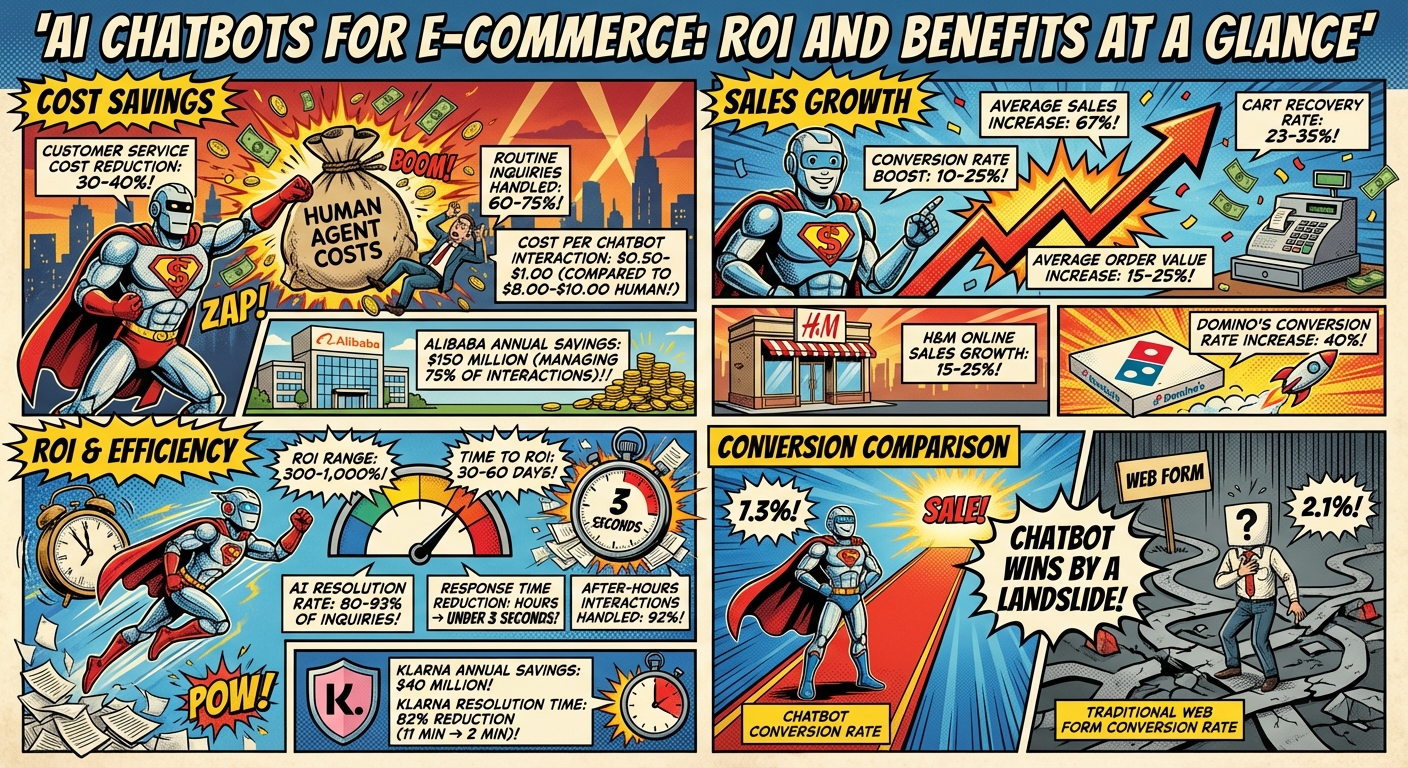
- Cost Savings: Chatbots reduce customer service costs by 30%–40%, handling up to 75% of routine inquiries for just $0.50–$1.00 per interaction compared to $8.00–$10.00 for human agents.
- Sales Growth: Businesses see a 67% average sales increase, with chatbots boosting conversion rates by 10%–25% and recovering up to 35% of abandoned carts.
- Fast ROI: Companies report a 300%–1,000% return on investment within 30–60 days of implementation.
- 24/7 Availability: Chatbots handle 92% of interactions outside business hours, ensuring no missed sales opportunities.
Real-world examples include:
- Alibaba: Saved $150 million annually by automating 75% of customer interactions.
- H&M: Increased online sales by 15%–25% with personalized chatbot recommendations.
- Domino’s: Boosted conversion rates by 40% with instant chatbot ordering.
AI chatbots aren’t just tools – they’re a necessity for staying competitive in e-commerce. Building a high-performing tech stack with the right business tools is essential for this growth. Whether you’re cutting costs, recovering lost sales, or improving customer satisfaction, the numbers make it clear: chatbots deliver measurable results.
AI Chatbot ROI and Performance Metrics for E-Commerce
ROI Data for AI Chatbots in E-Commerce
ROI Numbers You Should Know
The financial impact of AI chatbots is anything but hypothetical – it’s measurable and often impressive. Companies report first-year returns on investment (ROI) ranging from 300% to over 1,000%, with many seeing results within just 30 to 60 days of implementation. These quick returns come from reduced operational costs, additional revenue, and better use of human resources.
AI chatbots can cut customer service expenses by 30% to 40% in the first year alone, thanks to their ability to handle 60% to 75% of repetitive inquiries without human intervention. But it’s not just about cutting costs – chatbots also help drive revenue. They provide 24/7 sales support and engage customers proactively. Many e-commerce businesses have reported a 10% to 25% boost in conversion rates and a 15% to 20% increase in average order values when AI-powered recommendations are in play.
Efficiency gains are another major benefit. By offloading routine Tier-1 tickets, human agents can focus on more complex issues, handling three to four times as many cases. AI agents resolve between 80% and 93% of customer inquiries on their own, slashing response times from hours to under 30 seconds. These numbers aren’t just statistics – they’re backed by real-world examples.
Ready to leave the job you hate and find the fastest path to online wealth? Learn the best asset you have right now to leverage income and build financial run way in my bestseller "Fire Your Boss." Click here to download the book for free.
Cost Savings Examples
Real-world success stories highlight the scale of savings AI chatbots can deliver. For instance, in June 2024, Alibaba Group reported saving over $150 million annually by using AI chatbots across its e-commerce platform. These chatbots manage 75% of online interactions – about 10 million conversations daily – while also increasing customer satisfaction in dispute resolutions by 25%.
Smaller businesses are also reaping the benefits. Moonrise Apparel, a Shopify brand, introduced an AI agent in September 2025 that recovered 29% of abandoned carts, translating into $18,000 in monthly recovered revenue. Their customer support response times plummeted from 12 hours to under 30 seconds. Similarly, Create Wellness implemented a Rep AI shopping assistant in June 2025 and saw shoppers interacting with the AI achieve an average order value of $94 – 25% higher than their typical AOV – while recovering 35% of abandoned carts.
For businesses managing thousands of customer interactions daily, these savings can quickly snowball into millions of dollars annually.
Main Benefits of AI Chatbots in E-Commerce
Higher Conversion Rates
AI chatbots are game-changers when it comes to turning visitors into customers. In a six-month study involving 1,247 businesses, chatbots achieved a visitor-to-customer conversion rate of 7.3%, compared to only 2.1% for traditional web forms. Timing is everything here: when chatbots respond within three seconds, conversion rates hit 5.7%. But if there’s a delay of up to five minutes, that number can plummet to 1.8% or even lower. The secret? Chatbots don’t just collect information – they guide users through the buying process with targeted, conversational questions. As Dr. Amy Wong, a conversion expert, puts it:
"Conversations allow progressive disclosure. People will answer 6 questions in a chat that they’d never answer in a form. It feels like help, not homework."
By engaging customers in real-time, chatbots not only boost conversions but also help recover lost revenue and improve customer loyalty.
Recovering Abandoned Carts
Cart abandonment is a major headache for e-commerce, with average rates of 69.57% on desktops and a staggering 85.65% on mobile devices. Chatbots tackle this issue head-on by stepping in when customers show signs of leaving. They address common pain points like unexpected shipping costs (48%), forced account creation (24%), and complicated checkouts (17%). While traditional abandoned cart emails recover less than 10.5% of lost sales, chatbots recover between 23% and 35%.
Take FashionForward Boutique, for example. By using chatbots to offer personalized style suggestions, they achieved a 34% cart recovery rate, doubling their monthly revenue from $47,000 to $91,000 in just six months.
Increased Customer Lifetime Value
Chatbots don’t just drive immediate sales – they build long-term customer relationships. Customers who interact with chatbots tend to spend 25% more than those who don’t. This is largely thanks to chatbots’ ability to remember past purchases, preferences, and support interactions, enabling them to deliver highly personalized product recommendations. Such personalization leads to a 40% boost in overall revenue, with AI-powered suggestions increasing sales by up to 30%.
Chatbots also encourage bigger purchases. Average order values jump by 15% to 25% when chatbots recommend complementary items or bundles, and 41.5% of shoppers say product recommendations are their favorite feature.
Before and After AI Chatbot Implementation
The impact of AI chatbots becomes crystal clear when comparing key metrics before and after their implementation. Here’s a snapshot of the transformation:
| Metric | Before AI Chatbot | After AI Chatbot |
|---|---|---|
| Conversion Rate | 2.1% (Form-based) | 7.3% (Conversation-based) |
| Response Time | Hours/Days | < 3 Seconds |
| Cart Recovery | 0% – 5% (Email only) | 23% – 35% |
| Support Costs | 100% (Human-only) | 60% (40% reduction) |
| Sales Increase | Baseline | +67% (Average) |
| Average Order Value | Baseline | +15% to +25% |
These numbers tell a powerful story. Businesses using AI chatbots see an average sales increase of 67%, with some implementations driving sales up by as much as 234%. When chatbots are integrated with CRM and inventory systems, the sales boost skyrockets to 94%.
It’s clear that chatbots are not just tools – they’re transformative assets for any e-commerce operation looking to grow.
Case Studies: Measured ROI with AI Chatbots
H&M: Driving Sales and Streamlining Support
H&M introduced AI-powered digital assistants designed to act as emotionally aware shopping companions. These chatbots could interpret customer emotions and provide tailored style advice and product recommendations across platforms like Kik and Facebook Messenger. Customers answered style-related questions and received curated outfit suggestions, which they could purchase directly through the chat.
The results were striking. H&M saw online sales grow by 15–25%, reduced customer response times by 70%, and increased engagement by 30%. By automating routine tasks like size inquiries, order tracking, and FAQs, the company allowed its human agents to focus on more complex customer needs.
Domino’s: Speeding Up Service and Boosting Conversions
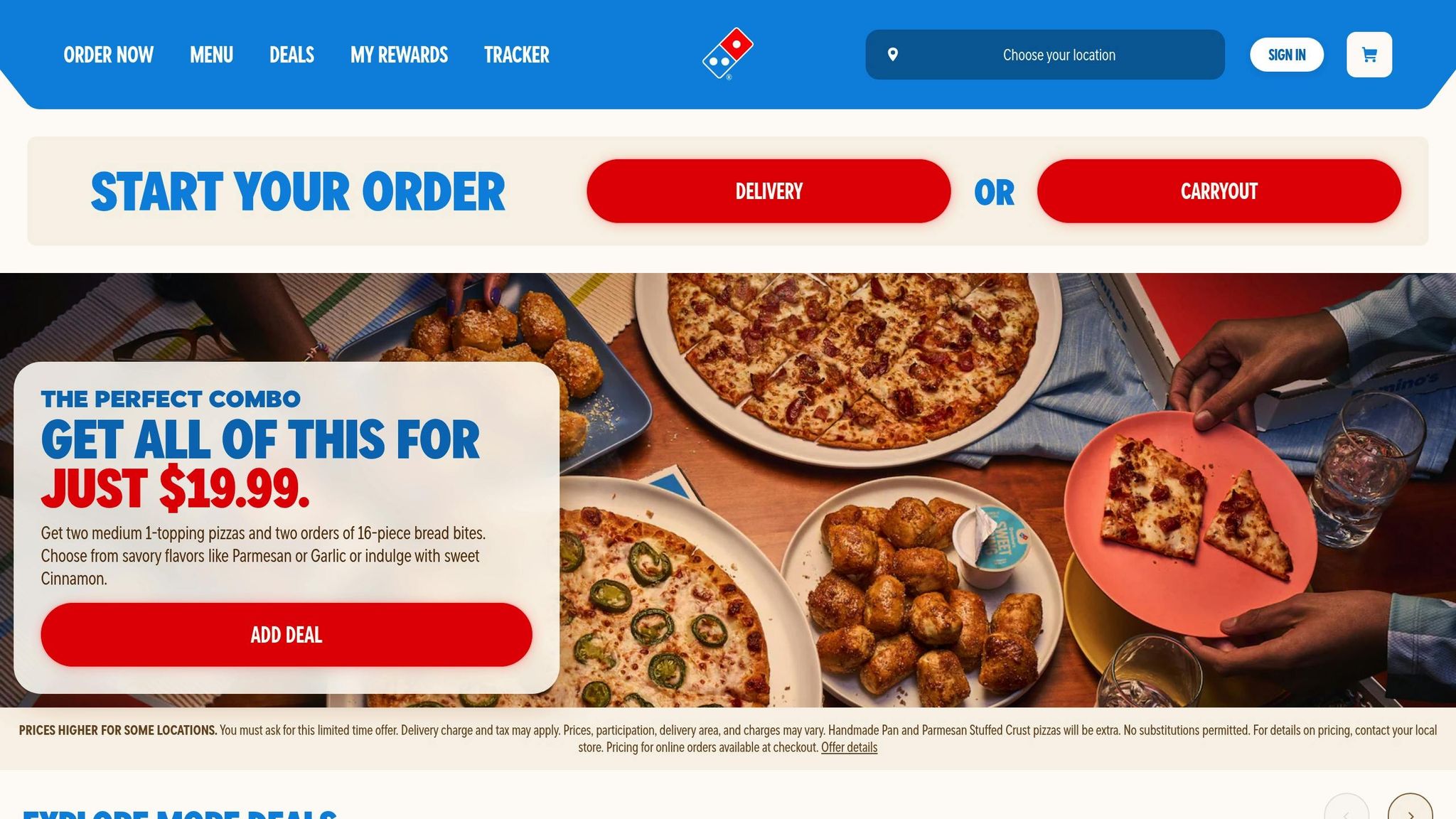
Domino’s implemented AI chatbots across its digital channels to handle orders and customer inquiries. These bots ensured instant assistance and guided users through the ordering process seamlessly. The impact? Support resolution times dropped by 25%, and conversion rates climbed by as much as 40%. For perspective, customers who interacted with chatbots converted at a rate of 12.3%, compared to just 3.1% for those who didn’t.
Klarna: Cutting Costs and Improving Customer Satisfaction
In early 2024, Klarna launched a custom GPT-4 assistant capable of handling tasks equivalent to 700 full-time agents. Within its first month, the AI managed 2.3 million conversations across 23 markets in more than 35 languages. The chatbot accessed real-time policies and order data, efficiently managing refunds, returns, and payments.
The financial benefits were substantial. Klarna saved $40 million annually, cut resolution times from 11 minutes to just 2 (an 82% drop), and improved customer satisfaction scores to 4.4 out of 5 – slightly higher than the 4.2 scored by human agents. Repeat inquiries also decreased by 25%, and the company recouped its implementation costs within months.
| Company | Key Metric | Result |
|---|---|---|
| H&M | Online Sales Growth | 15–25% increase |
| H&M | Response Time | 70% reduction |
| Domino’s | Resolution Time | 25% reduction |
| Domino’s | Conversion Rate | Up to 40% increase |
| Klarna | Annual Savings | $40 million |
| Klarna | Resolution Time | 82% reduction (11 min → 2 min) |
These examples highlight how AI chatbots can deliver measurable business results, from increased sales and faster resolutions to significant cost savings.
How to Calculate ROI for AI Chatbots
ROI Calculation Formula
To measure how AI chatbots turn cost savings and revenue boosts into measurable returns, you need a clear formula. The standard approach is: (Total Benefits – Total Costs) ÷ Total Costs × 100. This percentage reveals whether your investment is delivering results.
Total Benefits include savings from automating repetitive tasks, additional profits from higher conversions, and costs avoided by streamlining operations. On the flip side, Total Costs encompass subscription fees, initial setup expenses, ongoing maintenance, and usage fees for bots powered by large language models (LLMs).
Start by documenting baseline data – ticket volume, average handling time (AHT), cost per interaction, and conversion rates. Then, identify repetitive queries that can be automated. Studies suggest 40-70% of inquiries, such as order tracking and returns, fall into this category. Multiply these automatable queries by your current cost per human interaction to estimate savings.
For revenue gains, look at increases in conversion rates, recovered abandoned carts, and higher average order values driven by personalized recommendations. This is particularly impactful during after-hours, when 58% of website traffic typically occurs. A key point: always use gross profit per order, not total revenue, to avoid inflating your ROI estimate.
"ROI is a finance model, not a chatbot feature. If you don’t define what ‘benefit’ is in dollars and how you’ll measure it, you don’t have ROI. You have enthusiasm." – Social Intents
Once you’ve calculated your basic ROI, consider other elements that can shift your results.
Important Factors to Consider
ROI isn’t just about the numbers – it’s also influenced by operational factors. Speed of response plays a huge role. Vendors who respond first capture 35-50% of sales, and chatbots reduce response times from hours to just 3 seconds. This speed advantage can significantly boost revenue.
After-hours performance is another game changer. If your conversion rate drops from 3.2% during business hours to 0.4% at night, you’re leaving money on the table. AI chatbots fill this gap by offering 24/7 engagement, ensuring consistent results around the clock.
Most companies recover their investment in 3-6 months, with some seeing positive ROI in less than a month. Websites using AI chatbots often experience a 23% increase in conversion rates, and sales teams can see a 45% efficiency boost by filtering out unqualified leads.
Don’t forget ongoing costs, such as a monthly allocation for "knowledge ops" to update your chatbot’s knowledge base and review transcripts. Plan for about two hours of maintenance each month to keep your bot running smoothly and prevent ROI from slipping.
Lastly, be cautious with your calculations. Avoid counting the same savings twice. For instance, don’t double-dip by including containment savings as avoided labor costs while also factoring them into AHT reductions. When calculating labor costs, include benefits and overhead – typically 25-35% of salary – for a more accurate and defensible ROI model.
Conclusion: Growing Your Business with AI Chatbots
AI chatbots have evolved far beyond simple support tools – they’re now a powerful driver of revenue. Within just 3–6 months, these systems can pay for themselves, delivering an impressive 200% ROI through higher conversion rates, effective cart recovery, and reduced support costs.
The pace of change in the market is staggering. By 2025, it’s estimated that AI will handle 80% of all customer interactions. This shift makes chatbots less of an option and more of a necessity. As tech analyst Robert Kim aptly puts it:
"This is an iPhone moment. Businesses that don’t adopt conversational interfaces will be like retailers who didn’t go online. Extinct."
AI chatbots don’t just replace old service models – they reshape how businesses engage with customers, turning interactions into ongoing opportunities for revenue. What sets them apart is their ability to scale without increasing costs. Whether managing 500 or 15,000 customer inquiries, these systems maintain peak performance during high-demand periods, like Black Friday, freeing your team to focus on complex, high-value tasks. Additionally, every interaction doubles as a source of customer insights, helping refine your product offerings and marketing strategies.
The effectiveness of AI chatbots isn’t up for debate – case studies from companies like H&M, Domino’s, and Klarna clearly demonstrate their impact. The real strategic advantage lies in adopting these tools before your competitors do, giving you a head start in customer engagement and operational efficiency. Start small with one high-impact use case, track your results, and expand from there.
Beyond customer service, AI tools can transform your entire business model. Platforms like Serve No Master provide in-depth training on building automated, location-independent businesses. Integrating AI chatbots into your strategy could be the key to revolutionizing your e-commerce operations starting today.
FAQs
How do AI chatbots deliver a strong ROI for e-commerce businesses?
AI chatbots are game-changers for e-commerce, delivering results that make a real difference. They can recover up to 35% of abandoned carts, increase conversion rates by up to 4x, and slash customer support costs by as much as 70%. These gains often translate into a 200% return on investment within just 3 to 6 months.
By handling repetitive tasks, tailoring customer interactions, and offering immediate support, AI chatbots don’t just drive revenue – they make shopping smoother and more enjoyable. They’re quickly becoming a must-have tool for businesses looking to grow and stay competitive.
What are the key advantages of using AI chatbots to recover abandoned carts?
AI chatbots bring clear benefits when it comes to tackling abandoned carts in e-commerce. They can recover as much as 35% of abandoned carts by interacting with customers in real-time through tailored messages. This approach can boost conversion rates by up to 37%, directly impacting sales.
On top of that, businesses using these tools can achieve an impressive ROI ranging from 148% to 200%, thanks to a potential 27% reduction in cart abandonment rates. Beyond just improving sales, these chatbots elevate the shopping experience, making them an essential tool for online retailers looking to grow their revenue.
How do AI chatbots boost customer lifetime value in e-commerce?
AI chatbots are changing the game for e-commerce by delivering personalized shopping experiences that keep customers engaged and coming back for more. They boost conversion rates by providing real-time assistance, help recover abandoned carts by re-engaging shoppers, and drive repeat purchases with customized recommendations and instant support.
With 24/7 availability and streamlined communication, chatbots not only make customers happier but also help increase sales and build long-term loyalty. They’re quickly becoming a must-have tool for businesses looking to maximize revenue in the competitive world of online shopping.
Related Blog Posts
- How to Quit Your Job and Work for Yourself in 2026
- How Do I Create Passive Income Streams? 8 Answers
- How to Validate Business Ideas Before Quitting Your Job
- How ChatGPT Helps Identify Profitable Niches
Ready to leave the job you hate and find the fastest path to online wealth? Learn the best asset you have right now to leverage income and build financial run way in my bestseller "Fire Your Boss." Click here to download the book for free.