The Best AI Web Designer? I Made GLM 5.1, MiniMax M3 and Kimi K2.7 Code Build the Same 10 Pages
Primary keyword (RankMath): best ai for web design
I keep getting asked the same question. Which AI model actually builds the best website?
So I stopped guessing and ran the test.
I took three models — GLM 5.1, MiniMax M3, and Kimi K2.7 Code — and gave all three the exact same job. The same 10 web pages. The same prompt. The same customer copy, word for word. Thirty pages in total.
Then I put every result side by side so you can judge for yourself.
Here’s my verdict up front, because I’m not going to bury it. There is no single winner. GLM 5.1 is the strongest all-around designer by a wide margin. But MiniMax M3 pulled off a surprise on two pages that I genuinely did not see coming. And the answer to “which one is best” honestly comes down to your taste.
Want to master ChatGPT in a single day? Download my bestseller "ChatGPT Profits" absolutely free. Click here to download the book.
I walk through all 10 pages on camera, three at a time ↓
https://youtu.be/HWts72dvsgM
The One Thing That Surprised Me First
Before any of the design stuff, here’s the finding that settles half the argument.
All three models keep your words.
I checked the copy on every single page, and the wording came through almost perfectly across all three — somewhere around 98 to 100 percent. The only real slip was Kimi K2.7 Code mangling part of the contact block on the law firm page.
So none of this comes down to which model can write. They all keep your copy.
It all comes down to which one can design.
The 10 Pages, Three Ways
I picked 10 pages across five categories so this wasn’t a one-trick test: two SaaS homepages, two blog articles, two e-commerce product pages, two case studies, and two local-business contact pages.
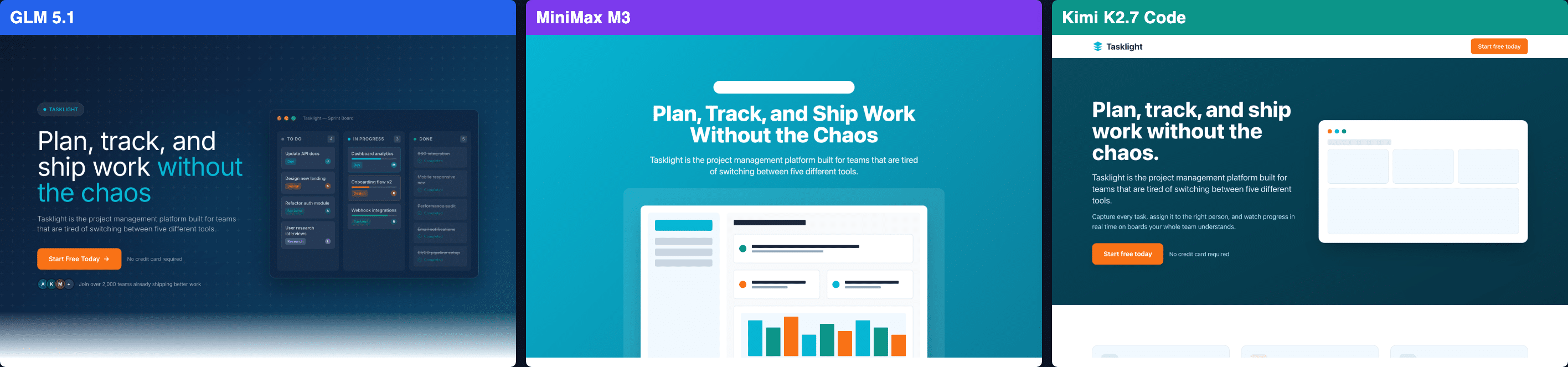
Take the very first one. A project-management homepage for an app called Tasklight.
GLM 5.1 goes product-first. It builds a dark, polished hero and drops a full working task board on the right — real columns labeled To Do, In Progress, and Done. You see the actual app the second the page loads.
MiniMax M3 takes the calm route. The headline sits centered over one clean dashboard graphic with a lot of open space around it.
Kimi K2.7 Code keeps it lean. A header, the headline, and a simple browser frame where the product shot would go.
Same page. Three completely different personalities. And that pattern held for all 10.
Where GLM 5.1 Pulls Ahead
I sent all 30 results to my business partner and had him pick the standout each time. He flagged GLM 5.1 on seven of the page types.
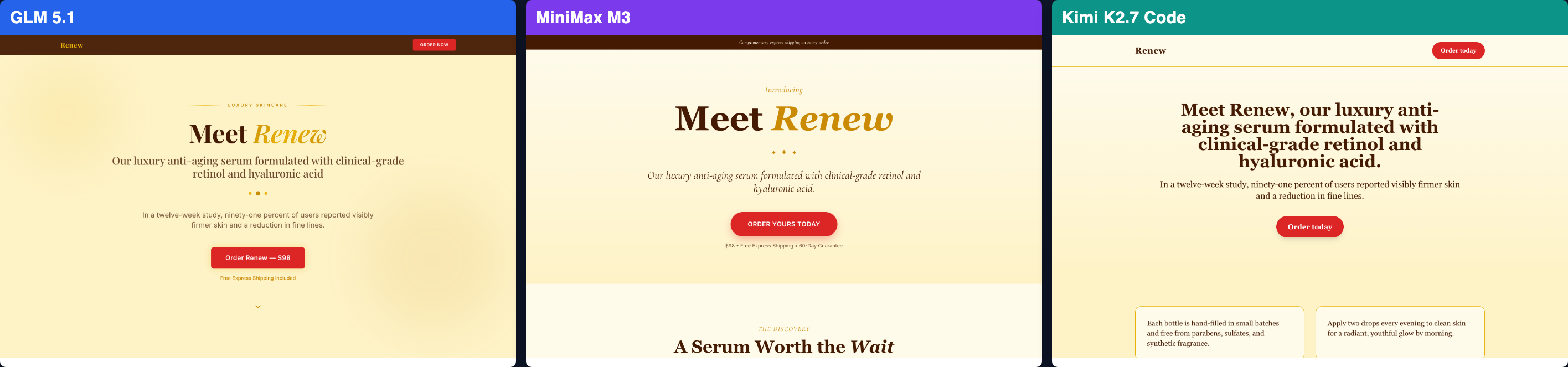
It makes sense once you see the builds. GLM 5.1 ships roughly twice the page of the other two. On the luxury serum product page it nailed the high-end beauty look — soft cream background, refined serif type, the $98 price sitting right on the buy button. On the coaching case study it built a dramatic, fully-designed story page with a dark hero and a bold result.
When you want the richest, most finished page out of the box, GLM 5.1 is the one doing the most work for you.
If you’re building something like a coach or consultant site, this is the exact problem I dug into when I wrote about building a business coaching website — the design carries the trust.
The Surprise: MiniMax M3 Owns the Contact Pages
Here’s the part I didn’t expect.
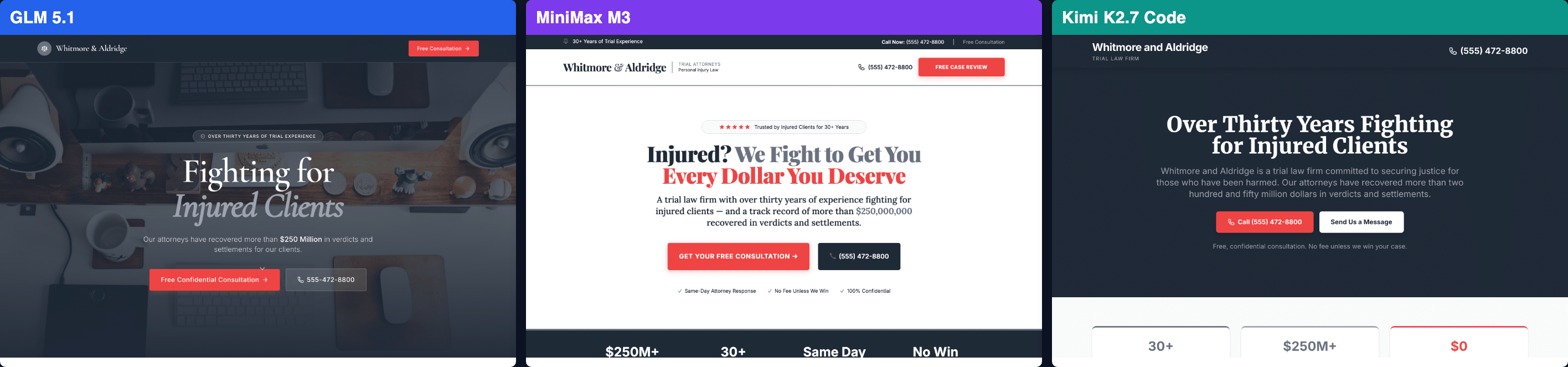
The two pages I keep coming back to both came from MiniMax M3. The law firm and the restaurant. The two contact pages.
On the law firm, MiniMax M3 went straight for trust and conversion — a clean, professional layout with trust badges, a clear phone number, and the firm’s case results right up top. On the restaurant, it built the full reservation experience, walking you step by step toward booking a table.
And here’s why that’s funny. MiniMax M3 is already the model I use for my coding. The pages that are mostly clean structure and a form went to the coding model.
That dovetails perfectly with my earlier test of it as a coding tool, and now I understand why it shines exactly where structure beats flourish.
What About Kimi K2.7 Code?
Kimi K2.7 Code built the leanest pages of the three. The coaching case study came back as a single clean white card — the name, the story, and nothing else competing for attention.
It took zero standout picks. But “lean” isn’t automatically worse. A few of Kimi K2.7 Code’s stripped-back pages might be exactly your taste if you like simple and direct.
Does Price Change the Answer?
A little. Here are the real numbers, per million tokens.
| Model | Input | Output |
|---|---|---|
| MiniMax M3 | $0.30 | $1.20 |
| GLM 5.1 | $0.98 | $3.08 |
| Kimi K2.7 Code | $0.75 | $3.50 |
GLM 5.1 runs about three times the price of MiniMax M3. And the strange one is Kimi K2.7 Code — it’s a coding model, it’s the most expensive on output, and it didn’t win a single page.
But here’s the thing. Every one of these pages costs pennies to generate. Price isn’t going to stop you from testing all three yourself.
So Which One Should You Use?
That’s the real question, and I’m leaving it to you on purpose.
GLM 5.1 is the strongest all-around. MiniMax M3 owns the structured contact pages. Kimi K2.7 Code gives you the leanest, simplest builds.
Scroll back up, watch the side-by-side, and decide which one is winning you over. Because the best web designer right now is genuinely yours to pick.
Category: AI Tools
Want to master ChatGPT in a single day? Download my bestseller "ChatGPT Profits" absolutely free. Click here to download the book.