
How to Start a Side Hustle While Working Full Time
Starting a side hustle while working full-time is about building systems, not sacrificing all your free time. With 1 in 3 Americans already juggling side gigs and inflation making a single paycheck harder to rely on, now is the time to create an extra income stream. The key? Use AI and automation to save time and effort.
Here’s a quick breakdown of how to do it:
- Find profitable ideas: Use AI tools like ChatGPT to match your skills with real market demand.
- Validate quickly: Test your idea by landing your first paying customer within a month.
- Automate tasks: Tools like Zapier and n8n can handle repetitive work, from email automation to social media scheduling.
- Manage time smartly: Dedicate 10–15 hours weekly by blocking time and cutting low-value activities.
- Grow efficiently: Scale with AI, delegate low-priority tasks, and explore passive income streams like digital products.
The secret is working smarter, not harder. Start small, automate early, and let AI handle the heavy lifting while you focus on growth. Done is better than perfect – start today.
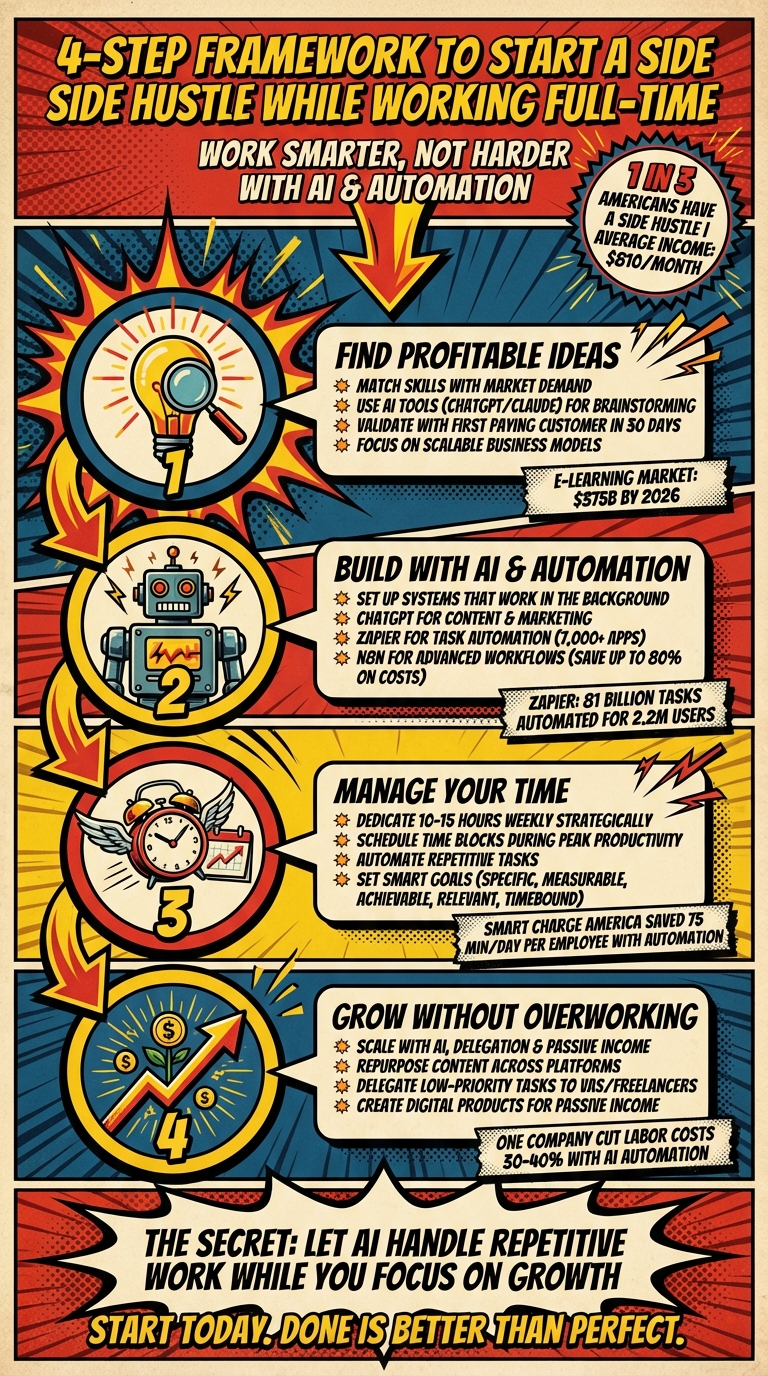
4-Step Framework to Start a Side Hustle While Working Full-Time
Step 1: Find Side Hustle Ideas That Make Money
The biggest mistake people make when starting a side hustle? Picking something exciting but unprofitable. A successful side hustle should align with your skills, fit into your schedule, and – most importantly – solve a problem people are willing to pay for. Nearly 40% of U.S. adults have a side hustle, with an average monthly income of $810. But that kind of success only happens if you choose an idea with real demand.
Use AI Tools to Spark Ideas
AI tools like ChatGPT or Claude can help you brainstorm business ideas in no time. The key is to be specific with your prompts. Instead of asking, "What side hustle should I start?" try something like:
"Give me 10 side hustle ideas based on skills in Excel, project management, and technical writing".
This method delivers ideas tailored to your strengths and expertise.
AI can also uncover hidden customer pain points. For example, you can ask ChatGPT to dig through Reddit communities related to your skills and identify common frustrations. If you’re great at organizing systems, check productivity or small business subreddits for recurring complaints. These insights can reveal problems people are eager to pay someone to solve. For those over 40, passive income models like digital products, automated newsletters, or faceless brands are excellent options – no need to appear on camera.
Ready to leave the job you hate and find the fastest path to online wealth? Learn the best asset you have right now to leverage income and build financial run way in my bestseller "Fire Your Boss." Click here to download the book for free.
Once you have a list of ideas, focus on finding business models that can grow with minimal effort.
Pick Growth-Friendly Business Models
Not all side hustles are created equal. Some require constant effort – trading hours for dollars – while others can scale without you being hands-on all the time. For example, the e-learning market is estimated to hit $375 billion by 2026, making digital products like online courses, templates, and planners a smart choice. These options allow you to earn income long after the initial work is done.
Other scalable ideas include niche websites that generate steady organic traffic, AI consulting services to help businesses streamline operations, or custom GPTs you can sell on the OpenAI GPT Store. If you have specialized expertise, coaching or fractional consulting can also be lucrative, often earning between $25 and $42 per hour. The key is avoiding ventures that lock you into constant manual work, like freelance gigs where you’re always chasing new clients.
Validate Your Idea Quickly
Before you dive in, make sure people are willing to pay for your idea. Use tools like Perplexity AI to refine your market research and gauge demand. Check Google Trends to see if interest in your niche is growing, and explore platforms like Etsy, Fiverr, or Reddit to analyze competitor pricing and customer feedback. Entrepreneur sums it up perfectly:
"The first goal in starting a business is going from zero to one – getting the first customer that values and pays for your work" (Entrepreneur).
Set a simple challenge for yourself: Can you land one paying customer in the first month? Offer your product or service at a discounted rate to friends, family, or a small online group to gather honest feedback. AI tools like ChatGPT can help you create a quick product description, business name, and launch checklist so you can hit the ground running without getting bogged down in admin work. If no one bites, pivot immediately. The goal isn’t to be perfect – it’s to prove that someone is willing to pay. As Microsoft advises:
"The first version doesn’t have to be perfect, just real. You can improve it as you go" (Microsoft).
Once your idea is validated, you’re ready to build your side hustle with automation.
Step 2: Build Your Side Hustle with AI and Automation
After validating your idea, it’s time to build your side hustle – without giving up all your free time. The key is to set up systems that work in the background while you’re busy with your full-time job. These systems, powered by technology, become the backbone of your business, keeping everything running smoothly. As Simone Astarita wisely notes:
"AI doesn’t replace your work – it amplifies it".
A great place to start is by using tools like ChatGPT to simplify content creation and marketing tasks.
Use ChatGPT for Content and Marketing
ChatGPT can churn out content and marketing materials in no time. Whether you need blog posts, social media updates, email campaigns, or product descriptions, ChatGPT has you covered. The trick is to be specific with your prompts. Instead of saying, "Write a blog post", try something like: "Create a 500-word blog post about time management tips for new freelancers, written in a friendly tone for solopreneurs."
One standout strategy is content repurposing. Take a single blog post and break it into smaller pieces – think social media snippets, video scripts, carousel graphics, or even Reddit comments. This way, you’re not constantly reinventing the wheel. For email marketing, ChatGPT can help draft subject lines, create lead magnets, and even build automated sequences to keep your audience engaged without you having to write every email manually.
Of course, AI isn’t perfect. Always review its output and add your personal touch. As Simone Astarita reminds us:
"Automation should remove repetitive work, not human connection. Always keep control of customer-facing communication – let AI handle background tasks like scheduling, emails, or research".
Automate Tasks with Zapier
Beyond content creation, Zapier is your go-to tool for automating repetitive tasks. It’s perfect for those who want to streamline workflows without needing coding skills. With connections to over 7,000 apps, Zapier has already handled more than 81 billion tasks for over 2.2 million users.
Start by automating simple, time-consuming tasks – things you do repeatedly that eat up your day. For example, you can:
- Automatically save email attachments to Google Drive.
- Sync new leads from social media to your CRM.
- Send a welcome email whenever someone joins your newsletter.
Even small teams have managed to automate millions of tasks, saving hours of work and boosting efficiency.
Zapier offers a free plan with 100 tasks per month, making it easy to test the waters. If you need more, paid plans start at $19.99/month for 750 tasks. To speed things up, check out Zapier’s "AI Starter Kit" templates for workflows like automated social media scheduling or AI-powered customer support.
Build Workflows with n8n
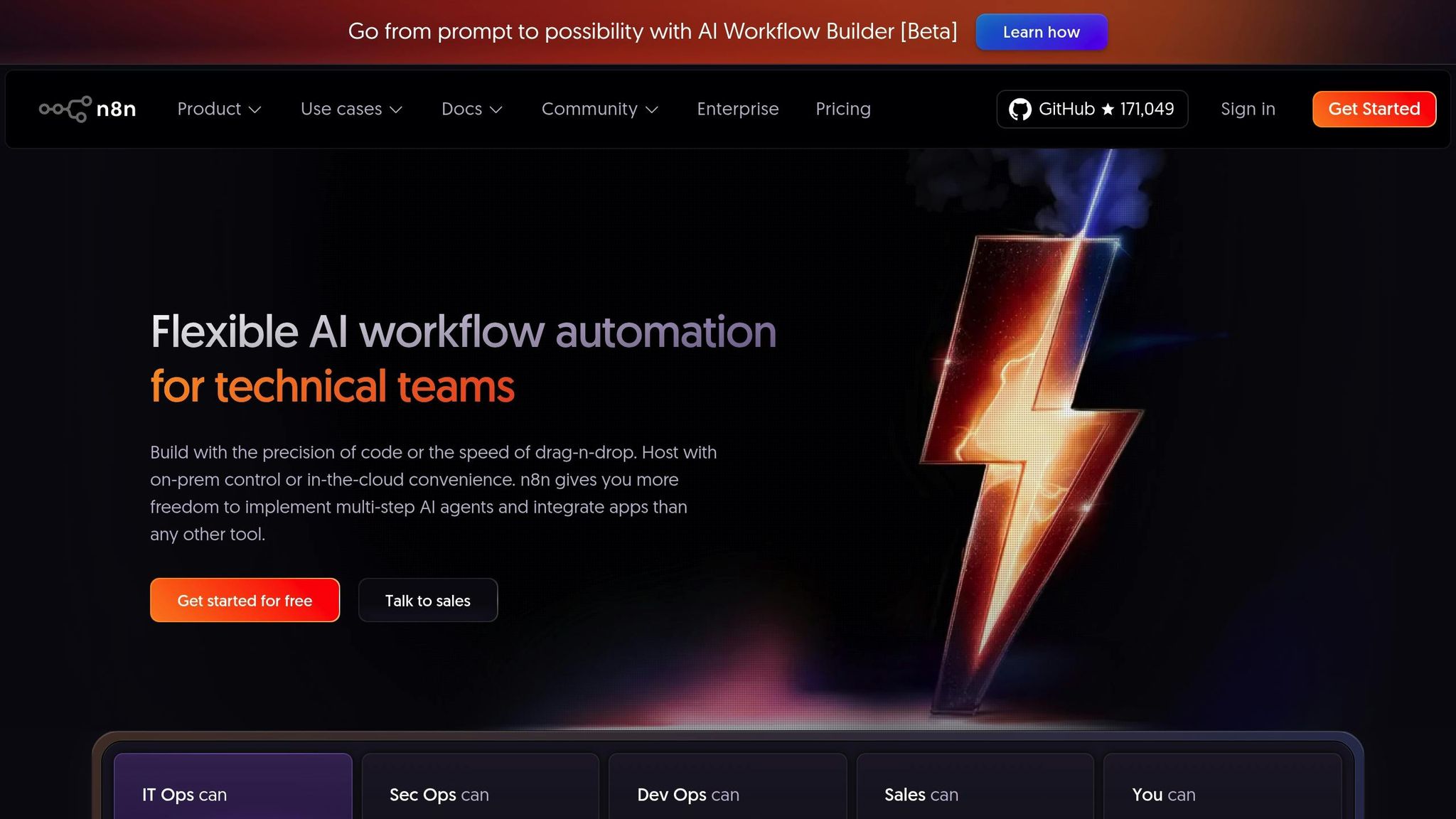
For more advanced workflows or cost-effective scaling, consider n8n. If you have basic technical skills or a desire to save money as your business grows, n8n is a great alternative. Unlike Zapier, which charges per task, n8n uses an execution-based pricing model – meaning an entire workflow counts as just one run. This makes it ideal for handling high volumes of automation without breaking the bank.
Take SageDev0’s example: they built a "Content Machine" using n8n that pulled research from spreadsheets, generated social media posts via AI, and scheduled them across five platforms. This reduced their costs from $49/month with Zapier to just $10/month with n8n for the same 2,000 tasks. Similarly, Susana Toth used n8n to create an automated blog pipeline. Her setup pulls keywords from a Google Sheet, uses AI to write content, performs SEO checks, generates images, and publishes directly to WordPress – allowing her to manage three websites simultaneously.
"With Zapier, you hit the ceiling fast… n8n has no ceiling. If you can imagine it, you can build it".
n8n offers a free self-hosted version or cloud plans starting at $20/month for unlimited executions. It’s perfect for workflows that involve loops, conditional logic, or AI integrations with OpenAI and Anthropic. If you’re just starting out, experiment with Zapier for quick setups, then switch to n8n for more complex, high-volume workflows as your side hustle expands.
Step 3: Manage Your Time
After setting up your automation systems, the next hurdle is carving out time for your side hustle. Most side gigs require just 10–15 hours a week. That might sound daunting with a full-time job already on your plate, but the trick isn’t squeezing more hours into the day – it’s making better use of the ones you already have.
Schedule Time Blocks for Your Side Hustle
Start by taking a hard look at your current schedule. How much time and energy do you realistically have left after work and personal responsibilities? This honest evaluation can save you from overcommitting and burning out.
Once you’ve got a clear picture, figure out when you’re most productive. Are you sharper in the early morning, or do you hit your stride at night? Entrepreneur and blogger Ryan Robinson puts it perfectly:
"Be selfish and give your passion project the best part of your day".
If mornings are your golden hours, consider setting your alarm earlier.
Don’t overlook smaller time pockets in your day, either. A lunch break, a train ride, or even the hour before work can be turned into productive moments for quick tasks. Just make sure to set firm boundaries – no side hustle work on your company computer, and keep weekends for rest whenever possible. Once you’ve mapped out your time, focus on cutting distractions and sticking to achievable goals.
Cut Out Repetitive Tasks with Automation
With your automation systems in place, it’s time to identify and ditch those time-draining tasks. Spend 30 days tracking how you use your time – it can be eye-opening to see how much of it gets eaten up by repetitive admin work like scheduling posts, formatting data, or sending follow-up emails.
Take a page from Smart Charge America’s playbook. In 2024, they implemented 77 automated workflows using Zapier, saving each estimator 75 minutes a day. These automations tackled over 18,000 tasks weekly, allowing the company to scale to 50 employees while maintaining the output of a 100-person team. David Laderberg, the company’s Vice President, shared:
"Without Zapier, we would have needed over 100 employees today just to do what we’re doing, which would have been unsustainable. We would have been out of business by now".
Your goal is to do the same: let automation handle the boring stuff so you can focus your energy on growth – whether that’s creating new products, engaging with customers, or fine-tuning your marketing.
Set Goals You Can Actually Reach
Now that your schedule is streamlined and repetitive tasks are automated, it’s time to set clear, achievable goals. Use the SMART framework to make each goal Specific, Measurable, Achievable, Relevant, and Timebound. For example, instead of vaguely aiming to "grow my business", try something like, "Gain 50 email subscribers by March 15, 2026, by posting on LinkedIn three times a week."
Stick to one side hustle at a time. Spreading yourself too thin can dilute your efforts. Focus on the project you’re most passionate about or the one that’s already gaining traction, and commit to steady progress. Ryan Hutchinson offers this advice:
"Give yourself patience to figure it out. Be consistent. Most of all, enjoy the journey!".
Even dedicating just 30 minutes a day to your side hustle can make a difference – whether that’s learning a new skill or taking steps toward your goals. Don’t worry about perfection at the start. What matters is launching, gathering feedback, and improving along the way.
Finally, cut out low-value activities. Take a hard look at how you spend your free time. Reducing Netflix marathons, video games, or endless social media scrolling can free up hours without sacrificing sleep or family time. These small adjustments can help you build something meaningful while keeping your life balanced.
Step 4: Grow Your Side Hustle Without Overworking
Growing your side hustle doesn’t mean piling on more hours – it means working smarter. Once you’ve set up your automated systems, the key to scaling lies in strategic moves that expand your reach without stretching your time thin. Let’s dive into how AI, delegation, and diversified income streams can help you grow without burning out.
Let AI Handle Content and Operations
For many side hustlers, creating content and managing customer communications can feel like a never-ending grind. But here’s the good news: you can turn one piece of content into a goldmine of material. For instance, a single blog post can be repurposed into social media updates, video scripts, email campaigns, and more – all with the help of AI.
AI doesn’t just stop at content. It can transform your operations, too. Take the example of an industrial goods company that cut labor costs by 30–40% and boosted revenue by automating 70% of quote requests. Eric Jesse, Managing Director & Partner at BCG, highlights the potential of AI:
"Instead of seeking incremental gains by automating discrete steps within a process, organizations should redesign entire processes end-to-end, with AI agents assuming different roles along the way."
You can apply this thinking to your side hustle by using AI tools to handle tasks like customer inquiries, organizing inbound requests, and managing routine communications. This frees up your time for what truly matters – developing your product, building partnerships, and planning your next big move. Make sure your automation systems – like auto-posting, scheduling, and delivery – are solid before you scale up.
Delegate Low-Priority Tasks
Once AI has streamlined your operations, it’s time to offload the tasks that don’t require your personal touch. Delegating these low-priority jobs allows you to focus on growth.
Virtual assistants can take care of admin work like sending newsletters, verifying links, or creating presentations. For more specialized tasks – like bookkeeping, graphic design, or product packing – consider hiring freelancers on a project or part-time basis. This way, you get professional results without taking on the workload yourself. Keep control over customer-facing interactions to maintain that personal connection, but let others handle behind-the-scenes work like research, scheduling, or data entry.
Expand Your Income Streams
With your time freed up, you can start exploring ways to add more income streams without overwhelming yourself. This doesn’t mean juggling multiple businesses – it’s about maximizing the potential of your current hustle. For example, you can create digital products like eBooks, templates, or automated email newsletters that you produce once and sell repeatedly. Affiliate marketing is another option, where you can set up automated email sequences to promote products you genuinely believe in.
You can even venture into faceless content creation. AI tools can help you produce scripts, voiceovers, and visuals for short-form video content, allowing you to grow a brand without needing to be on camera daily.
Before diving into a new income stream, take a moment to check your energy levels. How much time and effort can you realistically spare after work and family commitments? Focus on passive income models that align with your skills and existing systems. The goal here isn’t to create another full-time job – it’s to build assets that can grow in value over time with minimal effort.
Conclusion
Success isn’t about squeezing more hours into your already-packed schedule – it’s about creating systems that do the heavy lifting for you. Launching a side hustle while holding down a full-time job isn’t about working harder; it’s about working smarter. By validating your idea, automating repetitive tasks, managing efficiently, and scaling strategically, you can grow without burning out.
As Nipuna Maduranga, creator of LearnAItoprofit.com, wisely says:
Ready to leave the job you hate and find the fastest path to online wealth? Learn the best asset you have right now to leverage income and build financial run way in my bestseller "Fire Your Boss." Click here to download the book for free.
"While others are panicking about AI replacing them, you should be busy using it to replace your paycheck."
This perfectly captures the essence of what’s possible today. With AI and automation, you don’t need a big team or endless free hours to build something profitable. The tools are here to handle the grunt work that used to eat up your nights and weekends.
No matter your age – whether you’re 25 or 55 – the chance to create a self-sustaining income system has never been more within reach. The key is to automate early. Set up systems for content creation, scheduling, and distribution before you even launch. This ensures your side hustle keeps humming along, even during the busiest weeks at your day job.
You’re not a machine – AI is. Let it take care of the repetitive tasks so you can focus on what truly matters: strategy, building relationships, and driving growth. Your side hustle should grow steadily without draining your energy. Start small, experiment quickly, and build a system that works in the background while you keep your full-time job secure.
The most important step? Start today. Refine as you go. Done is always better than perfect.
FAQs
How can I use AI to discover a profitable side hustle?
AI can be an incredible ally when it comes to uncovering side hustle opportunities that actually fit you. By analyzing your skills, interests, and current market trends, tools like ChatGPT can help you brainstorm ideas that play to your strengths while zeroing in on areas with high demand. It’s like having a personal strategist that doesn’t sleep, constantly researching emerging industries and customer needs to point you toward untapped niches.
What’s more, AI-powered platforms can take the headache out of testing and validating your ideas. By automating tasks like workflow management, they let you focus your energy on the opportunities that show real promise, instead of spinning your wheels on dead ends. For anyone juggling a full-time job and a busy schedule, AI offers a faster, smarter way to discover and refine side hustles that match both your abilities and what the market is craving.
What tasks can I automate to save time while starting a side hustle?
Starting a side hustle while juggling a full-time job can feel overwhelming, but smart automation can lighten the load. Here are a few ways AI tools and automation platforms can handle repetitive tasks for you:
- Email and customer communication: Use tools that send automated email replies and organize customer messages, so you don’t have to spend hours in your inbox.
- Social media scheduling: Keep your online presence active by automating your posts. This way, your content goes live consistently without you needing to hit "publish" every time.
- Invoicing and payments: Let digital invoicing systems take care of billing and tracking payments, so you can avoid the headache of manual bookkeeping.
By automating these everyday tasks, you’ll gain more time to focus on scaling your side hustle without sacrificing your day job.
How can I grow my side hustle without burning out while working full-time?
To keep your side hustle growing without running yourself into the ground, focus on automation and streamlining your processes. AI tools and automation platforms can take care of repetitive tasks like drafting content, managing customer inquiries, and tracking finances. This way, your hustle can expand without needing you to be involved every single step of the way.
Set up workflows that can grow with your business. Think about automating responses to common emails, pre-scheduling your social media posts, or using AI to whip up marketing materials. By building automation into your operations early, you’ll save yourself from burnout, free up time for big-picture planning, and still keep up with your full-time job.
Related Blog Posts
Ready to leave the job you hate and find the fastest path to online wealth? Learn the best asset you have right now to leverage income and build financial run way in my bestseller "Fire Your Boss." Click here to download the book for free.