
How to Quit Your Job and Work for Yourself in 2026
Tired of your 9-to-5? 2026 is the perfect time to go solo. With AI tools slashing costs and speeding up tasks, starting your own business has never been this accessible. You don’t need to be a tech expert, just someone who can solve problems with the right tools. Here’s the game plan:
- AI is booming: The market grew from $50B in 2023 to $184B in 2024, and 75% of small businesses now use AI.
- Low startup costs: Run an AI-powered business for $50–$200/month instead of traditional $3,000–$10,000 expenses.
- Leverage your skills: Your industry expertise and network are more valuable than coding knowledge.
- Focus on demand: AI adoption is high, but most businesses lack the talent to use it effectively.
Start small by validating your business idea, learning in-demand AI tools, and automating tasks. Transition smartly by saving 2–6 months’ expenses and landing your first clients before quitting. Whether you offer AI services, create digital products, or build passive income streams, the opportunities in 2026 are massive. Ready to take control of your career? Let’s dive in.
Step 1: Check Your Readiness and Learn AI Skills
Review Your Financial and Career Situation
Before you make the leap to self-employment, it’s crucial to get a handle on your financial situation. Start by listing out all your income sources and monthly expenses – this includes your salary, side gigs, rent, utilities, debt payments, subscriptions, and groceries. This breakdown will give you a clear picture of how much income you’ll need to cover both personal and business costs.
The general rule of thumb is to have six months of living expenses saved before quitting your job. However, if you’ve already landed one to three clients or signed a paid contract, you might be able to lower that safety net to two to four months. In fact, a 2025 survey showed that 68% of employees now have an emergency fund, the highest percentage in five years. This reflects a growing trend of people preparing for financial changes. To further minimize risk, validate your business idea by having 10 to 15 conversations with potential clients. These chats can help uncover the specific problems they’re willing to pay you to solve.
"Transitioning to self-employment isn’t a leap of faith – it’s a sequence of deliberate steps." – Emily Lauderdale, Writer, SelfEmployed.com
Don’t forget to make the most of your current benefits while you still have them. For example, the IRS allows a personal 401(k) contribution limit of $24,500 in 2026. Max out those contributions and take advantage of any unused HSA funds or deferred compensation before you leave. As financial planner Daniel Sharkey from Mariner Wealth Advisors explains, "Removing any type of friction from your savings plan is probably the best piece of advice that I can give you". You can also set up automatic 401(k) escalators to increase your savings by 1% each quarter leading up to your resignation.
Timing matters too. Plan your resignation to follow a major deliverable at work. This not only helps maintain goodwill but could also lead to referrals from former colleagues.
Ready to leave the job you hate and find the fastest path to online wealth? Learn the best asset you have right now to leverage income and build financial run way in my bestseller "Fire Your Boss." Click here to download the book for free.
Once your financial foundation is set, it’s time to focus on learning the AI skills that will meet your future clients’ needs.
Learn AI Skills That Clients Need
After sorting out your finances, shift your attention to building the skills that are in demand. You don’t need a computer science degree to thrive in an AI-driven business, but you do need hands-on experience with tools your clients already use. Platforms like ChatGPT, Claude, and Gemini can handle tasks like generating text, coding, analyzing data, and even creating images. By 2026, there’s a growing focus on "Agentic AI" – autonomous systems that can plan and execute tasks with little human input.
Here’s the reality: while 79% of organizations now use AI, 41% report difficulties in integrating it into their workflows. Even more striking, 70% admit they don’t have the talent needed for AI and advanced analytics. This creates a massive opportunity for skilled professionals. Certifications can help boost your credibility and even increase your income by 15% to 25%. But don’t stop at certifications. As Paddy Lambros, CEO of Dex, advises, "If you want to stand out in AI, then build a prototype, a tool, or an example of the work… No one else does this, it’s virtually free, and so much more impressive".
If you’re just starting out, foundational courses are a great entry point. Andrew Ng’s "Generative AI for Everyone" course on Coursera is highly rated (4.8/5) and has over 747,000 students enrolled. It costs about $59 per month. For more specialized credentials, consider certifications like the AWS Certified Machine Learning exam ($300), Google’s Professional ML Engineer certification ($200), or Microsoft’s Azure AI Engineer Associate exam ($165). These certifications align with the tools and platforms businesses rely on, making them immediately useful.
Step 2: Create Your AI-Powered Business Model
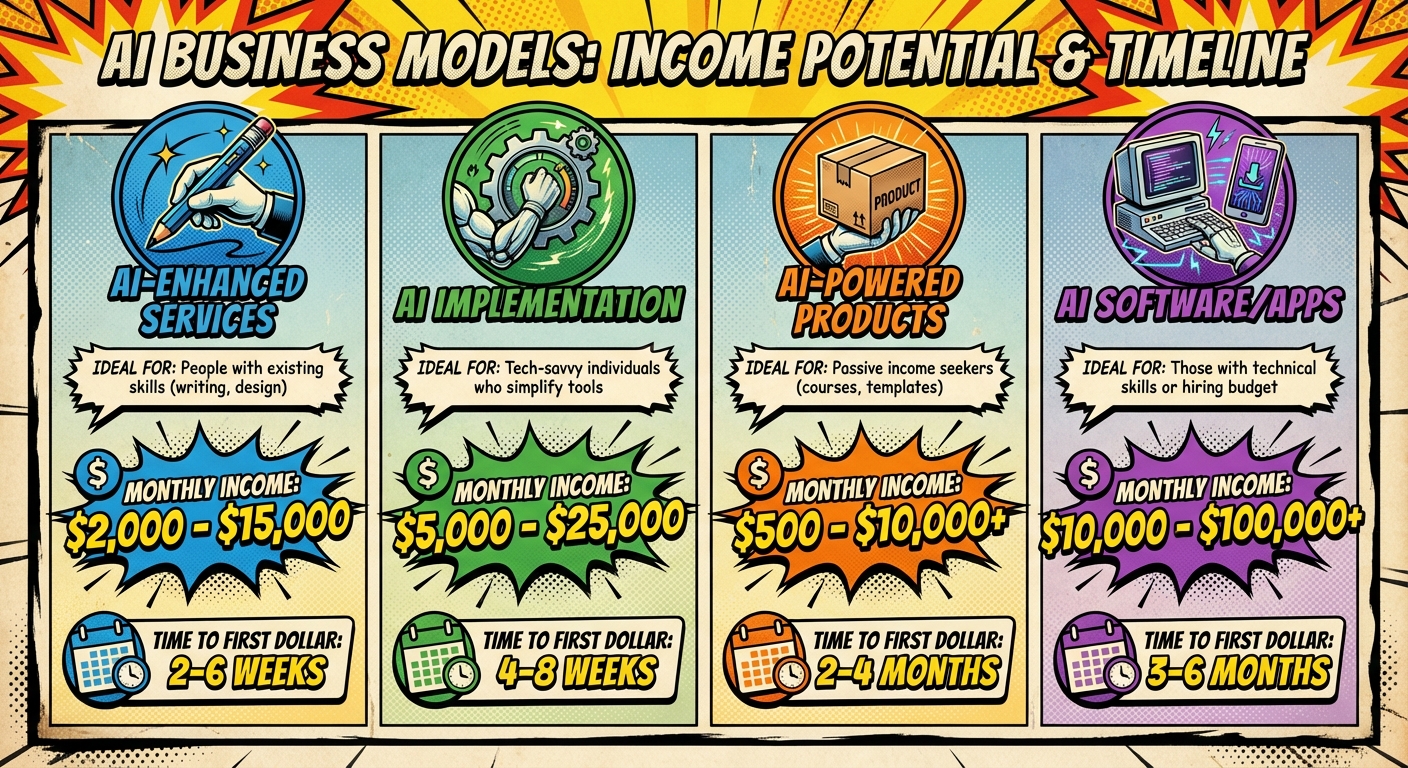
AI Business Models Comparison: Income Potential and Timeline to First Revenue
Find Your Niche and Business Opportunity
Once you’ve built up your AI skills, the next challenge is figuring out how to turn them into a profitable business. The key? Don’t try to do everything. Instead, zero in on a specific niche – something like "AI-driven content marketing for SaaS companies" or "custom AI chatbots for dental offices." Broad, generic offerings often fail to stand out, so focus on solving highly specific problems that people are willing to pay for.
Stanford Professor Steve Blank refers to these as "Million-Dollar Problems" – issues so pressing that clients are already spending money to fix them. Tools like ChatGPT or Claude can help you brainstorm by asking them, "What are the top 10 challenges [specific audience] faces daily?".
The best niches often combine your existing expertise with the power of AI. For example, if you’re skilled in writing, design, or SEO, AI tools can help you deliver results faster and more affordably. Take Sarah, who built an AI-powered content agency for SaaS companies. She scaled to 12 clients and now earns $28,000 a month. Or Marcus, who designs custom AI chatbots for local businesses, pulling in $8,500 in recurring monthly revenue from 32 clients.
Before diving into product development, validate your idea. Talk to at least 10 potential customers to understand how they currently solve the problem and how much they spend. A quick and simple way to test interest is by creating a landing page using tools like Carrd. If people sign up for more information or book a call, you’re onto something. But if all you hear is "interesting" without actual commitments, it’s time to rethink.
Here’s a quick breakdown of four popular AI business models and their earning potential:
| Business Model | Ideal For | Income Potential (Monthly) | Time to First Dollar |
|---|---|---|---|
| AI-Enhanced Services | People with existing skills (writing, design) | $2,000 – $15,000 | 2–6 weeks |
| AI Implementation | Tech-savvy individuals who simplify tools | $5,000 – $25,000 | 4–8 weeks |
| AI-Powered Products | Passive income seekers (courses, templates) | $500 – $10,000+ | 2–4 months |
| AI Software/Apps | Those with technical skills or hiring budget | $10,000 – $100,000+ | 3–6 months |
By aligning your niche with your skills and validating your business model, you’ll set yourself up for success. From there, the next step is to use AI tools strategically to stand out.
Use AI Tools to Stand Out from Competitors
Once you’ve nailed down your niche, it’s time to use AI tools to elevate your services. The good news? You don’t need a huge budget. Many entrepreneurs spend just $100–$200 a month on AI tools. Subscriptions like ChatGPT Plus and Claude Pro cost about $20 each per month, while design tools like Canva Pro are around $13.
The trick is to blend automation with human oversight. Let AI handle repetitive tasks like drafting, research, or data analysis, while you focus on quality control and strategy. This combination ensures your work doesn’t feel generic, which is a common pitfall when over-relying on AI.
Take Jane, for example. A former software engineer, she launched an AI-powered resume service for tech professionals using Resumly‘s AI Resume Builder. In just three months, she served 120 customers, charging $39 per bundle, and earned $4,680 – while keeping her advertising costs under 10%.
Automation tools like Zapier, Make, and n8n can also help you create smooth workflows. Mark, who runs a gardening affiliate site, used GPT-4 to generate article drafts. In just two months, his site traffic jumped by 62%, boosting affiliate earnings from $150 to $620 per month. Plus, he slashed his content creation time from 15 hours to just 4 hours a week. And it’s not just small businesses seeing results – companies using AI in advertising report a 40% improvement in campaign performance, while automation is projected to increase global productivity by 0.8% to 1.4% annually.
"With AI, you have at your fingertips a pretty good consultant [who] in the past would have charged you $10,000."
- Steve Blank, Professor, Stanford University
Specializing in a specific problem is what gives you an edge. As Bo Sar puts it, "If you’ve worked in an industry and know where inefficiencies lie, it’s easier to communicate your solution and sell it to peers in that field". Start small with a minimum viable product – like automating lead follow-ups for real estate agents – before expanding into a broader set of services.
Step 3: Build Automation Systems That Scale
Automate Your Daily Tasks
Once you’ve chosen your AI tools, it’s time to tackle those repetitive tasks that eat up your day. The goal here is to eliminate bottlenecks and free up your time. Or as Luke Kim from Berkeley Startup Studio puts it, "Automation is the only way that preserves your self-sufficiency".
Start small by automating tasks that don’t need much human oversight – things like sorting support tickets, managing email responses, or qualifying leads. Take Remote, for example. In 2025, they used Zapier and ChatGPT to handle 1,100 IT support tickets monthly for their 1,800 employees. This system pulls data from Okta, uses ChatGPT to prioritize issues, and references past solutions. The result? 28% of all tickets are resolved automatically, saving their three-person IT team over 600 hours every month.
Popl, a digital business card company, offers another great example. In December 2025, they set up automation using Zapier and OpenAI to process hundreds of daily form submissions. Their system verifies lead details in Google Sheets, sends notifications to Slack, and routes leads to sales reps based on location and company size. By automating over 100 workflows, Popl saved $20,000 annually.
Platforms like Zapier and n8n make automation accessible for everyone, even if you’re not a tech wizard. Zapier connects with over 8,000 apps, including Slack, HubSpot, and Gmail, making it a favorite for non-technical users. For those who want more customization, n8n offers a visual, node-based setup with access to over 5,000 community-created templates. These tools are budget-friendly, too – basic subscriptions range from $24 to $30 per month, and free tiers are available for testing.
Once you’ve streamlined your day-to-day tasks, it’s time to think bigger: building systems that can grow with your business.
Design Systems That Support Growth
Automation isn’t just about saving time today – it’s about setting up workflows that can scale as your business grows. The trick is to design systems that handle the bulk of the routine work while leaving room for human oversight where it matters most.
Consider ActiveCampaign’s success story. In 2025, they rolled out an AI-powered onboarding system using Zapier webhooks and Demio. This system boosted webinar attendance by 440%, doubled product adoption within 90 days, and reduced early churn by 15%.
What sets AI-driven automation apart from traditional tools is its ability to make decisions. Unlike rigid if-then setups, AI workflows can process varied inputs and apply judgment. Nicole Replogle from Zapier explains it best: "AI workflow automation is basically automation with a brain".
To scale effectively, documentation is crucial. Use tools like Notion to centralize your workflows, whether it’s AI prompts, onboarding steps, or delivery checklists. This ensures consistency and makes it easy for new team members or contractors to hit the ground running without constant guidance. Think of automation as a 24/7 employee that doesn’t need breaks or vacations – and costs a fraction of a human hire, typically just $50–$200 per month compared to $3,000–$10,000 for traditional staff.
Step 4: Launch and Grow Your Income Streams
Start an AI Consulting or Automation Service
Offering AI consulting or automation services can be a fast track to generating income. The key isn’t about creating new technology – it’s about using tools like ChatGPT and Claude to solve business challenges more efficiently and affordably than traditional methods.
To stand out, specialize in a niche. Instead of casting a wide net with "AI services for everyone", focus on something specific, like "AI chatbots for dental offices" or "workflow automation for real estate agencies". Before diving in, test the waters with a Pre-Sell Test. Create a landing page that outlines your service and measure interest. As Noah Kagan, founder of AppSumo, advises:
"If people are willing to pay before you’ve even launched, you know you’re onto something."
Structure your services into clear packages to make your offerings easier to sell. For instance:
- Basic Package: AI audit and recommendations for $1,500
- Standard Package: Audit plus implementation for $3,500
- Premium Package: Full setup with training for $7,000
Start with an AI Opportunity Audit – a free or low-cost evaluation that can lead to high-ticket contracts ranging from $5,000 to $25,000. Once you’ve built a portfolio of positive testimonials, consider increasing your rates by 20–30% to attract premium clients and improve profit margins.
Once your consulting business is running, you can expand your revenue streams by creating scalable digital products.
Create and Sell Digital Products
Consulting brings in immediate revenue, but digital products allow you to earn repeatedly from a one-time effort. Options include online courses, AI prompt libraries, digital templates (like Notion templates), business toolkits, and AI-generated design assets.
Take Jennifer, for example. In February 2024, she launched an AI course for freelancers, teaching them how to use AI tools effectively. By starting small with just five core lessons and pricing the course at $97, she sold it to 50 customers, earning $4,850 in three months. By February 2025, her combined income from courses, templates, and affiliate marketing hit $12,000 per month. Similarly, Jane, a former software engineer, created a "Tech Career Boost" bundle using AI resume tools. Priced at $39, she sold it to 120 customers between March and June 2025, generating $4,680 in revenue while keeping her advertising costs under 10%.
The secret to success? Launch quickly. Develop a Minimum Viable Product (MVP) within 1–4 weeks. For a course, start with five essential lessons instead of 50. For templates, offer a pack of 10 rather than 100. Use platforms like Reddit or Google Trends to gauge interest, and test your idea with a simple landing page before committing significant resources.
To market your product, use a simple funnel. Offer a free lead magnet (such as a checklist or mini-course) to grow your email list. Then, follow up with an automated three-part email sequence leading to your paid product pitch. As AI tools like ChatGPT and Claude become more integrated into daily life, optimize your content for AI Engine Optimization (AEO) to ensure these systems recommend your products.
Finally, always review AI-generated content yourself. While AI speeds up production, your expertise ensures the final product is polished and worth its price tag.
Build Passive Income Streams
Once your consulting business is stable, consider adding passive income streams to earn money even when you’re not actively working. Popular options include membership sites, affiliate marketing, and subscription-based services.
Membership sites can charge anywhere from $20 to $200 per month for exclusive content and tools. Document your AI prompts, workflows, and processes so members can implement them independently.
If you’ve created a custom ChatGPT model or an automation workflow that solves a specific problem, offer it as a subscription service. Pricing typically ranges from $20 to $500 per month, depending on the value it provides.
Affiliate marketing is another excellent passive income option. Once you’ve built credibility, recommend AI tools and platforms you trust. Many companies offer recurring commissions of 20–40%, allowing you to earn consistent income for every customer you refer.
The global AI market is projected to hit $1.77 trillion by 2032, growing at an annual rate of 29.2% – a clear sign of the massive opportunities in this space. Combining these strategies can be highly effective: start with services that generate immediate cash flow ($2,000–$15,000 per month), add scalable digital products ($500–$10,000+ per month), and layer in passive income models for steady revenue.
As Gary Vaynerchuk reminds us:
"From day one, focus on activities that generate revenue. It’s easy to get caught up in perfecting minor details, but cash flow is king in the early days."
Step 5: Use Serve No Master Resources

Access Training and Tools
If you’re serious about leveling up your AI skills and automation systems, you need more than just tools – you need the right training and support. Serve No Master offers targeted resources, including free access to the ChatGPT Profits book, which dives into the practical side of AI. This book lays out 25 real-world business applications for ChatGPT and walks you through crafting effective prompts step by step. It even highlights the four most common beginner pitfalls so you can avoid them right out of the gate.
But it doesn’t stop there. Serve No Master’s training is designed to help you build passive income systems – systems that keep generating revenue even when you’re not actively working. The focus is on creating automated frameworks that drive consistent growth over time. This approach is particularly helpful for professionals over 40 who want to transition gradually into entrepreneurship without risking their financial security.
Once you’ve built a foundation with these resources, you can take things a step further by connecting with like-minded entrepreneurs in the Serve No Master community.
Ready to leave the job you hate and find the fastest path to online wealth? Learn the best asset you have right now to leverage income and build financial run way in my bestseller "Fire Your Boss." Click here to download the book for free.
Join a Community of Entrepreneurs
Entrepreneurship doesn’t have to be a lonely path. As you grow your AI-driven ventures, having a community of peers can make all the difference. Let’s face it – leaving a stable job comes with its share of stress, uncertainty, and unpredictable income. That’s where a supportive network can step in.
"Success in entrepreneurship is 80% psychology and 20% mechanics. Cultivate resilience, adaptability, and a growth mindset before making the leap." – Carol Dweck, Stanford University Professor
The Serve No Master community connects you with other entrepreneurs who are also building AI-powered businesses. It’s a space for peer learning where you can swap workflows, share real-world insights, and learn from both successes and setbacks. With 75% of small businesses already using or exploring AI, you’ll find plenty of people tackling the same challenges and opportunities as you.
Beyond peer support, the community offers mentorship and guidance from seasoned entrepreneurs. These experts can help you move from your initial idea to generating steady income. As you scale, these connections become even more valuable, opening doors to potential collaborators, co-investors, and strategic partners who can help you grow your business.
"Leave your job on good terms. You never know when you might need to tap into your professional network or even return to traditional employment." – Alison Green, Founder of Ask a Manager
Conclusion: Start Your Path to Financial Independence
You’ve got the plan – now it’s time to make your move. The five steps we outlined aren’t just ideas; they’re proven methods that have helped entrepreneurs turn their visions into reality. Shifting from a 9-to-5 job to running your own business takes intentional planning, smart use of AI, and a solid support system.
Think about the financial upside here. You can kickstart an AI-powered business within six weeks for just $50–$200 a month. That’s a fraction of the time and money you’d need with traditional business models. This approach keeps your risks low while giving you the chance to build something meaningful.
The 90-day validation framework lays out a clear path: spend the first 30 days confirming that there’s demand for your idea, the next 30 days landing your first clients, and the final 30 days creating a financial cushion before you make the leap. This isn’t about making a rash decision – it’s about building steady confidence in your income through real-world client work and reliable systems.
"Launch early and iterate often. Your first version doesn’t need to be perfect; it needs to be in the hands of customers." – Reid Hoffman, Co-founder of LinkedIn
FAQs
What financial steps should I take before leaving my job to start working for myself?
Before stepping into self-employment, it’s essential to get your finances in order to make the transition as smooth as possible. Start with a savings cushion – aim to set aside enough to cover 3–6 months of living expenses. This buffer will give you breathing room during the early days when your income might be unpredictable.
Take a hard look at your financial needs. Figure out how much money you’ll need to sustain your current lifestyle and make sure your side hustle or freelance work can reliably meet – or better yet, exceed – that amount. To add extra stability, think about diversifying your income. You could offer consulting services, sell digital products, or even create automation solutions that bring in passive revenue.
On top of that, trim any unnecessary spending and steer clear of taking on new debt before you officially leave your job. Using AI tools and automation platforms can also be a game-changer, helping you streamline your workload and get more done with less effort. With thoughtful planning, you’ll be in a much stronger position to make self-employment work for you.
How can I use AI tools to grow my new business?
To make the most of AI tools in your business, start by pinpointing tasks that could benefit from automation or a more efficient approach. Think about areas like improving workflows, customizing how you engage with customers, or even creating content. Tools such as ChatGPT, Claude, and platforms like n8n or Zapier are great for handling repetitive tasks and automating processes, giving you more time to focus on growth.
You could also explore building AI-driven solutions like chatbots for customer support, tools for automated research, or content generators to elevate your services. If you’re looking to deepen your knowledge, earning AI certifications can enhance your skills and lend credibility as you bring these technologies into your business. By trying out various tools and weaving them into your operations, you can create systems that not only save time but also set the stage for sustainable growth.
How can I find a profitable niche for my AI-based business?
The key to building a successful AI-based business lies in choosing a niche that thrives on manual processes or involves high-value transactions. These areas are ripe for automation and can deliver steady revenue when enhanced with AI solutions.
Start by leveraging AI tools to dig into market trends, pinpoint unmet needs, and uncover smaller, underserved niches. Aligning your chosen niche with your own skills, passions, and financial goals can make it easier to sustain and grow. Some great examples of potential niches include AI consulting, automation services, or developing highly specialized digital products. Focusing on smaller, well-defined markets often means less competition and a more engaged audience.
Before diving in, validate your niche by testing the demand. Use AI-powered research techniques like scenario planning or content strategies to ensure your idea has room to grow. By blending data-driven insights with your personal expertise, you can carve out a profitable and distinctive spot in the market.
Related Blog Posts
Ready to leave the job you hate and find the fastest path to online wealth? Learn the best asset you have right now to leverage income and build financial run way in my bestseller "Fire Your Boss." Click here to download the book for free.