
7 Ways to Make Money Online With No Experience
You don’t need special skills or a degree to start earning online. Here are 7 simple ways to make money online, even if you’re a beginner:
- Online Surveys: Share your opinions on platforms like Survey Junkie or Swagbucks and earn $50–$150/month.
- Virtual Assistant: Manage emails, schedules, and social media for clients. Earn $24/hour on average.
- Sell Secondhand Items: Use platforms like Facebook Marketplace or Poshmark to sell unused items. Earnings range from $200–$3,000/month.
- Transcription: Convert audio to text. Beginners make $15–$22 per audio hour on sites like Rev or TranscribeMe.
- AI Content Creation: Use tools like ChatGPT to write articles or create designs with Canva. Earnings vary from $100 to $1,500/month.
- Freelancing: Offer services like data entry or writing on Fiverr or Upwork. Rates start at $15/hour.
- Print-on-Demand: Design t-shirts or mugs and sell them through platforms like Printify or Etsy. Profit margins can reach 60%.
Each method offers flexibility, minimal setup, and the potential to scale. Whether you want quick cash or a steady income, there’s an option for you. Start small, explore what works, and grow from there.
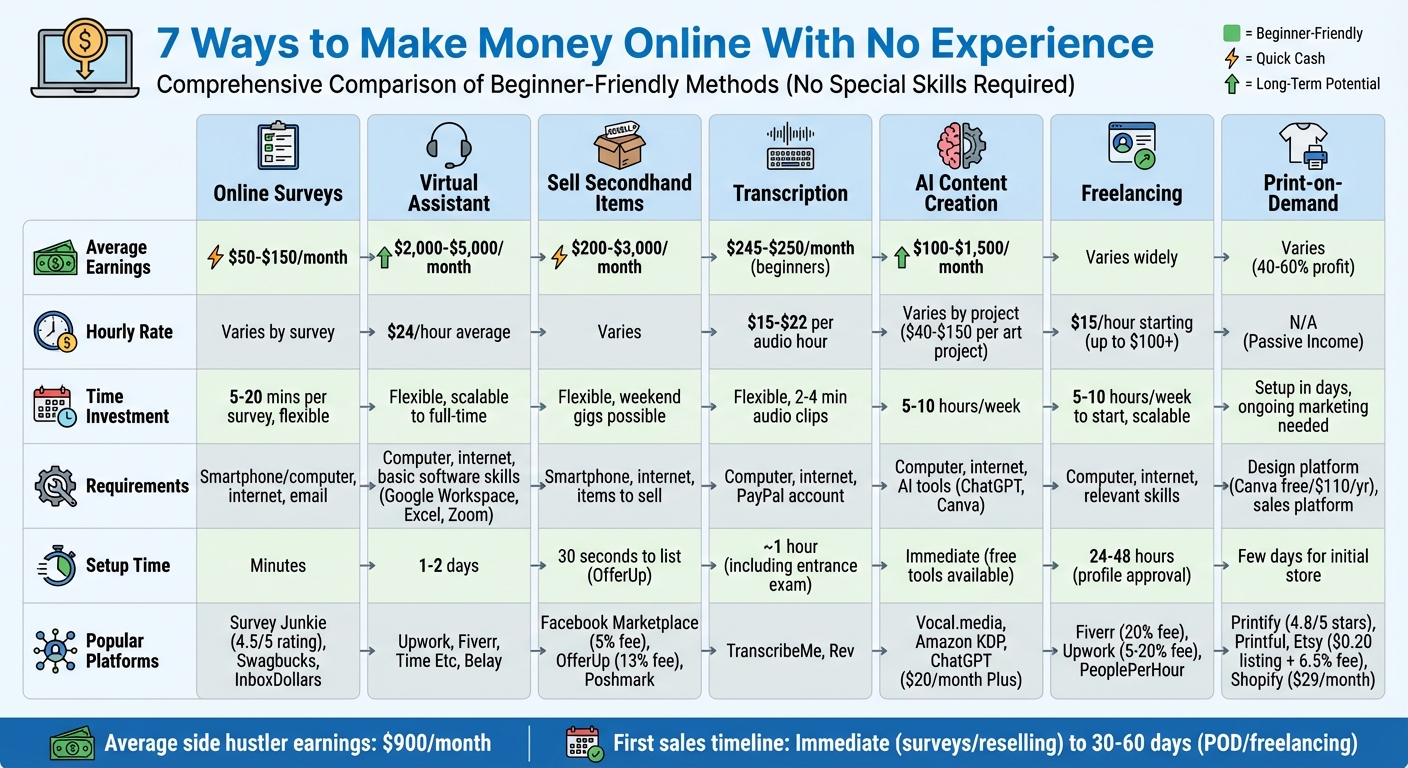
7 Ways to Make Money Online: Earnings, Time Investment & Requirements Comparison
1. Take Online Surveys
Getting Started Without Experience
Taking online surveys is one of the easiest ways to start earning money online. You don’t need any special skills – just your opinions. Signing up is quick and straightforward, often taking just a few minutes. Once registered, you’ll answer questions about products, services, or general topics. Companies then use your feedback for market research. It’s a simple process that allows you to start earning right away.
How Much You Can Earn
Platforms like Survey Junkie, which boasts over 20 million members, allow you to cash out once you hit $5.00 (equivalent to 500 points). If you complete around three surveys daily, you could make about $40 a month. For those who stick with it and use multiple platforms, monthly earnings typically range from $50 to $150, providing a nice boost to your budget.
Time Investment
The beauty of online surveys is their flexibility. You can complete them during lunch breaks, while watching TV, or whenever you have a few spare minutes. Most surveys take between 5 and 20 minutes to complete. Since payment is per survey rather than hourly, you control how much time to dedicate. To maximize opportunities, enable notifications on your phone so you can grab surveys before they fill up, as spots are often limited.
What You’ll Need to Get Started
All you need is a smartphone or computer, internet access, and a valid email address. Payments are typically made through PayPal, bank transfers, or e-gift cards. Popular platforms include Survey Junkie (rated 4.5/5 on Trustpilot with over 30,000 reviews), Swagbucks, InboxDollars, and Branded Surveys. A key tip: stick to legitimate survey sites that are free to join – any site asking for upfront fees is likely a scam. To increase your chances of qualifying for surveys, sign up for multiple platforms and complete your profile details accurately.
Ready to leave the job you hate and find the fastest path to online wealth? Learn the best asset you have right now to leverage income and build financial run way in my bestseller "Fire Your Boss." Click here to download the book for free.
2. Become a Virtual Assistant
Starting Without Experience
If you’re new to the workforce or looking for a flexible gig, virtual assistant work is a great option. You don’t need a college degree or specialized training to get started. Many tasks – like scheduling appointments, managing emails, organizing spreadsheets, or monitoring social media – are straightforward and easy to learn. Employers often prioritize soft skills like communication, time management, and the ability to adapt over formal qualifications. These entry-level tasks can quickly turn into a steady income stream.
How Much Can You Earn?
On average, virtual assistants make around $24 per hour, with monthly earnings typically falling between $2,000 and $5,000. If you specialize, such as focusing on social media management, you could earn between $300 and $1,000 per client each month. The demand for virtual assistants is booming, with the global market expected to grow from $8 billion in 2023 to $29 billion by 2031. As you gain experience or carve out a niche, your earning potential can increase significantly.
How Flexible Is the Work?
One of the best parts of working as a virtual assistant is the flexibility. You can start small – treating it as a side hustle alongside a full-time job – and scale up as you build a client base. Since most tasks are either project-based or hourly, you have the freedom to create a schedule that works for you.
Tools and Resources to Get Started
Getting started as a virtual assistant doesn’t require much. Here’s what you’ll need:
- A computer
- Reliable internet connection
- Basic software skills (think Google Workspace, Excel, Zoom)
To find clients, check out platforms like Upwork, Fiverr, or Taskrabbit, or explore agencies such as Time Etc and Belay. Creating a simple one-page portfolio using tools like Canva or Wix can help you stand out. If you want to boost your skills, take advantage of free learning resources like Google Digital Garage or HubSpot Academy. These small steps can help you land your first client and start building your career.
3. Sell Items Secondhand Online
Getting Started Is Simple
Selling secondhand items online is one of the easiest ways to earn extra cash. You don’t need any special training or a degree – just take a look around your home for things you no longer use, like clothes, furniture, or gadgets. Platforms like OfferUp make the process quick and painless; you can post an item in as little as 30 seconds. All it takes is snapping a few photos, writing a short description, and setting a price. That’s it – you’re ready to sell. How much you earn will depend on the effort you put in and the value of the items you list.
How Much Can You Make?
Earnings vary depending on the type of items you’re selling and how often you list them. Casual sellers can expect to make $200–$500 a month, while those who put in more time and effort can earn $500–$3,000 or more monthly . The secondhand market in the U.S. is thriving, with projections showing it could reach $70 billion by 2027. In 2022, nearly 52% of consumers shopped for secondhand clothing. A great example is Nica Yusay, founder of FashioNica, who turned thrifting into a business. By finding five to six vintage pieces weekly and creating styling videos, she was able to sell them online and even pay off her student loans.
Flexible Time Commitment
One of the best things about reselling is how flexible it is. You can start small, listing a few items on weekends, and gradually scale up as you figure out what sells. Local platforms like Facebook Marketplace and Craigslist are great for quick, in-person cash sales, while shipping-based platforms like Poshmark offer broader reach. Payouts vary by platform: Poshmark typically pays within 3 days of confirmed delivery, while Facebook Marketplace begins payouts 15 days after shipment or 5 days after delivery . Whether you treat it as a weekend side gig or a full-time hustle, the time you invest is entirely up to you.
Tools and Platforms to Use
All you need to get started is a smartphone, an internet connection, and items to sell. Popular platforms include:
- OfferUp: Perfect for selling locally; it boasts a 4.8-star rating from 4.4 million users on the Apple App Store.
- Facebook Marketplace: Offers access to a massive user base and supports both local and shipping options.
- Poshmark and Depop: Ideal for selling clothes and accessories.
For local pickups, platforms like Facebook Marketplace are great for quick cash. If you’re shipping items, platforms like Poshmark or Depop give you a broader audience but charge fees – OfferUp takes a 13% fee for shipped items, while Facebook Marketplace charges 5% (minimum $0.40) . To attract buyers, research pricing by checking similar sold items and use clear, well-lit photos . Choosing the right platform and putting effort into your listings can help you maximize your earnings.
4. Transcribe Audio Files
A Beginner-Friendly Option
Transcription is a straightforward way for beginners to earn money. The job involves listening to audio files and converting them into text. Platforms like TranscribeMe and Rev typically require you to pass a short entrance exam to prove your accuracy. Once approved, you’ll work on short audio clips, usually lasting 2–4 minutes, rather than lengthy recordings like interviews. This makes it an easy way to start earning at your own pace.
How Much Can You Earn?
For general transcription work, the pay ranges between $15 and $22 per audio hour, which translates to about $245–$250 per month for beginners. It’s important to note that your pay is based on the length of the audio file, not the time it takes you to transcribe it. Improving your typing speed can help you maximize your earnings. With experience, you could qualify for higher-paying specialized roles in medical or legal transcription, where rates can reach $60–$70 or more per audio hour.
Flexible Time Commitment
One of the best things about transcription is its flexibility. Since most tasks involve short audio clips, you can fit them into your schedule – whether during breaks, evenings, or weekends. Most platforms allow you to work whenever you want. Setting up an account and passing the initial exam usually takes about an hour, making it quick to get started.
What You’ll Need to Begin
To start transcribing, you’ll need a computer, internet access, and a PayPal account for payments. After passing entrance exams on platforms like TranscribeMe or Rev, you’ll gain access to consistent work opportunities. Signing up for multiple platforms can help ensure a steady flow of tasks. Additionally, using AI-powered transcription tools can speed up the process by generating drafts that you can edit for accuracy. These tools can help streamline your workflow as you grow your transcription skills.
5. Create Content Using AI Tools
Starting Without Experience
If you’re new to online ventures, AI tools offer a straightforward way to dive into content creation. You don’t need to know how to code or have a background in graphic design to get started. Tools like ChatGPT can help you craft blog posts, product descriptions, marketing emails, and even social media captions in just minutes. For visual content, platforms like Midjourney and Canva let you create custom digital art, logos, and graphics without requiring any artistic expertise. The key is learning to write clear and effective prompts – think of it as a creative skill rather than a technical one. Once you’ve mastered that, you can start turning these tools into a source of income.
How Much Can You Earn?
Earnings depend on the type of content you create and where you sell it. For example, in May 2025, a creator used ChatGPT to produce 50 articles in a single day and published them on Vocal.media. By earning milestone bonuses ($5 for 5 articles, $10 for 10, and $50 for 50) and receiving $3.80 per 1,000 views, this creator made around $115. Another example comes from Hazel Paradise, who shared that she earned $1,171.92 in just 30 days by selling a small e-book created with AI assistance in January 2024. For AI-generated artwork, creators typically charge between $40 and $150 per project, while those selling AI-assisted e-books report monthly passive income ranging from $400 to $1,500.
How Much Time Does It Take?
You don’t need to dedicate full-time hours to succeed with AI-powered content creation. Many creators invest just 5 to 10 hours per week. For instance, producing a batch of 50 articles using AI might take several hours, including time for writing prompts, reviewing the outputs, and formatting the final content. However, as Rafal Reyzer points out:
Since everyone is jumping on the AI bandwagon, it’s more important than ever to infuse your content with a human touch.
This means you’ll need to spend time refining and personalizing the AI-generated content to ensure it stands out. With a clear understanding of the time commitment, let’s look at the tools you’ll need to get started.
Tools and Platforms to Begin
Starting out doesn’t have to cost a dime. Many AI tools offer free versions that are perfect for beginners. ChatGPT, for example, has a free tier, while its Plus version, which includes advanced features, costs about $20 per month. Canva and Leonardo.ai also provide free templates and AI-driven image generation tools. When it’s time to sell your work, platforms like Vocal.media are free to join and pay through Stripe, with a $30 minimum withdrawal threshold. For e-books, Amazon KDP allows you to publish without any upfront costs. Just remember to review and refine AI-generated content to ensure it meets quality standards.
6. Start Freelancing on Task-Based Platforms
Getting Started Without Experience
If you’re new to freelancing, task-based platforms are a great way to dive in without needing an extensive portfolio or specialized skills. Websites like Fiverr, Upwork, and PeoplePerHour allow you to offer services such as data entry, writing social media captions, or conducting basic research. Among these, PeoplePerHour is often seen as beginner-friendly because of its lower competition. For even simpler tasks, platforms like Amazon Mechanical Turk, Clickworker, and Remotasks provide opportunities to complete small, repetitive jobs that require no prior experience. While many platforms let you sign up quickly, note that Upwork may take 24 to 48 hours to approve your profile. These platforms make it easy for beginners to start offering their skills and earning money.
How Much Can You Earn?
Earnings vary based on the type of work you choose and the time you invest. For instance, platforms like Outlier pay around $15 an hour for onboarding tasks, such as reviewing AI-generated content. On micro-task sites, payments are typically small, but some dedicated users have achieved significant earnings – one Amazon Mechanical Turk user reportedly earned over $50,000 over several years.
Freelancers like Soraya Ivette, a Content Marketing Strategist, have shared their success stories:
"Once I set up my profile on Fiverr, I started getting job requests within a couple of weeks and I started taking on more jobs and making regular money consistently every month".
Keep in mind that platforms charge fees: Fiverr takes 20%, Upwork charges between 5% and 20%, and Taskrabbit has a $25 registration fee. It’s important to factor these into your pricing.
Flexible Time Commitment
Freelancing on these platforms doesn’t require a full-time commitment right away. Many beginners start by dedicating 5 to 10 hours a week to build their profiles and connect with clients. Over time, as you gain experience and confidence, you can gradually increase your workload. According to research from Upwork, freelancers using AI tools can complete projects up to 70% faster. However, landing your first gig may take some patience, so don’t get discouraged if it takes a little time to get started.
Tools and Platforms to Help You Begin
You don’t need to invest in expensive tools to start freelancing. Most task-based platforms are free to join, though some may require background checks or additional approvals. Before setting your rates, take time to research what others in your field are charging – some freelance writers, for example, earn $100 per hour or more. When building your profile, list all your skills, even simple ones like managing calendars or organizing emails. These basic abilities can attract clients looking for virtual assistants or other support roles.
7. Sell Print-on-Demand Products
Why It’s Easy to Start Without Experience
Print-on-demand (POD) is one of the simplest ways to dive into online business without worrying about upfront inventory costs or managing storage. Here’s how it works: you create unique designs for products like t-shirts, mugs, or posters, and a third-party provider takes care of printing and shipping only after a customer makes a purchase. This means you can focus on designing and promoting your products while platforms like Printify handle the production and logistics. As musician and entrepreneur Darren Metz put it:
"It started very gradually…that was with zero dollars to my name so anybody can do it".
Even if you’re not a design expert, tools like Canva or AI-driven platforms such as DALL·E and Midjourney make it easy to create professional-looking designs. Before launching your store, it’s wise to order product samples to ensure the quality meets your standards – this step can save you from customer complaints later on. With minimal risk and no upfront investment, POD allows you to test the waters while keeping your costs low.
How Much Can You Earn as a Beginner?
Your earnings largely depend on your pricing strategy and the platform you choose. Most successful POD sellers aim for profit margins between 40% and 60%. For example, if you sell a t-shirt for $29.99 and it costs $11.25 to produce, you’d make about $18.74 per sale – a margin of 62%. Similarly, hoodies and mugs can bring in strong returns, though margins will vary depending on the products and platforms you use.
Keep in mind that platforms like Etsy and Amazon charge fees. Etsy has a $0.20 listing fee per item, along with a 6.5% transaction fee and payment processing costs. Amazon charges referral fees ranging from 8% to 15%. If you opt for Shopify, expect to pay $29 per month for its basic plan. With consistent marketing, many new sellers see their first sales within 30 to 60 days.
How Much Time Will It Take?
While you can set up a POD store in just a few days, scaling to consistent profits requires ongoing effort. You’ll need to spend time creating designs, optimizing product listings for search engines, and promoting your store through social media or ads. The upside? Once your store is live, order fulfillment is fully automated – your POD partner handles everything from printing to shipping.
To avoid burnout, start small with 5 to 10 well-thought-out product listings rather than launching with dozens of designs. Narrowing your focus to a specific niche – like pet lovers, healthcare workers, or hobby enthusiasts – can make your marketing efforts more targeted and effective. Ryan, the founder of UMAI Clothing, highlighted the advantages of POD:
"Really consider using print-on-demand because most people, when they start a business, they’re gonna start a clothing brand. They usually don’t have a lot of money… If you don’t use print-on-demand and your brand scales immediately, you won’t be able to keep up with the sales and orders".
What Tools and Platforms Do You Need?
To get started, you’ll need two key tools: a design platform and a sales platform. For design, Canva’s free version is a great starting point, or you can upgrade to Premium for about $110 per year. Procreate is another option, available for $14.99 on iPad, while Adobe Photoshop starts at $19.99 per month.
For selling, you can choose from marketplaces like Etsy, Amazon, or TikTok Shop, which offer built-in traffic but come with higher competition. Alternatively, you could build your own store on Shopify, giving you full control but requiring you to drive your own traffic.
When it comes to POD fulfillment, Printful and Printify are top choices, both earning 4.8 out of 5 stars on the Shopify App Store. Printful ships 97.66% of orders within five business days, and half of their orders are ready for shipping in less than three days. Before committing to a niche, use tools like Google Trends or Etsy’s search function to confirm there’s demand for your product ideas.
What to Consider Before You Start
Before diving into any side hustle, take a moment to evaluate how much time you can realistically dedicate and what your income goals are. If you’re short on time and looking for quick, low-effort options, activities like completing surveys or selling secondhand items could work. But if you’re aiming for a higher monthly income, you’ll need to commit more time and effort to options like freelancing, virtual assistance, or creating digital products. These decisions should align with both your goals and availability.
Be on high alert for scams. Always verify the credibility of platforms before signing up. Legitimate opportunities won’t ask you to pay upfront fees, buy certifications, or share sensitive information like your Social Security number or credit card details early on. Richard Morgan, CEO of Catalyst Fund, emphasizes:
"Be very cautious of potential scams that promise high returns with little risk, use aggressive sales tactics, or ask for upfront payments".
To ensure a platform’s legitimacy, check its reputation through resources like the Better Business Bureau or community forums such as Reddit. Watch out for red flags like poor spelling, grammatical errors, and unprofessional email addresses – they’re often telltale signs of scams.
Set realistic expectations for how quickly you can start earning. For example, you can begin taking surveys or selling items almost immediately. However, platforms like Upwork or Fiverr usually take 24 to 48 hours to approve your profile, and landing your first freelance gig might take weeks. If you’re considering building a blog or YouTube channel, be prepared to invest six to 12 months before seeing any meaningful income. On average, side hustlers earn about $900 per month on top of their main income, but reaching that level requires consistent effort over time.
Financial management is another key factor. Keep track of your earnings and taxes. If you expect to owe $1,000 or more in taxes from your online income, the IRS generally requires quarterly estimated tax payments. To stay organized, consider using a separate checking account and a dedicated spreadsheet to track your income and expenses. For gig work, like driving for delivery services, don’t forget to deduct costs such as gas, maintenance, and insurance to calculate your actual profit.
Finally, start small and build momentum. A great way to ease into freelancing or consulting is by leveraging your existing skills. Richard Morgan suggests starting with low-risk opportunities, such as working for friends or family, to build your resume and collect references. And when working through platforms, always keep communications within the official channels to avoid falling victim to scams.
Conclusion
Earning money online offers a variety of options, including taking surveys, working as a virtual assistant, selling secondhand items, transcribing audio, using AI tools to create content, freelancing on task-based platforms, and selling print-on-demand products. The key takeaway? Success online is often rooted in simplicity and dedication.
It’s best to focus on one method at a time. As Anna VanDem, Founder, wisely says: "Clarity beats variety every time". Choose the approach that aligns with your current lifestyle and stick with it for at least 30 days. If you need quick cash, consider selling items you already own or signing up for survey platforms. For long-term income, virtual assistance or freelancing might be the way to go.
Ultimately, consistent effort outweighs credentials in the digital economy. Soraya Ivette, a Content Marketing Strategist, shares her experience: "Once I set up my profile on Fiverr, I started getting job requests within a couple of weeks and I started taking on more jobs and making regular money consistently every month". Her journey is a testament to the power of persistence over a perfect resume.
FAQs
How can I find trustworthy platforms for online surveys?
When choosing survey platforms, stick to well-known sites that offer clear and reliable payment methods like PayPal or e-gift cards. Make sure the platform has transparent terms, a clear privacy policy, and strong user reviews. Trusted platforms typically match surveys to your profile and make it simple to redeem rewards. Be cautious of sites that request upfront fees or ask for sensitive personal details beyond basic demographics.
Ready to leave the job you hate and find the fastest path to online wealth? Learn the best asset you have right now to leverage income and build financial run way in my bestseller "Fire Your Boss." Click here to download the book for free.
How can I find clients as a beginner virtual assistant?
Finding clients as a new virtual assistant might seem daunting at first, but there are plenty of practical ways to get the ball rolling:
- Build a strong online presence by creating profiles on platforms like Upwork or Fiverr. Make sure to highlight your skills and provide examples of tasks you can handle, such as managing emails or scheduling appointments.
- Tap into your personal network by spreading the word to friends, family, and former colleagues. Sometimes, a simple recommendation can lead to your first few clients.
- Offer trial or discounted services to start. This not only helps you gain experience but also allows you to gather testimonials and case studies to showcase your abilities.
Consistency is key. Keep reaching out, adapt based on feedback, and stay patient. Before long, you’ll have a solid client base!
How can I create professional designs for print-on-demand products without any design skills?
You don’t need to be a design expert to create stunning visuals for print-on-demand products. Tools like Canva make it simple, even for beginners. With its drag-and-drop editor and ready-made templates, you can easily design items like t-shirts, mugs, and posters.
To get started, sign up for a free Canva account. Pick a template that matches your product, then tweak it to fit your style. Add your own text, adjust colors, and include graphics for a personal touch. Keep things clean by sticking to a simple color scheme and using no more than 2-3 fonts for a polished finish. Once your design is ready, export it as a high-resolution PNG with a transparent background. From there, upload the file to your print-on-demand platform, add mock-ups, and order a sample to check the quality.
With free tools like Canva, creating professional-looking designs is quick and easy – no design background required.
Related Blog Posts
Ready to leave the job you hate and find the fastest path to online wealth? Learn the best asset you have right now to leverage income and build financial run way in my bestseller "Fire Your Boss." Click here to download the book for free.